
A new opportunity for Africa in a post Hormuz world

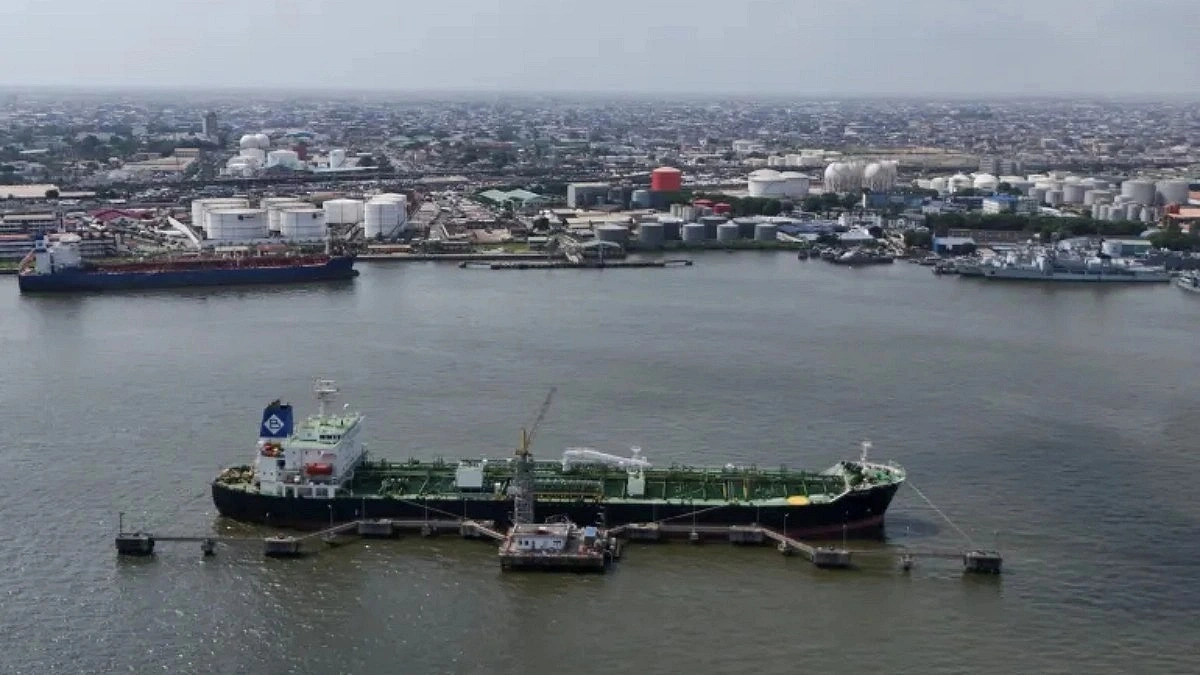
An oil tanker anchored in Lagos Lagoon in Lagos, Nigeria. File photo: Reuters
The disruption of shipping through the Strait of Hormuz, one of the most important waterways in global energy trade, has also affected African economies. Yet the continent possesses vast reserves of energy and other critical natural resources. African countries faced a similar crisis four years ago during the Russia Ukraine war.
The Iran war is now pushing the world into a new era. It could be called the “post Hormuz era.” It is a period in which the global system will no longer depend on a single critical waterway.
This change could create a major opportunity for Africa. For years, the continent has mainly supplied raw materials to the world. Major strategic decisions have been made elsewhere. Now Africa has an opportunity to shape its own geopolitical position.
The mindset toward the sea must change
The first major challenge facing Africa is a change in mindset. For a long time, African countries have viewed the sea mainly as their borders. The sea has not been given sufficient importance as a means of strengthening economies, politics and military power.
Land has been the main focus of Africa’s security thinking. The continent has paid greater attention to independence struggles, civil wars, insurgencies, coups and border disputes.
As a result, there has been comparatively little planning in Africa around the sea, naval power, the maritime economy and strategic waterways.
This mindset is known as “thalassophobia,” or fear of the sea. Africa needs to move beyond this mindset.
However, a change in mindset alone is not enough. Africa also faces major challenges in working together.
The first problem is sovereignty. The borders created during the colonial era became extremely important to African states after independence. As a result, adopting a joint maritime strategy would require countries to share some of their powers.
These include control of maritime boundaries, military operations, joint command and the exchange of critical intelligence.
The second problem is that the interests of African countries are not the same.
Piracy and oil theft are major problems in the Gulf of Guinea in West Africa. Illegal fishing and smuggling are major concerns in the western Indian Ocean. In the Mediterranean, migration is a major issue.
Therefore, creating a common maritime policy for the whole of Africa is not easy.
The third problem is funding and capacity. Building navies, coast guards, surveillance systems, intelligence capabilities and supply networks requires enormous amounts of money. Many African countries cannot afford these costs on their own.
As a result, everyone waits for someone else to take the lead.
Another major problem is dependence on foreign powers. Naval forces from various countries have long been deployed in African waters. Security is also being provided through military bases and international missions.
This has reduced the urgency for Africa to develop its own maritime capabilities.
In addition, many African political and economic groups benefit more from bilateral relationships with external powers than from regional cooperation. As a result, dependence on outside powers increases instead of coordination among African countries.
Internal insurgencies, border disputes and security crises have also added to the problem. Because of these challenges, the sea has consistently remained low on the list of priorities.
Why Africa needs geopolitical awareness
The importance of the sea in Africa becomes clear mainly when an international crisis occurs.
When a crisis emerges in Hormuz, African countries realize how dependent they are on the world’s major shipping routes.
Yet Africa possesses oil, natural gas and various minerals that are important for the energy transition. Its location between the Atlantic Ocean, Indian Ocean and Mediterranean Sea is also a major strategic advantage.
But these resources have not yet given Africa enough geopolitical power.
To change this situation, Africa needs to set its own priorities. Maritime security, ports and shipping routes, energy, industry, trade, foreign policy and strategic independence must all be brought together under one plan.
This is where the concept of the “post Hormuz era” becomes important.
It means that the global economy of the future will not depend only on the Strait of Hormuz. Alongside Hormuz, waterways such as the Bab el Mandeb, Red Sea, Suez Canal, Mozambique Channel, Cape of Good Hope and western Indian Ocean will also become increasingly important. The Arctic region could also become part of this network in the future.
Many of these waterways are located around Africa.
This means Africa is not simply a continent through which the world’s trade routes pass. In the future, Africa could also become a hub for some of the world economy’s most important maritime routes.
There are plans, but no implementation
It is not accurate to say that Africa has no plans on this issue.
In 2014, the African Union adopted the 2050 Africa’s Integrated Maritime Strategy. In 2016, it adopted the African Charter on Safety, Security and Development.
The problem, however, is that much of what is outlined in these plans has yet to be implemented.
The charter is also still waiting for the required number of countries to ratify it in order to take effect.
In other words, Africa’s problem is not a lack of plans. The problem is a lack of political will to turn those plans into reality.
This is the clearest evidence of Africa’s “fear of the sea.”
What Africa can do now
The first task is to change the way political leaders think about the sea.
The sea should not be viewed only as a border or a route for exporting goods. It should be seen as a major arena for economic development, security and political power.
This will require changes in budgets, institutions and military structures.
In this regard, relying solely on the African Union may not be realistic. Instead, countries with major maritime importance, such as South Africa, Nigeria, Egypt, Morocco, Kenya, Angola and Senegal, need to take the lead.
They can bring other countries together through regional alliances and various specialized arrangements.
An example already exists in Africa. The countries of the Gulf of Guinea established the Yaoundé Architecture. It increased information sharing and coordination. As a result, piracy in the region has declined.
This model could also be used in the western Indian Ocean and the Mozambique Channel.
In practical terms, Africa should have several priorities.
First, maritime agreements and policies that have already been adopted must be ratified and implemented.
Second, joint surveillance systems need to be developed. Satellite and radar data should be used together. Coordination among coast guards should be increased. Joint patrols should be conducted when necessary.
Third, funding must be secured. Africa could establish a maritime security fund financed by its own resources. This would reduce dependence on external donors.
Fourth, maritime policy and the African free trade system need to advance together. Ports and shipping routes should be developed as key infrastructure for intra continental trade.
Fifth, energy security must be strengthened. African countries that export crude oil need to increase their refining capacity. At the same time, strategic energy reserves should be built. This would reduce the impact of a crisis if an important shipping route is closed.
Sixth, Africa needs to develop maritime skills and industries. It needs naval training institutions, marine surveying, ship repair and shipbuilding industries, its own ship registration systems and a maritime insurance sector.
This would allow Africa to retain within the continent some of the substantial money and economic benefits that currently flow outside Africa.
Not a crisis, but an opportunity
Africa now faces a major question.
As crises in critical waterways such as Hormuz increase, the importance of alternative shipping routes in the global economy is also growing. And many of those routes are located around Africa.
Therefore, the “post Hormuz era” could be not only a risk but also a major opportunity for Africa.
Africa already has a place in global politics because of its geography and resources. But for years, the continent has failed to turn that position into political and strategic power.
Now it has an opportunity to stop simply waiting for others to make decisions and start making its own decisions. The question is no longer whether Africa will have a place in global politics. The question is whether Africa will shape its own destiny in that position or continue to depend on decisions made by others.
