
If Washington's winds change, what happens to Dhaka?

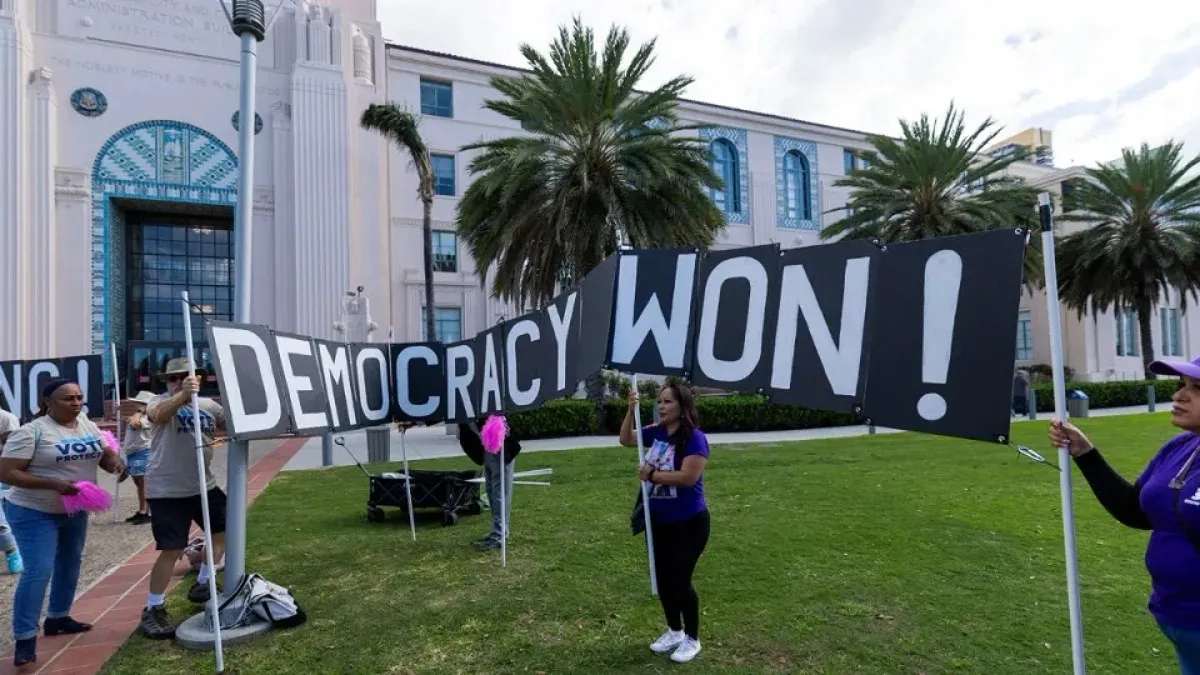
In San Diego, California, USA, various social organizations and voters have come together to celebrate their collective voting power following the midterm elections. Photo: Reuters.
There's an old saying here — the cloud that rumbles doesn't always rain. This time the clouds rumbled mildly over America; but what poured down can't be called rain — it's a flood. The question is: if the sky falls in Washington, why does Dhaka need to open an umbrella? We sometimes say this as a joke, sometimes with a serious face. Now, looking at the results of the US midterm elections, the question is no longer a joke. The storm that rose there will send a gust through this country's diplomatic, trade, and defense windows too.
Before the election, almost all opinion polls and forecast models said the Democrats would win. There was hope for a blue wave. If they got close to 51 Senate seats and 240 House seats, they would have been happy. But when results started coming in after evening local time, it became clear this was no wave — it was a tsunami. The Democrats are heading toward 55 Senate seats and 258 House seats. In the Senate, they snatched seats from the Republicans in Iowa, Kansas, Ohio, Maine, North Carolina, South Carolina, and Texas. A win in deep-South Texas was beyond imagination just a few months ago.
Why did this happen? The first reason is the wallet. In exit polls, Trump's approval stood at 38 percent, and 89 percent of voters said the cost of living played a big role in their decision. In 2024, the economy won Trump the election; this time that same economy sank his party. Young, Latino, and women voters, among whom Trump made inroads in 2024, went largely to the Democrats this time. The second reason is independent voters. Exit polls showed 56 percent of independents voted for the Democrats and 39 percent against. Voter discontent over inflation, tariffs, and the war with Iran also influenced the outcome.
But it would be a mistake to see this win as the Democrats' own success. Voters dislike Trump, but they still haven't placed their trust in the Democrats.
Now to the real question. Will this result change US policy toward Bangladesh? The answer is: the direction won't change, but the tone will. Under the US Constitution, foreign policy is largely the president's domain. And Trump is in the White House until January 2029. However, Congress also holds some reins. Budget, oversight, hearings, approval of ambassador appointments, and the constitutional power to impose tariffs — all rest there. Those reins had been loose so far. Now they will be tightened.
The basis of Bangladesh's relationship with Trump is transaction. Under the trade deal signed between the two countries on February 9 this year, Bangladesh will cut tariffs on 7,132 items of US goods. It will also buy military equipment from the US and import $150 billion worth of LNG. It will also limit defense imports from some countries. In return, US tariffs have come down to 19 percent. On top of that is a commitment to buy Boeing aircraft. The US had already entered the energy sector, since Chevron alone supplies 40 percent of Bangladesh's natural gas.
The most controversial part is defense. In a memo to Prime Minister Tarique Rahman on February 18, Trump urged decisive steps to complete "two regular defense agreements" so that "Bangladesh's army gets advanced US equipment." The two agreements are the General Security of Military Information Agreement and the Acquisition and Cross-Servicing Agreement. One is for exchanging classified military information, the other for exchanging military supplies and services. Critics fear that as a result, Bangladesh may lose a part of its intelligence sovereignty.
The defense question is a bit sensitive. Trump urged Prime Minister Tarique Rahman to take "decisive steps" to complete the defense agreements. It is only natural that the new majority Congress will raise questions about this. What are the terms of the agreement, are there any human rights conditions — these will be asked. The tariff agreement was also criticized for its secrecy. It would be good if our own parliament also discussed these agreements openly. It is important to answer the questions of the people of Dhaka before Washington's questions. And since the US Supreme Court struck down Trump's imposition of tariffs, the future of the trade agreement is now uncertain. In other words, Washington's biggest weapon had already been somewhat blunted.
Having won a majority, the Democrats will gain the chairmanship of various committees in the House and Senate and the power to summon. In the Senate, they will have a say in Trump's judicial and cabinet nominations. Secret trade agreements, defense agreements — hearings will now be demanded on these.
This result may bring some relief for Dhaka. When pressure eases, the room for bargaining grows. The argument for signing the two defense agreements in haste has now weakened. Both parties have sympathy on the Rohingya question. And on human rights, the Democrats are generally more vocal. If strong voices are heard in Congress on accountability for Myanmar and safe repatriation, it will benefit Dhaka.
The tone may also change on questions of democracy and media freedom. Bangladesh currently ranks 152nd out of 180 countries on the international index. It would be no surprise if letters or questions on this arrive on Capitol Hill. The government could view this as an opportunity for reform rather than as a jab.
This role of Congress is nothing new for us. In 1971, Nixon's White House stood beside Yahya Khan. But Senator Edward Kennedy toured the refugee camps and returned to Washington to speak out. Many members of Congress demanded an end to military aid to Pakistan. The White House and Capitol Hill do not always play the same tune. Bangladesh has many times been indebted to that second tune.
This is the lesson for Dhaka. Recently, a tendency has been seen in our diplomacy to deepen ties with one person. Letters, greetings, messages — all revolve around one person. There is nothing wrong with that, but betting on one individual is not wise, especially when that person's own country's voters are raising questions about him. We must maintain relations with both parties, build connections with think tanks, and make use of the voices of expatriate Bangladeshis.
The proverb says: whoever sets out in a boat seeing the wave drowns, but whoever knows the nature of the river crosses it. In America the wave has now become a tsunami; but the river is still where it was. That river's name is interest. Interest does not change with the color of a party. So rather than being elated or panicked by today's tsunami news, our task is to understand well the nature of the river.
Author: Chairperson, Department of Communications, California State University, Bakersfield.
