
US air travel disruptions to persist until late on Sunday, FAA head says
- US aviation shutdown blamed on L3 Harris installed router

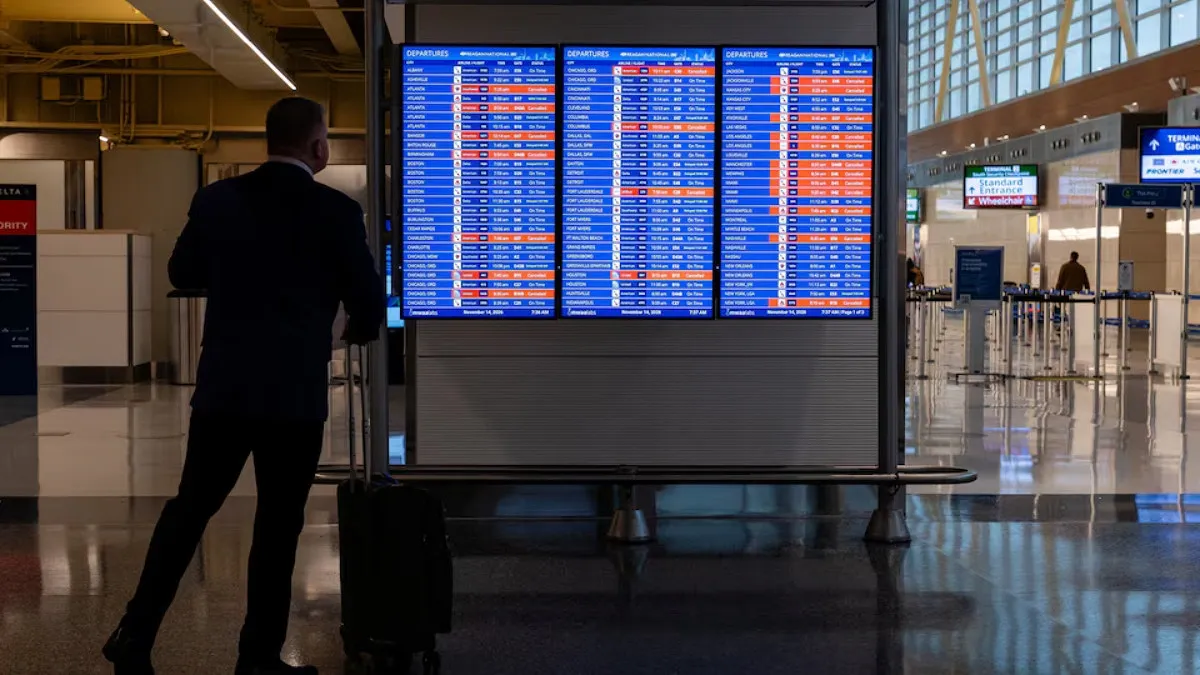
Reuters photo.
US air travel is not expected to return to normal schedules until late on Sunday, the head of the FAA said, as the aviation system gradually recovers from a nationwide flight shutdown that officials blamed on routine maintenance gone awry.
As of 9:35 p.m. ET (0235 GMT), airlines on Saturday had canceled more than 6,400 US flights and delayed more than 8,000, according to FlightAware, an aviation website. That followed about 9,200 flights canceled and 7,500 delayed on Friday after the FAA ordered a nationwide ground stop because of disruptions to air traffic communications. FlightAware said 875 flights scheduled for Sunday were already canceled.
Federal Aviation Administration head Bryan Bedford said on Saturday that he expected airline operations to largely return to normal by late Sunday. He also apologized for the disruption, adding that the system remains stable.
The FAA issued a nationwide ground stop on Friday that halted nearly all departing flights for almost five hours. It was the longest nationwide halt to air travel since the attacks of September 11, 2001, and one of the single worst US travel days ever.
The issue prompted the White House to convene an emergency meeting in the Situation Room on Friday and federal agencies to scramble to determine if it was a cyberattack. But the problem was traced to FAA contractor L3Harris' installation of at least one new router at a remote facility, Transportation Secretary Sean Duffy said on Saturday.
"We're working to determine whether we had incompetence, meaning was it user error or installer error from L3Harris, or did they install a faulty router? We haven't determined what the fault was," Duffy said at a press conference.
The Professional Aviation Safety Specialists, a union representing FAA safety employees, said the issue was isolated to two routers that were updated Friday. An official told Reuters it was believed the routers were in Arkansas and Texas.
An FAA official said the agency conducted a safety assessment before the work. The union said PASS-represented technicians were not involved in the upgrades that led to the ground stop.
L3Harris said it took the issue seriously and is supporting the FAA in its investigation. Its shares last traded down about 4% after hours on Friday.
OVERLOADED COMMUNICATIONS CENTERS
Duffy said the trouble began on Friday afternoon, when air traffic control centers experienced instability in radar and communications systems. The router issue led to data overloading other communications centers, officials said.
"We had over 1,000 connection attempts every four to five seconds, and what that did was (it) gave us issues with our communication with airplanes, and it also caused some disruption with our radar," Duffy added.
The issue affected communications at 17 of the FAA's 22 en route centers, which control aircraft during the cruise portion of a flight. Bedford said the FAA ordered the ground stop in case a center lost all communications. "No facilities went dark. Nothing was fully lost," Bedford added.
The FAA said it was doing additional testing with L3Harris to see if there are any additional risks.
Delta Air Lines, United Airlines and American Airlines, all canceled about 25% of their flights on Saturday, while JetBlue canceled nearly 45%. Airlines have issued travel waivers allowing passengers to rebook flights for later dates without cost.
Though the FAA lifted the ground stop on Friday evening, the disruption for passengers was far from over, with tens of thousands of people stranded in airports. Airlines were trying to get flight crews and other personnel in position to resume flights.
The disruption stranded some college football teams on Friday before games scheduled for Saturday.
FUNDS SOUGHT TO FIX SYSTEM STRAIN
Friday's disruption is the latest and most dramatic sign of strain on a US air traffic control system beset by aging technology, equipment and communications problems and a shortage of several thousand controllers.
Duffy called on Friday for $50 billion in funding to upgrade air traffic control systems, up from his earlier request of $30 billion — after Congress approved $12.5 billion last year.
House Speaker Mike Johnson told Fox News on Saturday that he supports approving more funding for air traffic this year. Johnson's Republicans control Congress until next year, when Democrats will take over because of their gains in the November 3 midterm elections.
US aviation shutdown blamed on L3 Harris installed router
The massive, nearly five-hour shutdown of the US aviation system that has disrupted more than 20,000 flights since Friday may have been the fault of a single router installed by government contractor L3Harris, government officials said Saturday.
The incident is the latest painful example of the aging US air traffic control telecom system and the struggles to replace systems while keeping the old communications working.
The FAA's aging telecom systems in recent years have failed after errant fiber cuts, accidental deletion of files and a strong chemical smell caused by a melted component. The system will fail again until it is properly upgraded, officials said.
"This was an FAA system that didn't meet the moment," Transportation Secretary Sean Duffy said Saturday.
Duffy said on Friday L3Harris was conducting routine maintenance to switch telecommunication lines from old copper wire to fiber at at least one remote location. Officials told Reuters there may have been problems with routers installed in both Arkansas and Texas.
"We're working to determine whether we had incompetence, meaning was it user error or installer error from L3Harris, or did they install a faulty router? We haven't determined what the fault was," Duffy said.
L3Harris said it took the issue seriously and was "supporting the FAA in its investigation to understand the conditions that led to the Nov. 13 ground stop of our nation’s air travel."
L3 noted it has completed more than 70% of the planned airspace communications conversion from legacy copper wires to a fiber-optic system.
The FAA spends $1 billion annually to maintain its old copper wire system and is racing to replace it with more modern fiber-based communications.
"We need L3Harris or whoever provided that router to us to do a better job," Duffy said, noting that "virtually every single institution in America has gone from copper to fiber, from analog to digital."
