
Iran US deal expires, what happens now

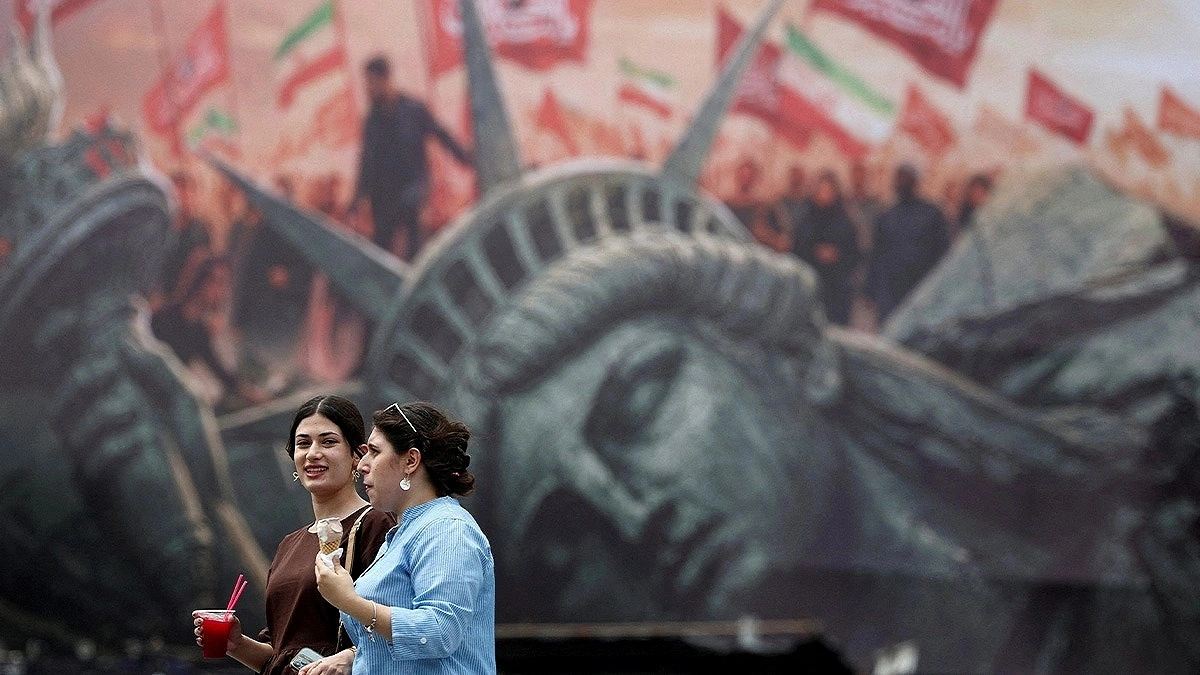
People walk past an anti US billboard on a street in Tehran, Iran. Photo: Reuters
Iran and the United States reached an agreement to halt the fighting that had continued since February. The agreement expires today. But hopes of an end to the fighting remain distant.
The war has continued intermittently in different forms. Threats and counterthreats are also continuing unabated. Aggressive statements are being heard from leaders of both countries. Neither side appears interested in extending the agreement.
Iranian Foreign Minister Abbas Araghchi said last Saturday that Tehran was not interested in talks. In a post on his Telegram account, he said Iran had not yet decided whether to begin negotiations with the United States.
However, Qatar and Pakistan, which want to mediate, have not stopped their efforts. Officials from both countries have held discussions with Iranian officials. However, Iran appears more interested in ensuring dominance over the Strait of Hormuz than in negotiating with the United States to end the war. For that reason, it is continuing talks with Oman. Meanwhile, US President Donald Trump wants to declare Hormuz as US territory. In this situation, it is almost certain that the dispute between Iran and the United States will enter a new phase.
What was in the agreement
The memorandum of understanding was signed on June 17. Pakistan mediated the agreement. Iranian President Masoud Pezeshkian signed it on behalf of Iran, while US President Trump signed it on behalf of the United States.
At the time, the agreement came as major good news. Its sole objective was to end the war. The agreement was intended to stop bombing not only in Tehran but also in Lebanon. Complicated issues such as Iran’s nuclear program were left for later. There was hope that deaths from bombing would stop. Commercial ships would once again travel through the Gulf, a waterway through which nearly one fifth of the world’s energy trade passes.
The agreement stated that Iran and the United States were declaring a permanent end to military operations. At the same time, a final agreement would ensure a permanent end to the war on all fronts.
The agreement also stated that the final deal would be approved by the United Nations Security Council.
The agreement was to be completed within a maximum of 60 days. It also stated that the period could be extended by mutual agreement. But today, August 17, after two months, there is no indication that the agreement’s term will be extended.
The agreement also required the United States to withdraw its naval blockade within 30 days. After a final agreement was reached, its forces were to be withdrawn from areas near Iran. Work was also to begin on a reconstruction and development package worth at least $300 billion for Iran.
Washington had agreed to lift sanctions on Iran, ease restrictions on Iranian oil exports and allow Tehran to use frozen funds.
On the other hand, Iran was supposed to remove mines from the Strait of Hormuz. The country was also supposed to allow ships to pass through Hormuz “free of charge” for 60 days.
Tehran also said it would not seek to acquire nuclear weapons and would discuss issues such as uranium enrichment.
How successful was the agreement
Debate over the agreement began immediately after it was signed. Arguments continued over whether it was a ceasefire or a permanent agreement and what each side was supposed to do.
Amid the debate, Trump described Iran’s attacks in various Middle Eastern countries as “a stupid violation” of the agreement. Iran, meanwhile, said the US attacks “violated Article One of the memorandum of understanding.”
Later, Trump announced that the agreement had ended. Following that announcement, the war effectively resumed.
During the agreement’s term, the United States did not completely lift sanctions on Iran. The US president also mocked the idea of providing Iran with money for reconstruction.
In this situation, the reopening of the Strait of Hormuz was also not implemented. Iranian and US officials continued to claim that the waterway was under their control. Ships are frequently being attacked in the waterway.
According to Mustafa Khoshcheshm, a professor at Tehran University of Applied Sciences, the ceasefire ended because the United States failed to comply with the terms of the agreement or memorandum of understanding.
According to the professor, Tehran believes the United States failed to fulfill its commitments to transfer Iranian assets, lift sanctions, remove the naval blockade and withdraw Israeli troops from southern Lebanon.
“Now, formally, on paper, it is being said that the deadline has expired,” Khoshcheshm added.
What could happen now
Although the agreement is set to expire today, what exactly that means depends on which side you ask.
According to Iran’s Students News Agency, or ISNA, the Iranian foreign minister said last Friday that the United States had violated the memorandum of understanding and continued its attacks. As a result, it was not a 60 day ceasefire whose extension was necessary.
Iran’s national security system has recently undergone changes. This makes it clear that Tehran will take a tougher position in future negotiations. At the same time, the country does not appear willing to retreat even slightly on control of Hormuz.
Earlier this month, former IRGC chief Mohsen Rezaei was appointed as the new head of Iran’s Supreme National Security Council, the country’s highest security body.
Analysts say the move means there will be better coordination between military and civilian operations.
According to Khoshcheshm, Rezaei’s appointment and other recent leadership changes prove that Iran believes it has the upper hand.
“In any new negotiations, Iran will probably come to the table with some additional demands,” the researcher added.
These could include issues that would make the United States and its ally Israel uncomfortable. The researcher believes Tehran may call for an end to the war in Gaza, the lifting of sanctions and the blockade on Yemen, and the nuclear disarmament of Israel.
The United States has few options left
Although Trump has failed to gain an advantage in the war, he has not backed down in his rhetoric. He and officials in his administration issue new threats every day. Last Friday, Trump announced, “After defeating Iran, I will soon declare the Strait of Hormuz to be US territory.”
US Treasury Secretary Scott Bessent also said Friday that the United States would take action against Iran on a scale never seen before.
However, such threats have not appeared to have any effect on Iran. Analysts, however, believe Trump has few “weapons” left to put pressure on Iran.
Barbara Slavin, a distinguished fellow at the Washington DC based Stimson Center, said Trump has few options left if he wants to increase pressure on Tehran.
According to the Stimson Center researcher, the United States’ stockpile of interceptor missiles has declined. Its strategic oil reserves have been depleted. Important military equipment, including aircraft carriers, has remained at sea for several months longer than planned. This means the United States has very few military options left to try.
Regarding economic pressure, Slavin said Tehran has shown that it can cause economic damage to itself by disrupting shipping through the Strait of Hormuz. Iran has taken a hard line on the issue. It is clearly angry with the Trump administration for failing to fulfill the memorandum of understanding signed in June. Iran is shaking the international economy. Donald Trump, meanwhile, has been put in a difficult position.
According to Slavin, Iran will probably receive compensation for the war in one form or another. It will gain significant control over the Strait of Hormuz.
The researcher predicted that the conflict will most likely end with an agreement after the US midterm elections.
Iran, however, claims to have found victory in the agreement itself. That indication came from Iranian Parliament Speaker Mohammad Qalibaf. Speaking to reporters in Tehran on Saturday, he said, “The concessions Iran secured in the memorandum of understanding are a source of pride and victory. I can say with complete certainty that we have truly emerged as the winner of this war, both militarily and politically.”
Source: Al Jazeera (Adapted)
