
World debt hits $365 trillion as interest costs fuel Europe protests

Graphics: Agamir Somoy
Hundreds of thousands of people have taken to the streets across Europe in recent weeks, protesting against rising living costs, low wages, unaffordable housing, and underfunded schools.
Demonstrations in France, Belgium, Italy, and Portugal have at times descended into clashes, looting, and fires, though many protests have remained peaceful. France stood at the center of the unrest, where according to the Interior Ministry, more than 5,50,000 people demonstrated nationwide on Saturday following weeks of student protests over education and living costs.
This widespread unrest has highlighted a severe fiscal squeeze that governments are struggling to manage. Years of heavy borrowing have left many European nations deeply in debt, and servicing that debt is becoming increasingly expensive.
France’s borrowing costs have reached their highest level since 2002, and as governments allocate more funds to interest payments, fewer resources remain available for schools, hospitals, and pensions.
Mechanism of government borrowing and rising costs
Governments borrow money in a manner similar to individuals, but rather than obtaining bank loans, they sell bonds. In exchange, the government pays bondholders interest and commits to repaying the full principal on a specified maturity date.
A 10-year bond represents a loan repaid after a decade, and its yield - the return earned by investors - serves as the primary indicator of market confidence in a country’s debt management.
For example, when an investor purchases a €100 10-year bond, the government receives the borrowed funds. Over a 10-year period, the investor receives regular fixed interest payments: at 2.5 percent, this equals €2.50 annually (€25 in total), while at 5 percent, it equals €5 annually (€50 in total).
Upon maturity after 10 years, the government returns the original €100 principal.
When bond prices fall, yields rise, making borrowing significantly more expensive. Similar to a household managing a higher mortgage rate, a government must direct more revenue toward interest, leaving less capital for public essentials like schools, hospitals, and infrastructure.
Ten-year borrowing costs for major European economies have not reached 5 percent since the early 2000s, shortly after the introduction of the euro. During the eurozone debt crisis from 2010 to 2012, struggling economies such as Greece, Italy, and Spain paid yield rates at or above that threshold, while yields exceeding 7 percent forced Ireland and Portugal to seek financial bailouts.
France pays around 5 percent to borrow for 10 years, compared to 3.41 percent for Germany. This widening spread indicates that investors demand higher returns to lend to France. A comparative analysis shows France’s 10-year borrowing costs across the euro area and the United Kingdom now exceed those of Italy and Greece - two nations severely impacted during the eurozone debt crisis - with only the UK, operating outside the eurozone, paying higher rates.
Global debt rankings among major economies
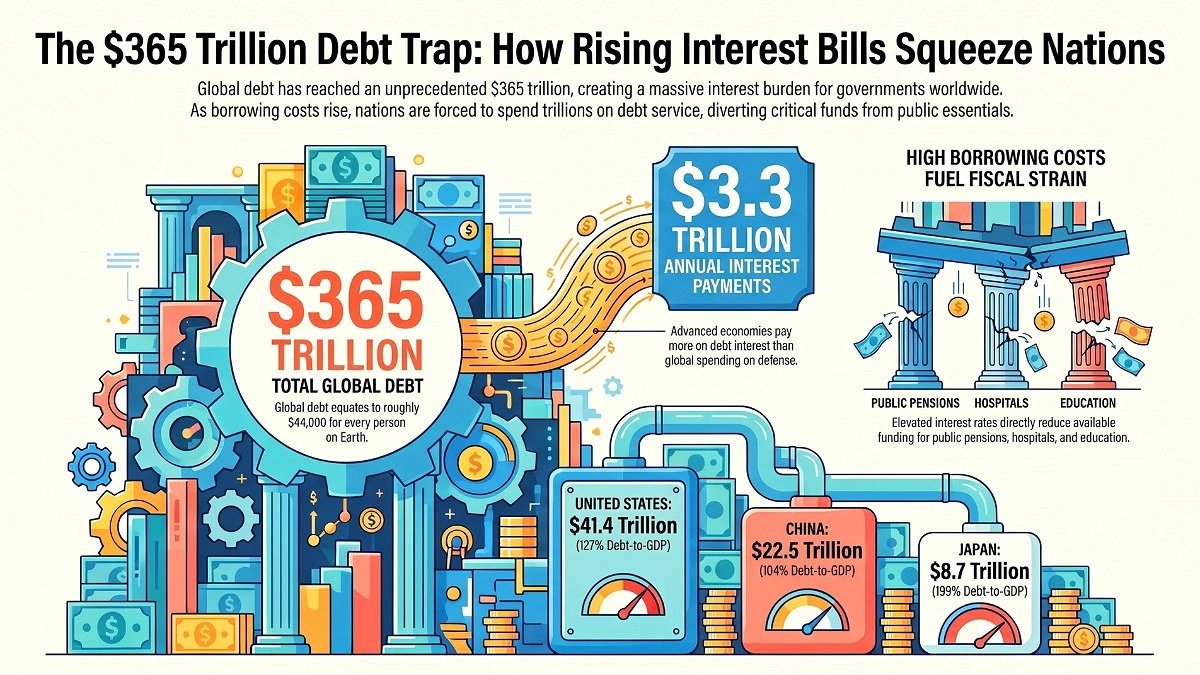
US holds the world’s largest government debt by a wide margin, totaling $41.4 trillion, which equals 127 percent of its gross domestic product (GDP). US benefits from borrowing in US dollars, the global primary reserve currency, sustaining international demand for its debt, though its borrowing capacity remains finite.
China holds the second-largest debt at $22.5 trillion (104 percent of GDP), while Japan owes $8.7 trillion, maintaining the highest debt-to-GDP ratio among major economies at 199 percent. United Kingdom’s debt stands at $4.4 trillion (102 percent of GDP).
France ranks fifth globally with a public debt of $4.2 trillion (118.5 percent of GDP). This exceeds Italy’s $3.7 trillion in total debt, although Italy’s debt ratio relative to its economy is higher at 138 percent of GDP. Germany owes $3.5 trillion, representing 65 percent of its GDP.
International Monetary Fund (IMF) projects that France’s public debt will increase to 121.8 percent of GDP by 2030, presenting more challenges to establishing sustainable public finances. A comprehensive table ranks countries globally by government debt levels for reader reference.
The mounting $3.3 trillion interest bill
According to data from the Institute of International Finance (IIF), total global debt - encompassing governments, households, and corporations - increased by $10 trillion during the first half of 2026, surpassing $365 trillion.
This translates to around $44,000 for every individual globally, with a significant share of the expansion driven by emerging markets.
Servicing this accumulated volume of debt carries substantial costs. Advanced economies spent over $3.3 trillion strictly on interest payments for government bonds over the past year. This annual interest bill exceeds total global expenditures on defense ($3.1 trillion), artificial intelligence ($2.6 trillion), and clean energy ($2.3 trillion).
For public, escalating interest obligations directly reduce funding available for essential public services, including education, healthcare, and pensions. To meet these financial obligations, governments may need to implement tax increases or spending reductions.
Moreover, higher government borrowing costs frequently push up consumer interest rates on home mortgages, auto loans, and credit cards.
Source: Al Jazeera (adapted)
