
Trump to take Xi to US Archives after summit

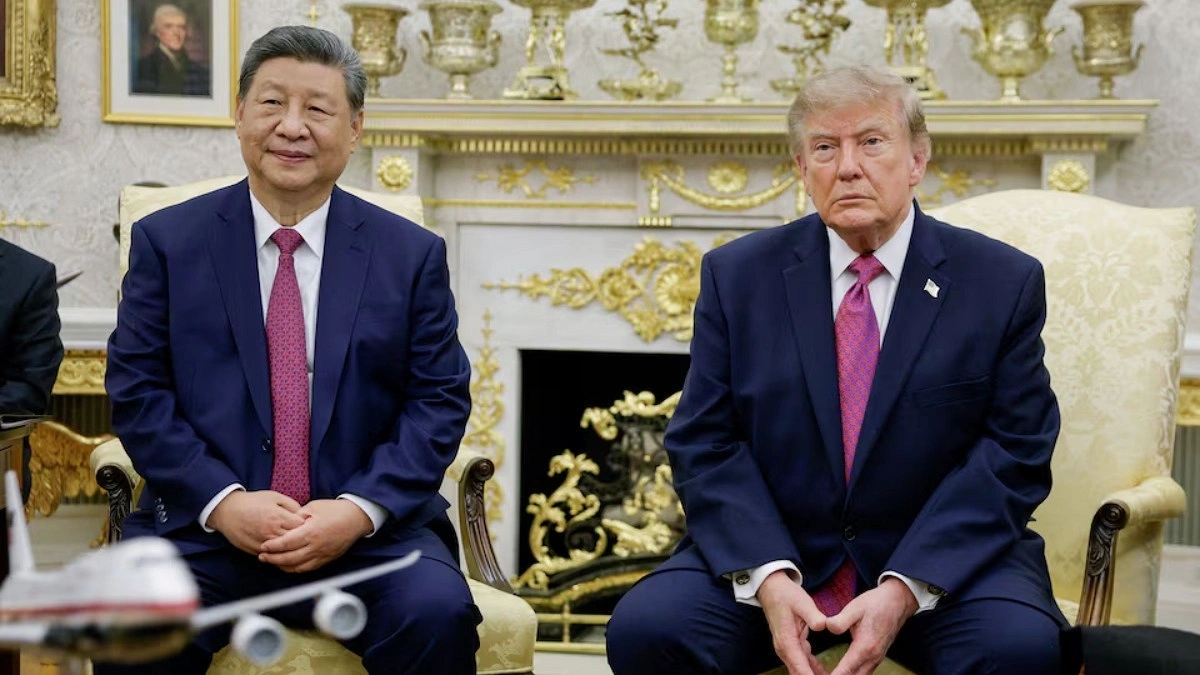
Photo: REUTERS
US President Donald Trump will conclude his high-stakes summit with Chinese President Xi Jinping on Friday by hosting the Chinese leader on a guided tour of the US National Archives.
Both leaders plan to emphasize their perspectives regarding the historical trajectory and future direction of bilateral ties between their countries during the archives visit.
The lavish White House state summit on Thursday delivered significant symbolism while remaining light on practical substance, yielding no immediate major diplomatic breakthroughs between the world’s two largest economies.
However, Trump highlighted positive momentum under a bilateral trade mechanism, pointing to enhanced market access for American farmers and ranchers, while both heads of state identified artificial intelligence as a key domain for mutual cooperation.
Welcoming Xi, Trump announced that they would view landmark historical documents at the National Archives, including the Declaration of Independence, the US Constitution, and the Bill of Rights.
Trump noted that the archival exhibition includes “artifacts testifying to the long and cherished relationship” between China and the US alongside their historical “cultural exchanges.”
Reflecting on their shared history, Trump said, “Just as our ancestors reached across the ocean centuries ago to trade, to learn, and to build a better world, our two countries do really the same thing, and we’re very proud of it and the relationship.”
Although China has issued no official statement regarding the archives itinerary, geopolitical analysts suggest Xi seeks to inspect historical records surrounding Washington’s 1979 decision to transfer diplomatic recognition from Taiwan to communist China.
Taiwan strain and congressional backlash
Beijing continues to claim democratically governed Taiwan as its sovereign territory, and Xi has repeatedly urged Trump to publicly say the US opposes Taiwanese independence, departing from Washington’s long-standing policy formulation that it merely does not support independence.
Xi remains eager to persuade Washington to halt military arms sales to the island. During Thursday’s deliberations, Xi actively pressured Trump on the island’s status, saying he expected the US to “handle the Taiwan question with prudence.”
At the same time, China’s official state news agency reported that Xi “hopes the US side will adhere to the correct position of opposing ‘Taiwan independence’.”
Although the US lacks formal diplomatic relations with Taipei, Washington serves as its vital international partner and maintains a statutory legal obligation under US law to supply the island with defensive weaponry.
Asian allies of the US are closely monitoring Trump’s rhetoric regarding Taiwan following Xi’s visit. Following his May summit with Xi, Trump - whose administration authorized an $11 billion defense package for Taiwan in December - placed a second arms package valued at $14 billion on hold, labeling the delayed shipment a “very good negotiating chip.”
Senior fellow Craig Singleton of the Foundation for Defense of Democracies think tank remarked that Beijing likely believes it has established a fresh baseline with Trump regarding Taiwan. Singleton observed that Xi’s choice of the word “adhere” proved revealing because “it implies Beijing believes Washington is already behaving in ways it wants.”
Singleton explained, “In the context of the current standdown on Taiwan arms sales, China may increasingly view that restraint as a new baseline rather than a temporary pause. Beijing’s objective is to get Trump to absorb Chinese red lines into his own definition of a stable relationship.”
On Thursday, Senate Democrats fiercely criticized the summit outcomes, asserting that Trump failed to secure concrete concessions from Beijing on trade, strategic security, artificial intelligence, or human rights.
Lawmakers rebuked Trump for failing to publicly challenge China’s ongoing military pressure against Taiwan and demanded the immediate delivery of approved arms sales and military assistance to Taipei.
Temporary trade truce extension
During the elaborate White House state visit on Thursday, Trump and Xi navigated complex negotiations centered on commercial trade, artificial intelligence, and their expanding strategic rivalry. Washington secured a brief extension of its active trade truce this week.
US Treasury Secretary Scott Bessent confirmed that both delegations agreed to extend a bilateral trade agreement - which previously halted last year’s trade war and faced a November expiration date - by an additional two months.
Bessent explained that the brief extension provides Washington and Beijing with “more time to see what we can do on the economic front.”
Rather than establishing a durable, permanent trade framework, the short extension effectively defers core economic disputes - including import tariffs, Chinese purchase quotas, rare-earth material supplies, and technology export restrictions - into upcoming negotiation rounds.
On Wednesday, Bessent revealed that while Beijing is fulfilling its contractual commitment to purchase 25 million tons of American soybeans, Chinese purchases are lagging behind its pledge to buy $17 billion in other agricultural products.
Moreover, US officials reported that Chinese deliveries of vital rare-earth elements continue to fall short of expectations, signaling deep persistent gaps between the negotiating teams.
As a result, commercial enterprises face ongoing operational instability, as tariff rates remain temporarily suppressed while corporate leadership must navigate an unpredictable, shifting policy landscape.
Rose Garden spectacle and White House display
Trump utilized Xi’s White House visit as a platform to display an American capital remade in his own personal style. Reciprocating Xi’s previous Beijing hospitality - which included a guided tour of a Ming dynasty temple and an exclusive walled garden retreat - Trump orchestrated an elaborate public spectacle.
Participating military troops wore historical wigs and tri-corner hats while marching in formation and performing music inside a newly redesigned Rose Garden styled after a Trump golf resort. Military fighter jets and heavy bombers roared through the sky during ceremonies staged on Wednesday and Thursday, generating a noise level so intense that Trump flinched during the flyover.
When White House officials summoned the press corps to cover the two leaders, the event focused on visual optics rather than high-level policy discussions.
Instead of taking policy questions, officials directed journalists to photograph the leaders touring the Marine One helicopter and inspecting the newly redesigned South Lawn, which features a massive helipad adorned with the presidential seal.
Brushing aside reporter inquiries regarding substantive negotiations, Trump remarked on Xi’s architectural preferences. “He loves good granite,” Trump told reporters regarding Xi, adding, “Great meeting.”
Strategic risk and Artificial Intelligence
Addressing broader strategic tensions, Xi once again invoked the “Thucydides Trap” - an academic concept postulating that competition between an established global power and an emerging rival frequently leads to military conflict.
Although the Chinese leader said such risks “can be overcome,” his statement underscored how fears of military confrontation shadow relations between the two world powers.
Xi maintained that both nations gain through constructive cooperation and suffer through confrontation, advocating for regular bilateral military dialogues and robust crisis-prevention mechanisms.
Countering these concerns, Trump cited the shared history of both nations to highlight opportunities for future collaboration, referencing their historic wartime alliance against Japan.
However, the two heads of state expressed divergent visions regarding the governance of artificial intelligence. Trump, who advocates renaming AI as super intelligence or SI, declared in a social media statement that he intends “to leave it exactly where it is” while relying on the US Department of Justice rather than imposing regulatory frameworks.
Trump further asserted that China shared his minimal regulatory stance. Disagreeing with that assessment, Xi said on Thursday the two leading nations must actively manage technological growth.
Xi added, “We have both the capability and responsibility to develop and manage AI for good, and ensure that the development of AI is always under human control and serves the well-being of the people.”
Prominent technology leaders attended Trump’s Thursday night state dinner honoring Xi, including Sundar Pichai of Alphabet, Sam Altman of OpenAI, and Jensen Huang of Nvidia.
Source: Reuters (adapted)
