
Politics in India
After CJP protests in Delhi, women face ugly attacks

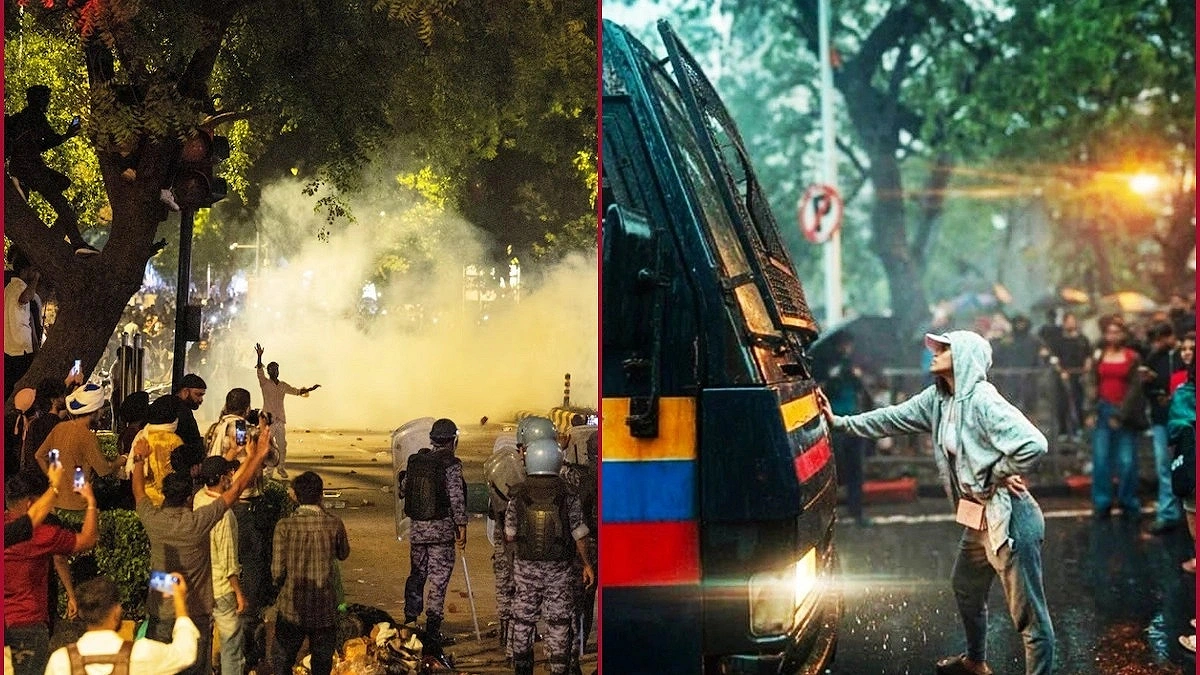
Photo: Reuters.
A scene lasting just a few minutes seemed to become a symbol of the entire country's movement. In the middle of heavy rain, a young woman wearing a hoodie stood alone in front of a moving police bus. Inside the bus were detained student protesters, and the young woman standing in front refused to budge. Within moments, the photo and video went viral. But unfortunately, very quickly she transformed from being a courageous face of the movement into a target of slander, trolling, character assassination, and personal attacks.
She is Riya Ahir, a 27-year-old model and actress from Mumbai. She became one of the most recognised faces of the student movement that spread across the country following the call of the CJP party over the NEET paper leak controversy and the protests that formed at Jantar Mantar in Delhi on 20 July. However, Riya was not alone. Many female students, lawyers, homemakers, and working women who took part in the protests in various cities across the country, including Delhi, Mumbai, Assam, and Kolkata, have spoken of the same experience. They allege that within days of the protests subsiding, their photos were being circulated on social media. In many cases, artificially altered images created using artificial intelligence were even being spread. Elsewhere, calls were also being circulated to identify them and file complaints with the police.
Riya Ahir claimed that on 22 July, she went to join the protest at Shivaji Park in Mumbai. Upon arriving at Shivaji Park, she saw that many students had been detained in police buses. Riya said that she asked two police officers whether there was any written order for the detentions. However, neither police officer gave her a clear answer. As a result, when the bus began to move, she decided to stand in front of it. In her words, "If I had done nothing, I would have felt like a criminal to myself for the rest of my life. As a citizen, I would have failed. Even if I had been run over, I still would not have moved. At that moment, that was perhaps my life's purpose." She added that even before this incident, she had tried to support the students by emailing the Supreme Court, the High Court, and the United Nations office.
But this was only the beginning. The situation started to change as soon as the photo went viral. Morphed images of her began circulating on social media. Even false propaganda was spread that she sells objectionable content. Her family members also became targets of ridicule. In response, she filed a complaint at the police station regarding harassment and defamation. It is learnt that the Maharashtra Cyber Police is also looking into the matter. Deputy Commissioner of Police for Mumbai, Datta Nalawade, confirmed that the complaint has been received and has been sent to the MIDC police station in Andheri East for investigation.
The same picture was seen in Kolkata as well. Sutithi, a law student at Jadavpur University, said that after the Jantar Mantar protests on 20 July, and especially during the march from Sealdah to Dharmatala on 24 July, a huge number of women participated. Even women over the age of sixty were seen walking long distances in the procession. According to Sutithi, the significance of this generation of female students is not just in their numbers. Their role in building the arguments for the movement was also important. In her words, "When the core demands of a movement cannot be refuted, then women's character, clothing, and language are used as weapons of attack. Patriarchy then becomes the most effective tool."
Another protester from Mumbai, Karishma Kodaji, who participated in the protests for three consecutive days starting from 18 July, said that she did not feel unsafe at the protest site because she is a woman. According to her, the biggest fear was police force. However, the leaking of personal information, circulation of obscene images, online harassment, and insults directed at female participants after the protests did not surprise her. In her words, this is the reality in India.
However, she has observed that many female protesters have responded to this slander with firmness. Without being afraid, they have highlighted the movement's message even more strongly. Karishma claimed that several female police officers personally thanked them, because due to their jobs, they could not protest publicly themselves.
On the other hand, it is not just online attacks; concerns have also arisen over surveillance during the protests. A report by Feminism in India highlighted that a JNU student who participated in the Jantar Mantar protests was avoiding cameras out of fear for her family. Several female students from IIT Delhi and IIT Madras also feared that these videos could be used against them in the future. Even some police officers were seen wearing smart glasses equipped with facial recognition technology.
Meanwhile, former JNU Students' Union president Aishi Ghosh filed a petition in the Delhi High Court, alleging that permanent surveillance towers were installed at Jantar Mantar to continuously record female protesters on video. The petition also stated that protesters were threatened with having their photos sent to their families and educational institutions.
On the other hand, a report in Outlook India on 23 July 2026 stated that Delhi Police used AI-powered surveillance vehicles equipped with facial recognition technology. Although Solicitor General Tushar Mehta informed the High Court that these were used solely for maintaining law and order, not for surveillance purposes.
Even several right-wing Hindutva social media accounts tried to portray female protesters as uncultured or opposed to Indian values. Yet, male protesters had also raised the same slogans. Mohammad Zubair, co-founder of Alt News, said that the same tactics were seen during the Shaheen Bagh and farmers' protests. Morphed images, misleading videos, and particularly attempts to character assassinate female protesters were common then as well. On the other hand, although Delhi Police issued notices to several political leaders regarding the removal of objectionable posts, many women who participated in the protests are still facing online targeting and personal attacks.
