
Myanmar refugees face uncertain lives in Mizoram

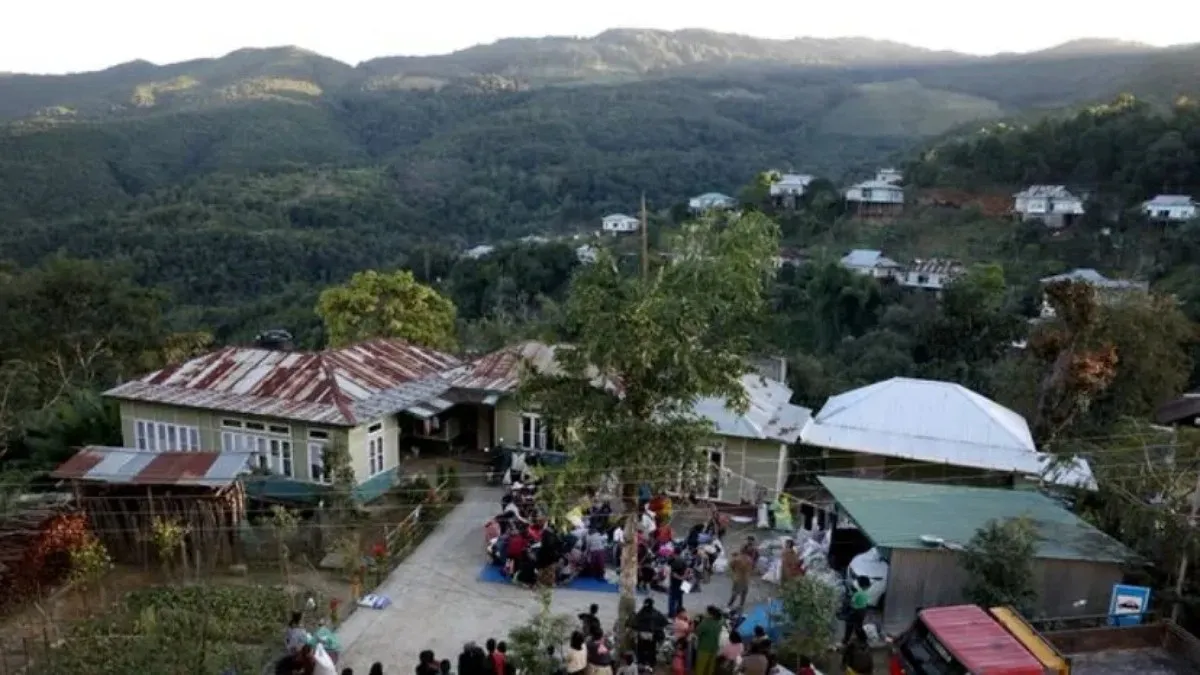
Photo: Agamir Somoy
Many have lost their legs in bomb blasts and landmine explosions. After fleeing across the border to save their lives, they found shelter in Mizoram. However, the war survivors continue to face daily struggles due to a lack of medical care, livelihoods and legal recognition.
The hands that once prepared meals for the family now bear scars of painful memories. The legs that once carried them across fields are gone. A single moment of an explosion has changed their entire lives.
They managed to cross the border and find shelter in Mizoram after fleeing the civil war in Myanmar. However, the wounds of war remain deeply embedded in their bodies and minds. They have no homes, no land and no secure livelihoods. Countless refugees are struggling to survive amid uncertainty over medical treatment and rehabilitation.
For these people living in the Sihhmui refugee camp in Mizoram and various parts of Aizawl, war is no longer just a memory of gunfire, airstrikes or explosions. It has become part of their everyday lives. The pain of losing limbs, family responsibilities, medical expenses and anxiety about the future have turned their lives into a prolonged wait for relief.
A woman once supported her family through farming in the Matupi area of Myanmar’s Chin State. She worked in the fields alongside her husband. She also cooked at home and looked after her children. However, the conflict that spread following the military coup shattered her ordinary life.
While she was cooking at home, a bomb suddenly fell from the sky. The impact of the explosion forced doctors to amputate her right leg below the thigh. Bomb shrapnel remains lodged in her other leg. Although she survived, all certainty of returning to a normal life disappeared in that moment.
On October 28, she reached a hospital in Aizawl with the help of her two sons. She needs surgery to remove the bomb fragments lodged in her left leg. However, there is no answer to what will happen after her treatment. Even after leaving her hospital bed, she will face an even harsher reality: How will she support her family? How will she afford regular medical care? And how will she return to a normal life?
It is not only people injured in airstrikes who have suffered. Many people have lost their legs to landmines during Myanmar’s military conflict. One of them was once a university history student. After the military coup, he joined the armed resistance movement demanding democracy. However, in March 2022, he stepped on a landmine during an operation in the Matupi area.
His injuries were so severe that one of his legs had to be amputated. He was later brought to Aizawl for treatment. His family had to help cover the cost of surgery. Although the resistance forces receive donations from ordinary people, they do not have sufficient funds to cover the long-term medical expenses of injured members.
He now lives with his wife and two young children in a small room at the Sihhmui refugee camp. He is no longer capable of doing heavy work. Returning home to complete his studies or finding a job remains uncertain.
Meeting daily expenses for food, rent, children’s needs and medical treatment is already a struggle. Buying a computer or starting a new livelihood remains beyond reach.
The woman who lost her leg in a bomb blast lives in a rented room in the Sihhmui area near Aizawl, Mizoram, paying 3,000 rupees a month. Three of her four children live with her. One remains in Myanmar.
Some of her children work clearing weeds in gardens, while others take up construction jobs as daily wage laborers whenever work is available. Their small earnings are the family’s only source of income. Sometimes, a meal consists of nothing more than rice and water.
The woman cannot work and requires regular care. As a result, her children have to take turns staying beside her. At an age when they should be building their own futures, they have had to shoulder the responsibility of supporting the family and caring for their mother.
Meanwhile, the earning opportunities for the family of the former student who lost his leg to a landmine have also steadily diminished. His wife previously worked as a tailor from home. However, she had to stop because of electricity costs and limited local work opportunities.
Mizoram shares an approximately 510-kilometer-long border with Myanmar. People on both sides have longstanding linguistic, cultural and ethnic ties. Driven by these connections, many people who fled Myanmar’s Chin State after the military coup in February 2021 found shelter in villages, churches and relatives’ homes across Mizoram.
With the sympathy of local residents and support from churches and voluntary organizations, many refugees initially found places to stay. However, prolonged conflict has turned these temporary shelters into permanent homes for many.
According to the Institute of Chin Affairs, nearly half of the population of Chin State has been displaced. Around 65,000 people have crossed the border and taken refuge in India. Another 130,000 people have been forced to seek shelter elsewhere within Myanmar.
According to official Mizoram government figures, 38,213 refugees arriving from Myanmar and other areas have been registered. Local organizations estimate that the actual number could exceed 60,000.
Despite the large number of people in need, arrangements for permanent rehabilitation, medical treatment and social protection remain limited. As a result, uncertainty continues to define their lives despite having found shelter.
The scale of the violence in Myanmar’s Chin State is evident from the figures on airstrikes.
According to the Institute of Chin Affairs, Myanmar’s military carried out 241 airstrikes in Chin State between February 1, 2021, and February 1, 2025. More than 1,061 bombs were dropped. The organization claims that at least 249 people were killed, more than 424 were injured and over 1,280 houses were destroyed.
The Chin Human Rights Organization alleges that airstrikes have targeted not only military bases but also churches, religious structures and residential areas.
On February 8, 2026, at least three people were killed, including a child, when a Baptist church in Chinpiang village in Matupi Township was attacked during a prayer service. Several others were injured.
Another airstrike in Bhumkhum village in Mindat Township on September 1 killed eight people and injured at least 15, according to a report by Burma News International.
Behind every number in these statistics lies a family, a shattered household and an unfinished life. Some children have lost their parents, while others have lost their own children. Some have survived but permanently lost their ability to walk normally.
The crisis facing refugees has become even more severe because of the lack of legal recognition.
India has no separate legal framework for recognizing citizens of Myanmar as refugees. India is also not a signatory to the 1951 United Nations Refugee Convention. As a result, the lives of refugees depend largely on the goodwill of local residents, churches, voluntary organizations and relatives.
The lack of necessary identification documents also makes it difficult for them to travel to other parts of India. They also face difficulties obtaining identification documents from the United Nations High Commissioner for Refugees (UNHCR).
Without valid documents, their opportunities for regular employment are limited. Access to government social protection programs is also difficult. Consequently, illness, physical disability or the death of a family member can deepen their financial crisis under any circumstances.
The situation is even more complicated for war refugees who have become physically disabled.
On the one hand, their income stops because they can no longer work. On the other, they require regular medical treatment, care, prosthetic limbs and rehabilitation. When a family member has to stay beside an injured person around the clock, that person also loses opportunities to work.
According to a doctor in Aizawl, a mobile medical service previously provided free treatment and prosthetic limbs to people injured in the conflict in Myanmar. However, the service could no longer operate after funding from the United States Agency for International Development (USAID) was discontinued last year.
According to the doctor, it is almost impossible for severely injured refugees to afford medical expenses without financial support from relatives living abroad or other sources of assistance.
Beyond the Sihhmui refugee camp, many injured people are receiving treatment at different hospitals. Some are paralyzed from the waist down. Others have been hospitalized for extended periods after being shot multiple times. For some, the possibility of returning to normal life remains slim even after several surgeries.
A young injured refugee had to undergo three surgeries after being shot in the shoulder. The resistance forces covered the costs of the first two operations. However, his family had to arrange 800,000 rupees for the third surgery.
He is now trying to support himself by providing care and translation services for other injured people.
For those living with the wounds of war, treatment is therefore not limited to a hospital bed or surgery. Even after medical procedures, they need long term care, psychological support, rehabilitation and livelihood opportunities.
The Sairang-Bairabi railway line became operational in September 2025, raising hopes for new opportunities in connectivity and tourism in Mizoram. The railway line has emerged as a new symbol of the state’s development.
However, just a few kilometers away from the benefits of this development, many people spend their days in uncertainty at the Sihhmui refugee camp.
Some have lost their legs, while others have lost their homes. Some have had to abandon their education, while others have lost their livelihoods. Still others are trying to rebuild their lives after losing family members.
Myanmar’s civil war has entered its fifth year. According to figures from the conflict monitoring organization ACLED, up to 100,000 people have been killed in the war and at least 3.5 million have been displaced. Various monitoring organizations claim that the military has intensified airstrikes after facing resistance in border areas.
Ordinary people are bearing the greatest consequences. Many of them may never be able to return to their previous lives.
The war forced them to leave their country. However, the refugee camps in Mizoram demonstrate that crossing the border does not erase all the wounds of war.
They need more than just shelter. They need medical care, rehabilitation, prosthetic limbs, livelihood opportunities and legal recognition. They need a system that enables them to live as people with rights rather than treating them merely as helpless victims.
Because surviving the battlefield is not the final struggle in life. For many, the real struggle begins after crossing the border and finding shelter, when securing daily food, medical treatment and their family’s future becomes the greatest challenge to survival.
