
Stores looted as Gen Z-led protests turn violent in Germany

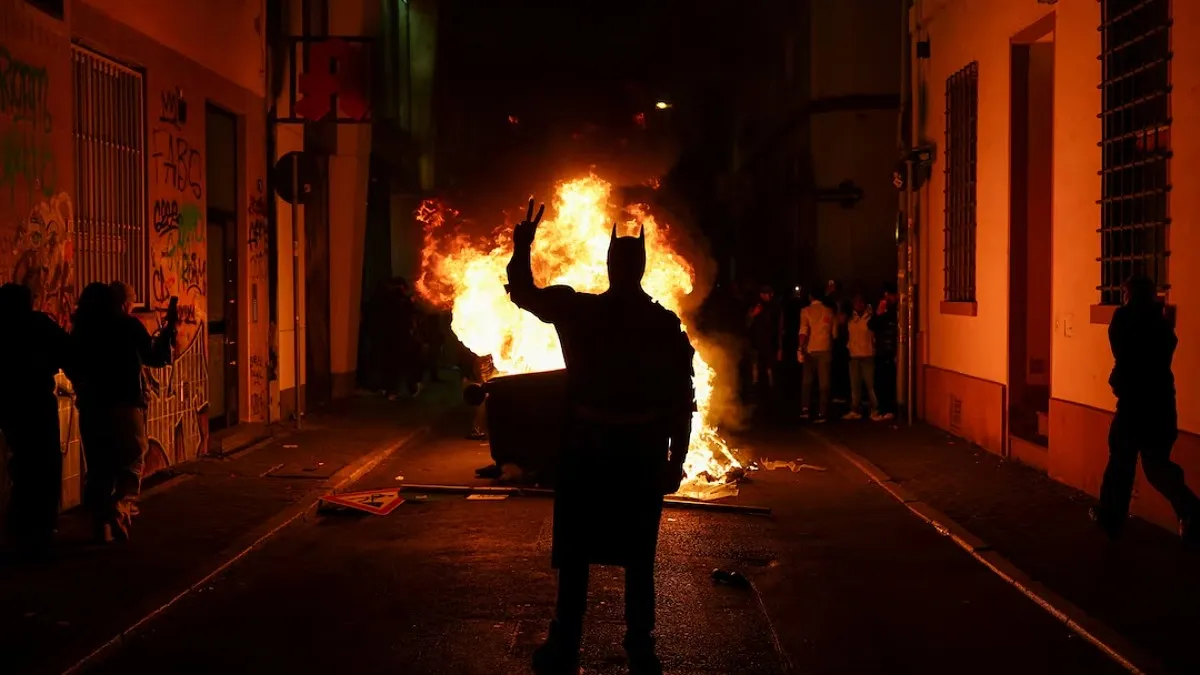
Photo: Reuters
Hooded rioters looted stores in Frankfurt on Saturday as tens of thousands of demonstrators took to the streets across Germany’s major cities demanding better education, lower living costs and an end to compulsory military service.
The demonstrations were organised by the campaign group Gen Z regelt, which means “Gen Z takes charge” in German. Protests took place in 34 cities, including Berlin, Frankfurt and Munich, amid a wave of Gen Z-led demonstrations across Europe this year.
In Frankfurt, Germany’s financial hub, at least two stores were looted as demonstrations turned violent. Several other shops were damaged, while police struggled to bring the situation under control, according to a Reuters witness.
“Violent disturbances are continuing,” Frankfurt police said on X. “In the city centre, windows have been smashed at several shops. Molotov cocktails are also being thrown at the emergency services. We urge all bystanders to avoid the city centre or to leave the area.”
Some barricades were also set on fire in Hamburg.
Official figures on Saturday afternoon indicated that turnout was lower than the 182,000 participants initially expected by organisers. Police in Frankfurt, Munich and Berlin reported up to 18,000 demonstrators, compared with approximately 36,000 listed on the organisers’ website.
German authorities said the demonstrations, which coincided with Halloween celebrations, had largely remained peaceful. However, they warned that extremist groups might attempt to exploit the movement.
In Berlin, Gen Z regelt spokesperson Lina Friedrich said the demonstrators were fighting for peace and freedom rather than war and coercion.
“What matters most to us is better support for the health and education systems. We are against compulsory military service and we are in favour of a fairer distribution of the burden,” she said.
Luxury shops board up windows
Germany’s Federal Interior Ministry said parts of the country’s far-left extremist scene and some groups linked to foreign extremist movements had joined efforts to mobilise support.
Roman Poseck, interior minister of Hesse, whose capital is Frankfurt, warned against a repeat of the violence seen in France.
“We all have those images from France in our minds, looting, burning houses, burning police vehicles, and attacks on police officers,” he said. “France must not be held up as a model in this regard.”
Several businesses across Germany boarded up their windows and planned early closures ahead of the demonstrations. These included shops along Berlin’s luxury Kurfuerstendamm shopping boulevard.
The campaign has highlighted growing economic and social pressures on younger generations in Europe’s largest economy.
“The government has offered no response to our concerns other than to continue making cuts and piling further burdens upon us,” said Steve, an 18-year-old scheduled to speak at a rally in Munich, addressing Chancellor Friedrich Merz.
“We will continue to exercise our fundamental right to assemble until you stop ignoring us,” he added.
Germany has struggled to revive economic growth while facing mounting pressure on pensions and public services as baby boomers retire and the working-age population declines.
Questions have also emerged over who is driving the campaign and whether it is genuinely youth-led, given the involvement of various political and civil society groups.
Germany’s national umbrella organisation for school students, BSK, has distanced itself from the initiative and plans to organise a separate protest day on November 20.
Meanwhile, Sean Baker, a student at the Technical University of Berlin, said he would join Saturday’s demonstrations to highlight the poor condition of university buildings.
“When you go inside and enter the rooms, it looks like an abandoned building,” he told Reuters. “Yet this is where we’re expected to study on a regular basis.”
Source: Reuters (Adapted)
