


Landslide at Guinea landfill kills 30, government says

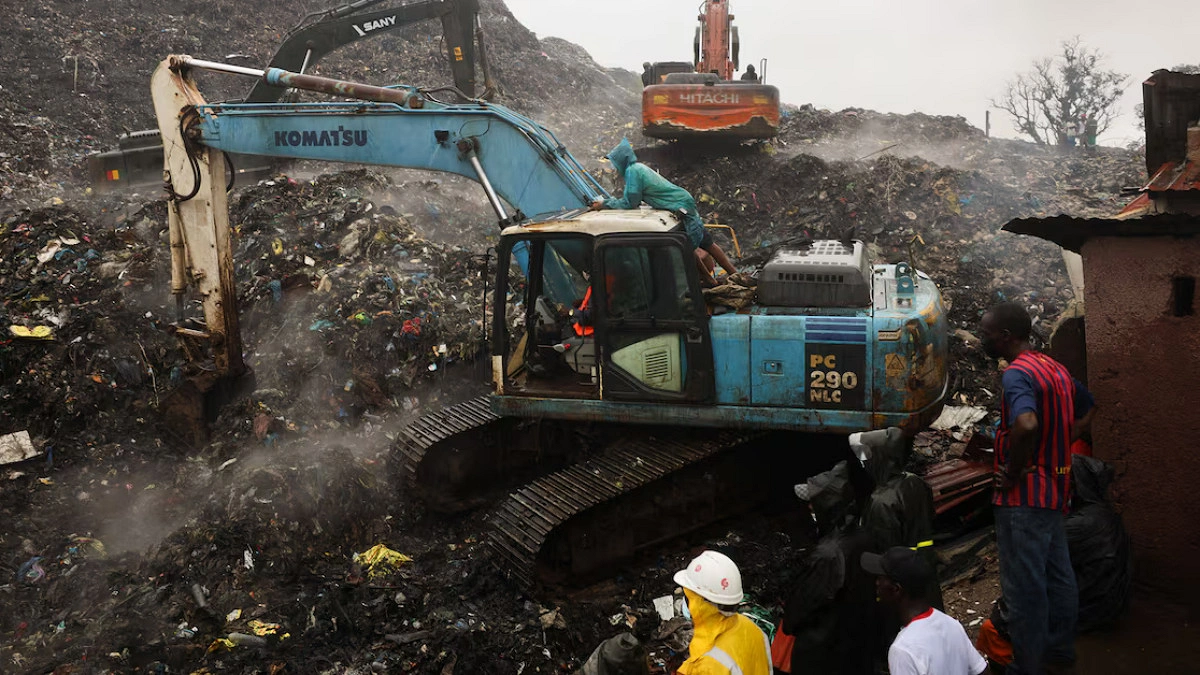
Reuters photo.
A landslide at a landfill in Guinea's capital killed 30 people, the government said on Sunday, after heavy rains overnight prompted the collapse of a massive mound of waste that engulfed nearby tents and shacks.
The incident occurred less than a week after the government announced plans to close the site and relocate the waste because of the threat it posed, especially during the ongoing rainy season, which causes landslides and fatal flash floods each year in crowded, underdeveloped cities across parts of West Africa.
The landslide took place at around 2 a.m. (0200 GMT) in the Gbessia commune of Conakry, according to a government statement. The death toll was 30, with six people seriously injured and 16 more lightly injured, the statement said.
Rescue workers were using excavators and other tools to clear the site of the landslide, which witnesses said was large enough to bury an apartment building along with more precarious dwellings.
One woman, Cire Diallo, told reporters at the scene that her five children were killed. "I have lost all my children. All I can do is put my trust in God," she said.
Guinea holds the world's largest bauxite reserves and richest untapped iron ore deposit at Simandou, where a massive mining project was launched in November. But the West African country has poor infrastructure and widespread poverty, with 3.7 million of its 15.1 million people living on less than $4.20 per day, according to a World Bank report published in April.
Guinea's minister of territorial administration, Djenab Toure, announced on Thursday that the government was closing the landfill because it was unsafe and said the waste was to be relocated outside Conakry.
Prime Minister Amadou Oury Bah visited the landfill on Sunday to assess the damage and supervise the response, the government statement said, adding that people should "remain calm, show solidarity, and strictly follow the instructions of rescue services and the competent authorities."
Euronews adds: Days prior to the incident, residents living nearby the landfill had been given eviction orders by the government, out of fear of a collapse. Many were forced to leave, but according to local authorities, many others were still around at the time of the disaster.
"We will ensure that the remaining families are relocated elsewhere,” Dienabou Touré, the minister of territorial administration and decentralisation, said at the scene.
A resident of the Dar Es Salam neighbourhood explained to press agency AFP the efforts local residents went through to prevent a tragedy from unfolding.
"We organised sit-ins, we invited the officials from the relevant departments, but they didn’t take it seriously. So that’s why today, with this landslide, I blame the State, because it didn’t take the necessary measures to have the dump closed. And yet they had promised us that, it’s been a year now," activist Abou Hamza explained.
Guinea is mineral-rich and holds the world's largest deposits of bauxite, a rock that serves as a main source of aluminium. The country and also has iron ore, gold, diamonds and minerals.
However, 43.7% of the population lives below the national poverty line, according to the World Bank, with around 3.7 million out of 15.1 million people living on less than $4.20 USD (€3.60) a day.
(Source: Reuters and Euronews)

