
Why Saudi Arabia is struggling to stop the Houthis

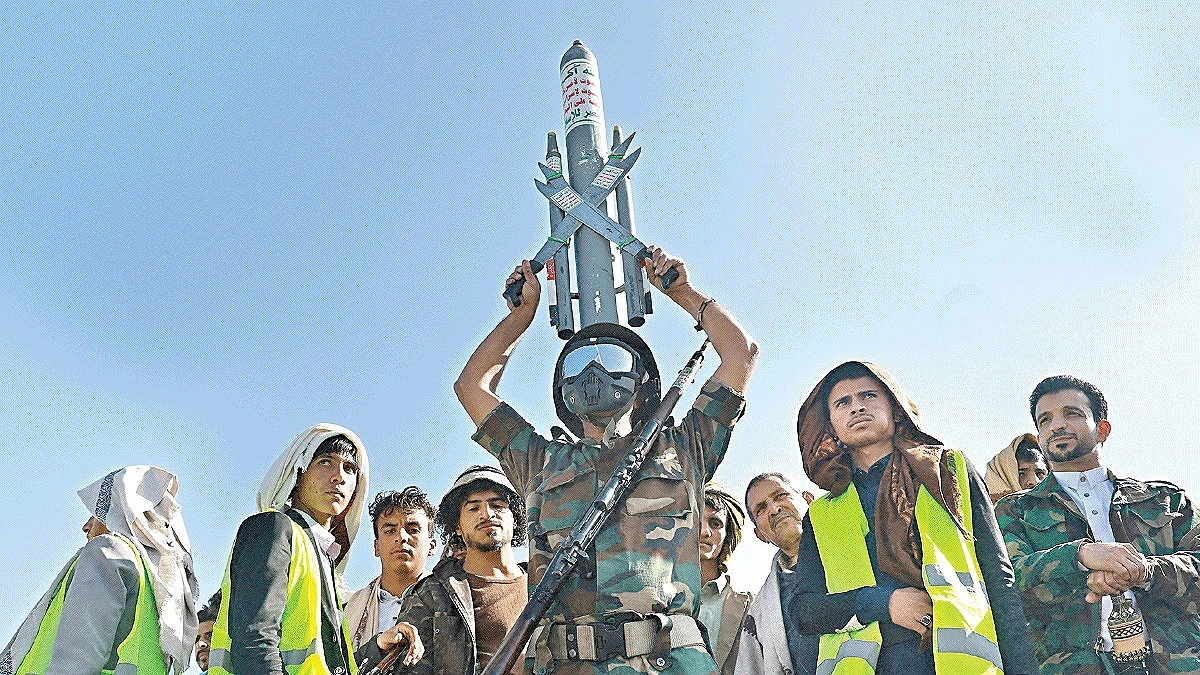
A Yemeni man supporting the Houthi group, dressed in military attire and holding a mock missile. Photo: Reuters
In the maze of the Middle East's regional storm, Saudi Arabia, the self-styled leader of the region, has now lost its way. The kingdom's royal forces, equipped with the pride of American petrodollars, advanced fighter jets, Patriot missiles, and billions of dollars worth of weaponry, are today in a deep psychological crisis. Sleep has become forbidden in the luxurious royal palaces.
The calculation that a few weeks of fierce airstrikes would reduce Yemen's rugged mountain tough guys, the Houthi rebels, to dust has now changed. The sky-high arrogance of Riyadh's rulers has blown away in the wind. Despite the vast wealth of its oil fields and mountains of modern military equipment, this hero of the desert cannot figure out the tricks of Houthi drones and guerrilla attacks. This silent question is now the biggest mystery in contemporary modern military history.
The Houthi group of Yemen, nurtured by Iran, and Saudi Arabia, the ATM booth of the United States, have been enemies for a long time. Nearly 17 years old. It began in November 2009. That time too, the Houthis had crossed the southwestern border into Saudi territory. They had captured Jabal al-Dukhan, a strategic mountainous region between the two countries on the border. Even then, there was the same allegation, that they were being supported by Yemeni government forces. It has been going on since then. Sometimes peace, the next moment war. In July of this year, the two rivals became embroiled in a new round of conflict along that familiar path of boots and bullets. The Houthis imposed a maritime blockade on Saudi Arabia. They declared the Bab al-Mandeb Strait in the Red Sea undesirable. Later, it took a more extreme form in September. Against the backdrop of the ongoing Iran-United States war and regional tensions in the Middle East, from September 18 and 19, the Houthis began large-scale direct ballistic missile and drone attacks on Saudi Arabia's mainland. A week before that, on September 10, the Houthis seized the port city of Mokha to take control of Bab al-Mandeb in the Red Sea, a globally energy-sensitive route. It has been going on since then. Even after launching a joint attack with a hundred aircraft in retaliation, the Saudi coalition cannot bring them under control. On the contrary, after pushing out Yemeni government forces, they took full control of the coastal areas of the Red Sea. However, on October 5, with the help of the Saudi air force, the Yemeni forces claimed to have regained control of the Bab al-Mandeb Strait in Operation Dawn of Yemen. But it is only an announcement; no results have been seen.
The modern technological radars and air defense systems of Saudi Arabia are collapsing under the attacks of nominally priced drones and missiles of the cheap sandal-wearing Houthi forces hiding in the crevices of the mountains. Despite military power, advanced air defense systems, and the support of Western allies, how are the Houthis getting inside Riyadh's home? Yesterday, Sunday, they also carried out new attacks on King Khalid International Airport in Saudi Arabia's capital, Riyadh. This caused a fire in a terminal of the airport. Until this report was written, nothing was known about casualties or damage. Just the day before, the Houthis carried out a terrible attack on the same airport. In it, 12 people were killed, including two Bangladeshis. 309 people were injured. Earlier, on October 6 and 7, the Houthi group attacked Abha and Riyadh airports. In this, three people lost their lives. 36 people were injured. The surprising thing is that Saudi Arabia has not been able to prevent any attack so far. Immediately after the attack on Riyadh airport, the Saudi coalition gave a strong response with counterattacks on Houthi strongholds, which the Houthis practically did not take into account. On the contrary, the Houthi forces have issued a warning against the use of Saudi Arabia's airports other than Mecca and Medina. The group's military spokesman, Yahya, gave this warning in a statement yesterday, Sunday. Yet on October 5, Saudi Arabia, Pakistan, and Turkey's military alliance implemented the Mecca Defense Agreement. Which means that if one country is attacked, it means an attack on all three countries. After the attack on Abha and Riyadh airports on October 8, that agreement was also implemented. Under it, Turkey and Pakistan activated military and intelligence support. Several close Western allies, including the United States, are providing defense support to Saudi Arabia. But in the end, everything is in vain. Moreover, in a new statement yesterday, the Houthi Foreign Ministry said that if Saudi military operations in Yemen continue, even stronger counter-responses may be given.
Why the risk despite advanced defense systems?
Several reasons behind the failure to stop Houthi attacks have emerged in international media. First, the limitations of air defense systems. Saudi Arabia mainly relies on high-tech air defense like the American Patriot system. These systems are effective in destroying large ballistic missiles or warplanes. But Yemen's Houthis use extremely cheap, small, and low-flying suicide drones and cruise missiles. These are not easily detected by radar, so billion-dollar defense systems are failing here. Second, the wrong strategy of buying security equipment. According to international analysts, Saudi Arabia has long sought to ensure security by purchasing huge amounts of weapons and foreign troops from the West rather than strengthening its own military from within.
Limitations of Allies and Political Interests
The US administration has shown reluctance to get involved in another direct war in the Middle East. Despite Riyadh's requests, it is providing only limited intelligence and logistical support instead of carrying out direct airstrikes. Pakistan is also unwilling to go into Yemen and directly participate in war against the Houthis because of its own diplomatic relations with Iran. Under the Mecca Agreement signed on August 7, Pakistan and Turkey are committed to protecting Saudi sovereignty, but they are mainly focusing on guarding Saudi borders and surveillance in air defense.
Geographic Location and Guerrilla Strategy
The Houthis operate attacks by spreading out across Yemen's mountainous regions. It is almost impossible to destroy such a network through conventional armies or airstrikes. Iran's support is behind this. Using Tehran's precise GPS-guided drone technology, they are targeting Saudi oil refineries and airports.
2 Bangladeshis Killed, 4 in ICU
State Minister for Foreign Affairs Shama Obaid Islam has said that two Bangladeshis were killed in the Houthi rebel attack on Riyadh's King Khalid Airport. Four more Bangladeshis injured in the incident are in the intensive care unit (ICU) of a hospital in Riyadh. The state minister gave this information while speaking to journalists at the Foreign Ministry yesterday. He said, "In the attack on the Saudi airport, two Bangladeshi citizens were killed and four were injured. They are in the ICU of Saudi's King Khalid Hospital. We are trying to confirm everyone's identity."
The state minister said that when the Houthis attacked before, one Bangladeshi was killed. Now two have been killed. Their identities have also been confirmed by the Ministry of Expatriates' Welfare and Overseas Employment. One is Md. Shahed Ahmed, son of Md. Rafiqul Islam of Shajahanpur in Bogura. The other is Md. Nasrullah Badarpuri, son of Maulana Mohammad Ullah of Langelkot in Cumilla.
