
US midterms: 3 possible paths and what to watch

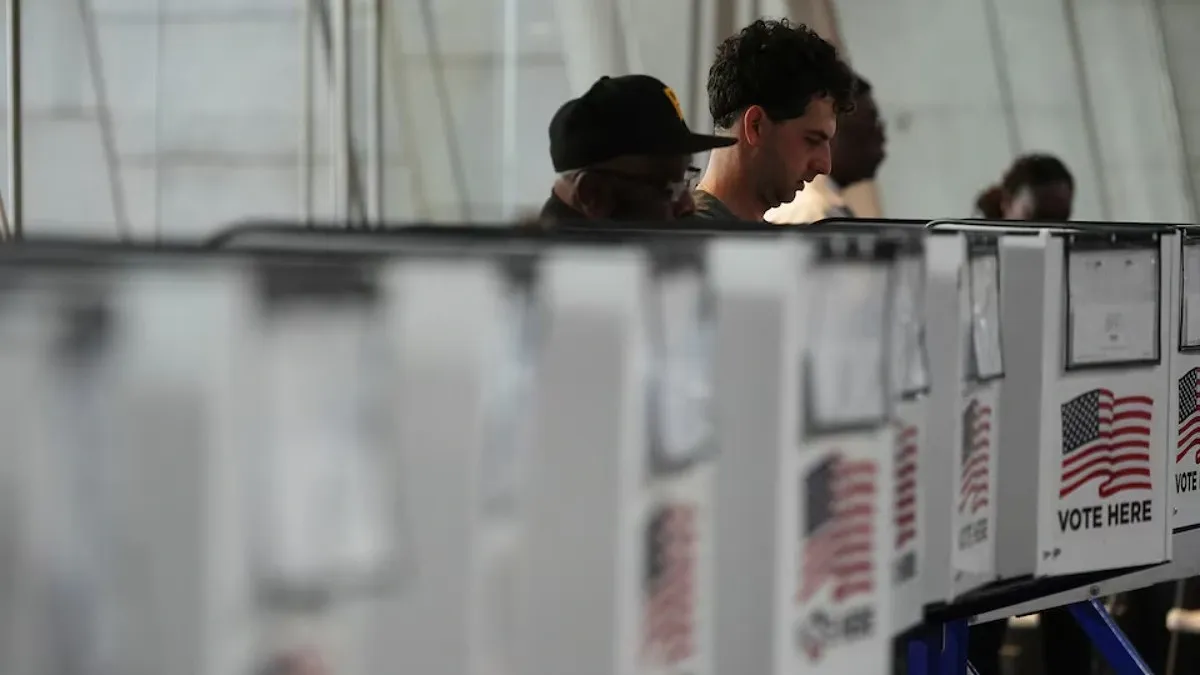
Photo: REUTERS
After months of intense campaigning and billions of dollars spent on the US midterms, election day has finally arrived. Latest public opinion surveys indicate that Democrats hold the upper hand, although historical polling has not always proven reliable, and this election cycle could deliver its own share of surprising results.
In broad strokes, three distinct scenarios outline how the American electorate could shape the nation’s political landscape. Examining these options illuminates what early indicators to watch as election authorities tally the results and what each path portends for the country’s governance.
In the first scenario, a massive Democratic wave sweeps across the nation. History demonstrates that midterm contests typically favor the out-of-power party.
Combining this historical precedent with what polls identify as a historically unpopular president, an ongoing war with Iran inflating consumer costs, and controversial administration policies such as aggressive immigration enforcement and public support for data center construction, conditions ripen for an electoral wave.
Under this first scenario, that precise wave materializes. Democrats do not merely capture the House of Representatives; they comfortably exceed the 218 seats required for a working majority. They secure victories not only across a dozen toss-up races rated by analysts as too-close-to-call, but also flip seats in traditionally conservative strongholds.
Regarding the Senate, this Democratic wave scenario requires Democrats to claim victory in all or most competitive toss-up contests, including several situated in traditionally conservative states.
Such an outcome features eye-popping victories in territories that have not elected a Democratic senator in a generation, such as Texas, or in nearly a century, as seen in Kansas. Under these circumstances, Democrats secure Senate control with a seat or two to spare.
This decisive margin avoids drama surrounding a potential legal dispute in Alaska, where a judge recently dismissed a Trump administration lawsuit concerning two individuals named Dan Sullivan on the ballot.
Democrats achieve this sweeping success by driving up turnout among core voters and winning independent voters by substantial margins. This reverses Trump’s 2024 gains among Hispanic voters and young men, while some Republican voters support Democrats or stay home entirely.
Such a result delivers a stinging rebuke to Trump and his Republican Party, establishing two years of conflict between an empowered Democratic legislative majority holding power and a president who seldom backs away from a fight.
Early indicators of this wave appear if Democrats retain key House contests in Florida, capture Republican-held districts in North Carolina, Michigan, New York, Virginia, and Kentucky, and flip the Senate seat in South Carolina.
In the second scenario, a Democratic trickle replaces the massive wave, indicating polls prove neither completely wrong nor entirely accurate. Here, Democrats gather enough low-hanging fruit in House contests to secure a majority, but fail to build a sizable cushion.
As a result, Democratic House leaders must continually wrangle with both fringe members on the left and the center to ensure necessary votes for passing legislation. In the Senate, Democrats flip only one or two seats - with North Carolina appearing virtually assured - while competitive races across the conservative heartland prove out of reach.
Republican Senator Susan Collins maintains her seat in Maine against Democratic efforts, left-wing candidate Abdul El-Sayed fails to keep Michigan in the Democratic column, and the dueling Dan Sullivans controversy sinks Democratic candidate Mary Peltola in Alaska.
For this Democratic trickle outcome to unfold, a massive election day turnout by Republican voters matches the heavy Democratic turnout observed during early voting. Trump’s energetic efforts to rally his base across Republican red states help his party avoid the worst-case scenario, leaving margin-of-error races divided between both political parties.
This dynamic yields a divided Congress, creating a clear recipe for political gridlock. Early indicators of this trickle scenario emerge if Florida remains comfortably Republican across the board, and while Democrats pick up select House seats in states like Virginia and Pennsylvania, entrenched Republican incumbents on sturdier political ground avoid getting washed away in an electoral deluge.
In the third scenario, Republicans experience a highly successful night by resiliently maintaining control over both chambers of Congress. This outcome requires public opinion polls - which previously underestimated Trump’s voter support - to prove wrong again, with most toss-up contests falling to Republicans.
Achieving this result demands that Republican voters turn out in unexpectedly impressive numbers, while independent and Hispanic voters who had seemingly soured on Trump’s policies ultimately break his way in the end. Control of the House of Representatives, far from standing as a guaranteed victory for Democrats, ultimately hinges on California and its extended days-long counting process for mail-in ballots.
Ultimately, Republicans eke out a slim overall House majority, aided in part by strategic efforts to draw favorable congressional district lines in places like Texas, Florida, and North Carolina. Furthermore, Republicans win all Senate contests in conservative states while flipping Michigan, a seat that Democrats held entering the election.
Even in competitive states where Republicans do not win - such as North Carolina, Democratic-controlled Minnesota, or New Hampshire - they make Democratic candidates sweat.
Should this third scenario unfold, Trump will claim a renewed electoral mandate on Wednesday morning, aggressively advancing his domestic and foreign policy agenda with the continued support of a Republican Congress.
Early indicators of a strong Republican performance appear if Senators Ashley Moody in Florida and Jon Husted in Ohio cruise to re-election, if Republicans hold their ground in House races across Pennsylvania and Virginia, and if they flip current Democratic seats in North Carolina, Ohio, and Florida.
Source: BBC (adapted)
