
From a BJP family to a Naxalite group—Neha Bora is making waves on the streets

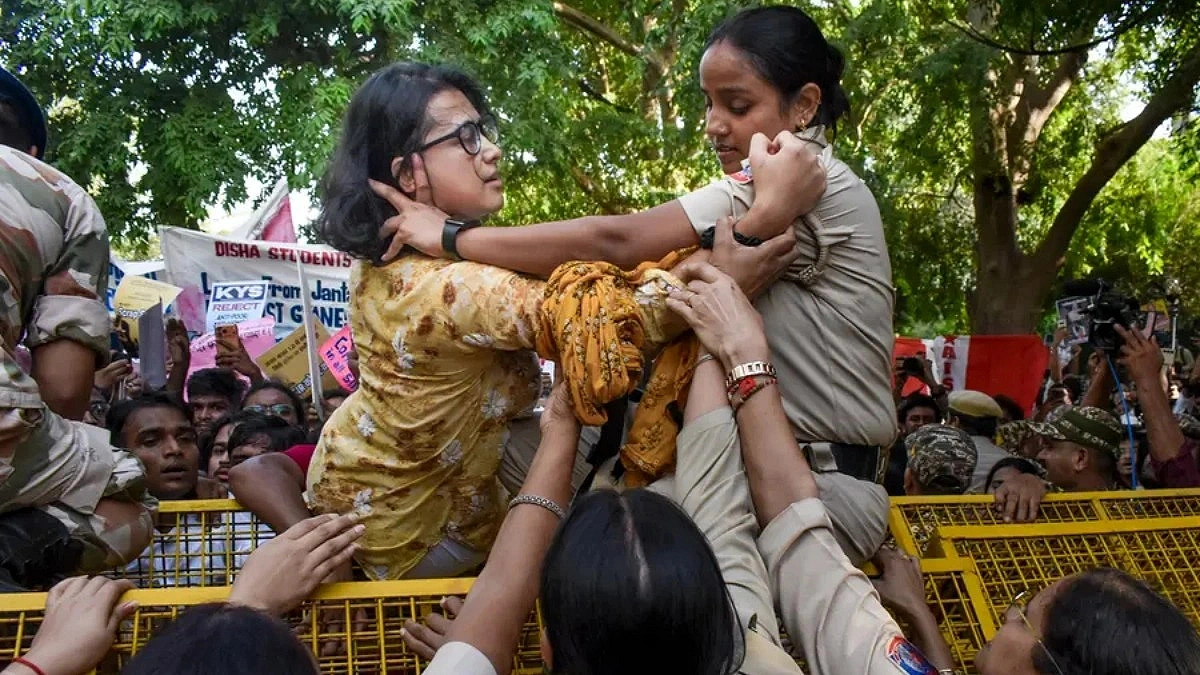
Neha Bora attempting to cross police barricades during the ongoing protests in Delhi — Collected photo.
Born into a BJP-supporting household, TV-theater artist and left-wing student leader Neha Bora—now the All India Students' Association (AISA) national president—has emerged as a prominent voice on India's streets, protesting against the very policies of the BJP-led government.
Neha first gained national prominence during a 23-day hunger strike at New Delhi's Jantar Mantar over alleged question paper leaks in the National Eligibility cum Entrance Test (NEET), demanding the resignation of the Union Education Minister. Standing alongside climate activist Sonam Wangchuk and Cockroach Janata Party (CJP) leader Abhijit Dipke, the Jawaharlal Nehru University (JNU) PhD scholar quickly became a central figure in student activism. Just months later, she returned to the streets demanding the resignation of Chief Election Commissioner Gyanesh Kumar, leading to her detention by Delhi Police on October 2–3.
From an Army Household to Street Activism
Born in Khatima, Uttarakhand, Neha grew up in a conservative family environment due to her father’s service in the Indian Army. His postings meant a childhood spent moving between various cities across the country.
While studying at Delhi Public School in Siliguri, North Bengal, Neha developed a keen interest in art, debating, public speaking, and social justice. She has credited her time in North Bengal as a major influence on her political consciousness, introducing her to the writings of Charu Majumdar, Pablo Neruda, and Arundhati Roy.
Academic and Political Journey
Neha actively entered student politics during her undergraduate studies at Delhi University. She later completed her master's degree at Dr. B. R. Ambedkar University in Delhi and is currently pursuing a PhD in Theatre and Performance Studies at JNU's School of Arts and Aesthetics.
Her connection to theater extends beyond academic research into her political style. Incorporating theatrical storytelling and emotional depth into her speeches, Neha stands out among student leaders for her distinct, impactful delivery at rallies and demonstrations.
Beyond the Campus: A Voice That Reached the National Stage
During her university years, Neha gradually became deeply involved in student politics. Her political engagement focused heavily on issues like the privatization of education, fee hikes, exam irregularities, campus safety, and student rights.
Eventually, she rose to become the national president of the All India Students' Association (AISA), a left-wing student organization affiliated with the Communist Party of India (Marxist-Leninist) Liberation.
As national president, Neha expanded her platform beyond university-specific matters. She took vocal stances on broader issues, including the humanitarian crisis in Gaza and the Bilkis Bano case, pushing her profile well beyond student activism.
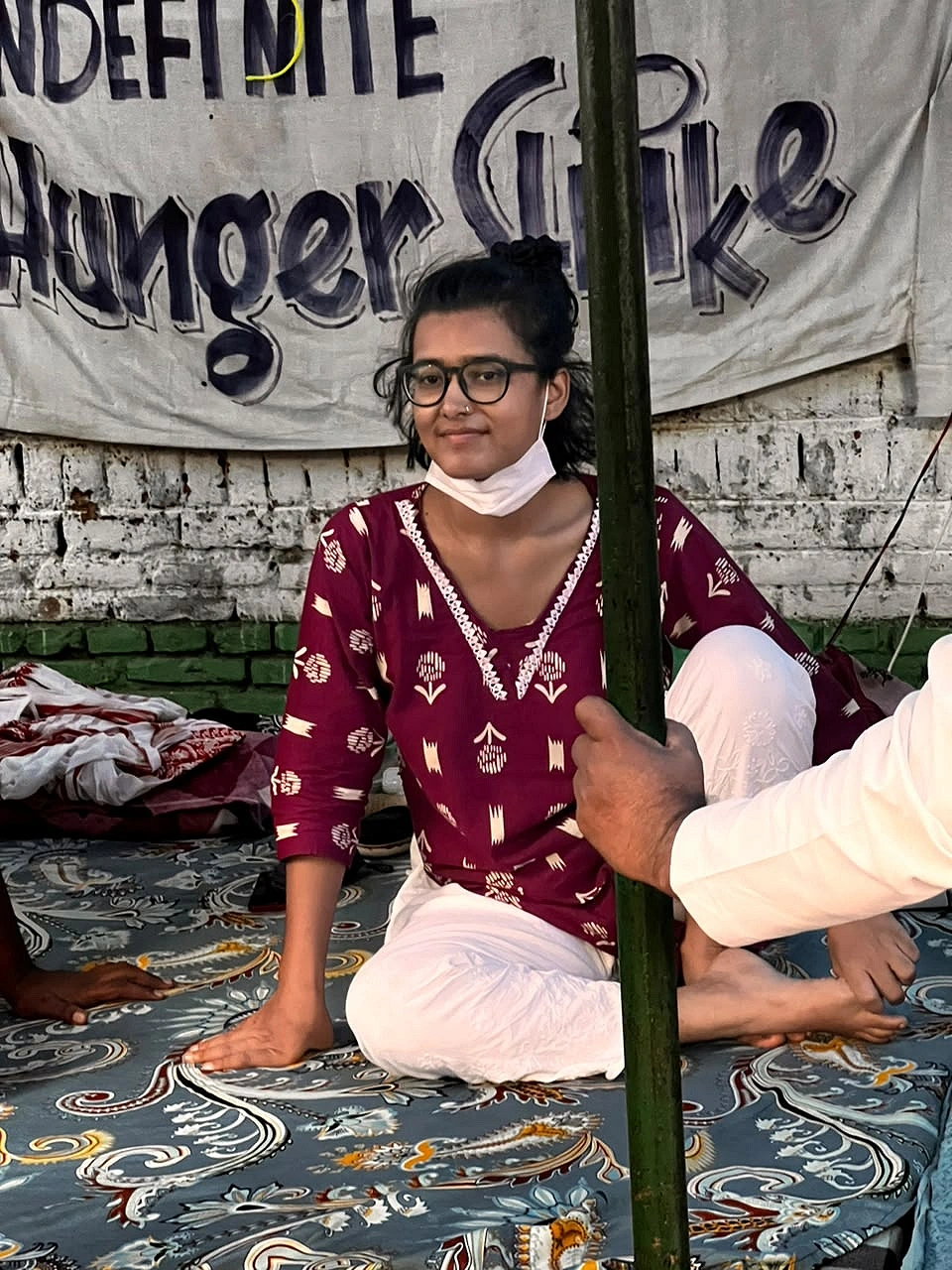
Neha Bora on a hunger strike — Photo: Gaurav Pandey
Neha returned to national prominence during widespread student anger over exam irregularities and alleged paper leaks in India. Joining AISA leaders and education reformer Sonam Wangchuk at New Delhi's Jantar Mantar, Neha—alongside Manish Kumar and Amene Amitoj—embarked on a 23-day hunger strike.
The prolonged fast established Neha as one of the key faces of India's student movement, drawing visits and support from prominent figures like actress Shabana Azmi and comedian Kunal Kamra.
A Ideological Divide: Family Politics vs. Neha's Path
The sharp contrast between Neha's political stance and her conservative family background remains one of the most compelling aspects of her journey. Speaking on the divide, Neha noted in an interview:
"There are staunch BJP supporters in my own family, and we used to have major disagreements at home over this. Ever since I moved to Delhi and became politically active, these political differences have persisted within the family."
She elaborated on maintaining her independence amidst tension:
"At times, the situation would get very intense. However, I feel I was independent enough regarding financial matters and making my own life decisions. I gained that independence around my second or third year of undergraduate studies, which proved to be a major turning point in my life."
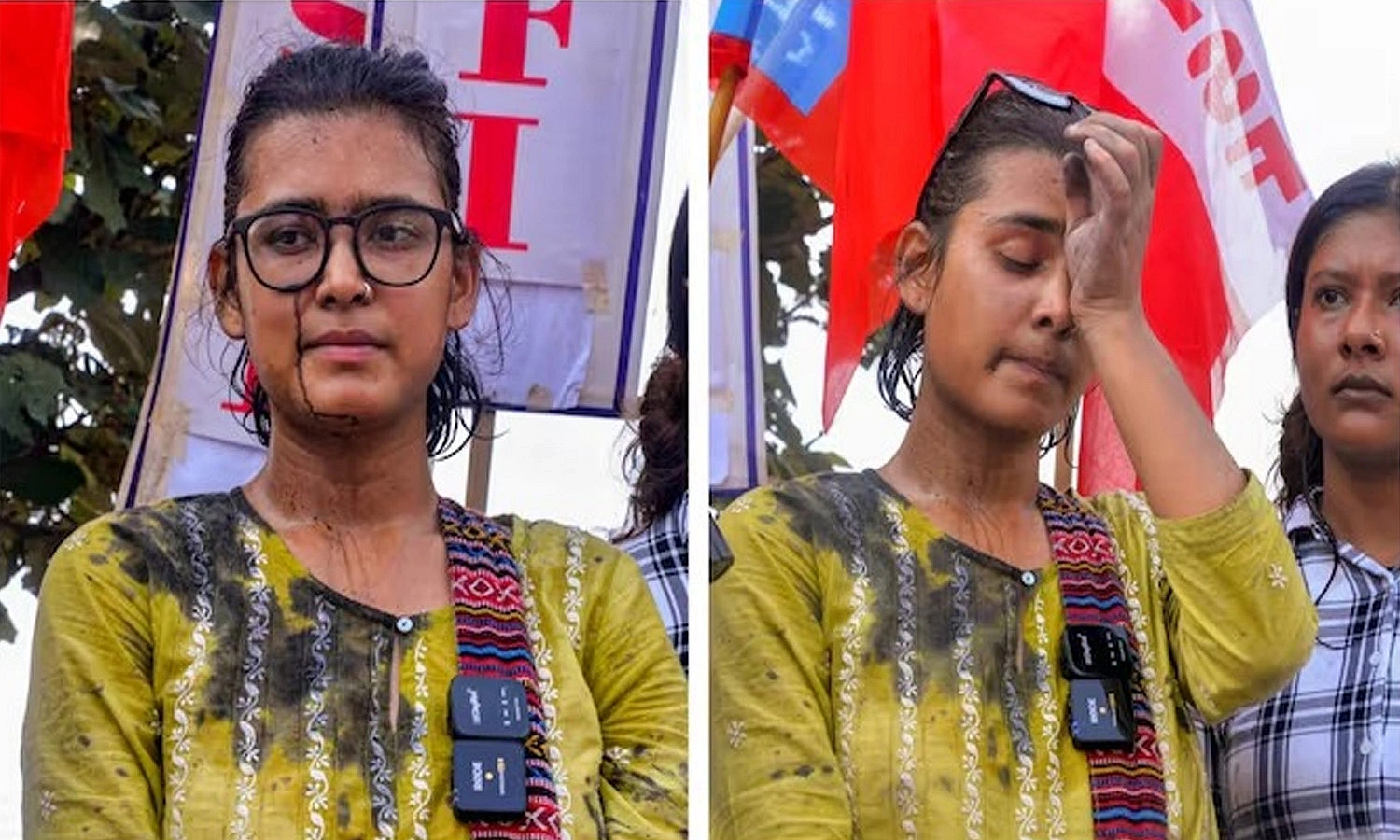
Ink was thrown at Neha during a protest in Jharkhand in August — Collected photo
Despite the friction, Neha shared that after witnessing police actions during the protests, even her BJP-supporting mother expressed praise for the demonstrators' perseverance. She noted that several parents and elders holding pro-BJP views who visited the protest site became emotional over the students' plight.
For Neha, this shift marks a vital turning point: when ordinary citizens connect with a cause beyond political affiliations, a student-led protest evolves into a broader social movement.
Joining Hands with the Cockroach Janata Party
Another key catalyst behind Neha's rising national profile was her involvement with the movement led by the Cockroach Janata Party (CJP). Initiated as a satirical online platform by activist Abhijit Dipke, CJP later transformed into a street-level movement.
Despite distinct political identities, AISA and CJP found common ground on specific public issues. Emphasizing solidarity over division, Neha asserted that political differences should never block collaboration when fighting for students and the general public. When asked about future partnerships, she affirmed that AISA would readily ally with any group working in the public interest.
This collaboration sparked widespread discussion on social media regarding her dynamic with CJP founder Abhijit Dipke. In a online debate over maturity and leadership, a user remarked that Neha possessed superior talent, a sentiment Dipke himself agreed with. Neha promptly responded to the thread, writing: "Not comparison, but solidarity. We fight together." Dipke replied, "Inquilab Zindabad."
The Ink Attack and Stance on Umar Khalid
Following the NEET demonstrations at Jantar Mantar, Neha made headlines again on August 7 during a student protest near the Jharkhand Legislative Assembly in Ranchi, where an individual threw ink at her. Police apprehended the perpetrator, who was granted bail by a Ranchi court on August 11.
In the aftermath of the incident, Neha's statements regarding former JNU student leader Umar Khalid—who has been detained without trial under charges linked to the 2020 Delhi riots—gained renewed traction. Grounding her stance on constitutional due process, Neha argued:
Citizens must not be subjected to trial by media, mobs, or political factions; the determination of guilt or innocence rests solely with the judiciary.
Redefining Slogans and Ideological Foundations
Addressing the contentious history of the "Azadi" (Freedom) slogan within JNU student politics, Neha described it as an inherently feminist call for liberation, emphasizing that a slogan's meaning is shaped by context and application.
Her perspective on the Naxalbari movement has also drawn public attention. Rather than viewing the historic uprising solely through the lens of violence, she contextualizes it within the structural struggles for land rights, agrarian labor, and working-class empowerment. This ideological framework has established her as one of the most visible faces of India's contemporary left-wing student movement.
A Recurring Voice on the Streets
Neha Bora’s path from Khatima in Uttarakhand to the political center of New Delhi reflects a unique convergence of background and ideology. Raised in a conservative military family, enriched by her deep involvement in theater, and sharpened through her academic journey across Delhi University, Ambedkar University, and her doctoral research at JNU, she has carved out a distinct political identity.
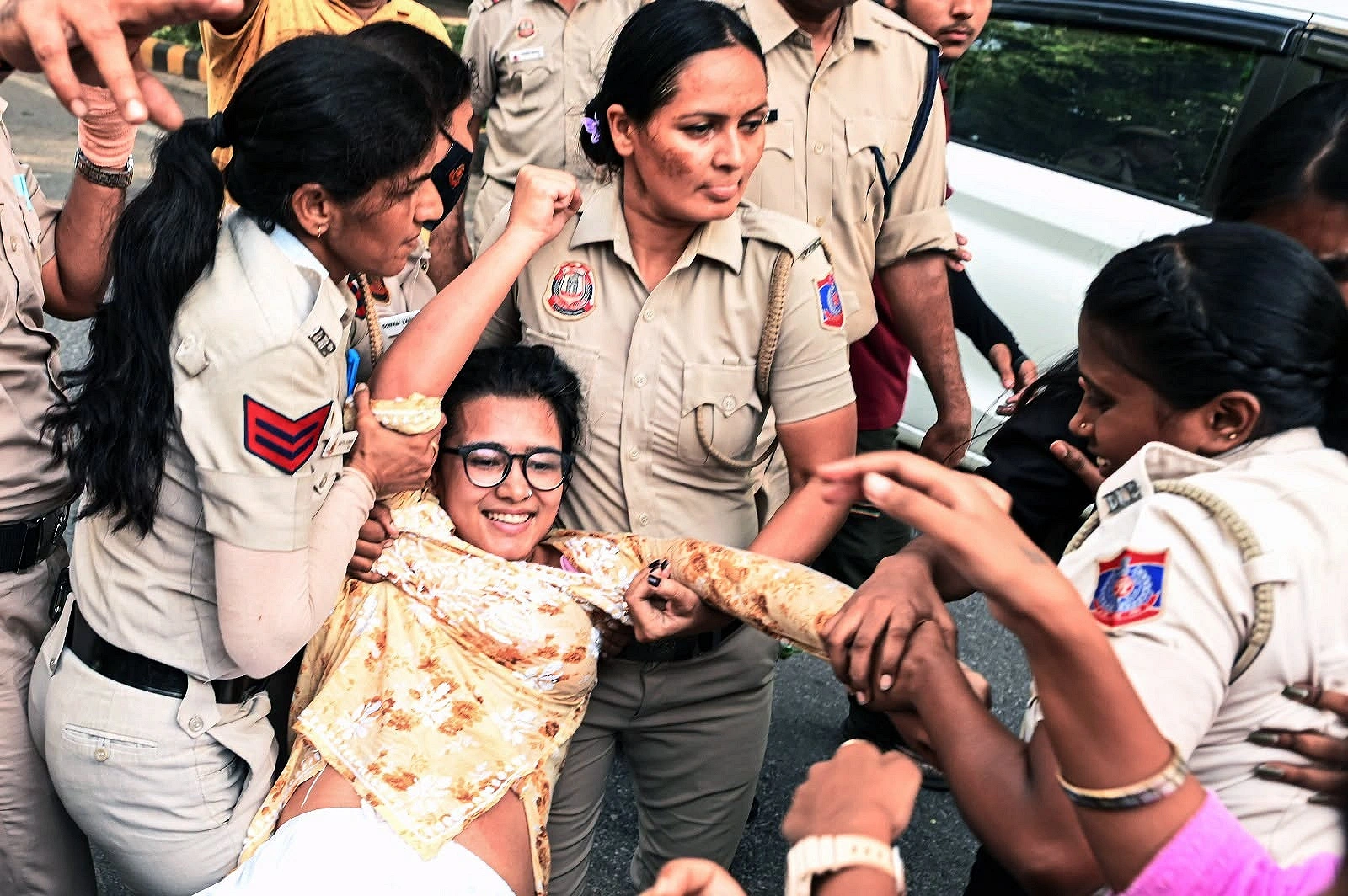
Police detained Neha from the protest site in Delhi on October 4 — Times of India.
Her 23-day hunger strike launched her into the national spotlight; her alliance with the Cockroach Janata Party expanded her reach into non-traditional activist spaces; and her firm positions on Umar Khalid, the "Azadi" slogan, and JNU's political legacy have kept her at the heart of national debate.
Now, Neha is back on the streets of New Delhi alongside her supporters, leading protests demanding the resignation of Chief Election Commissioner Gyanesh Kumar. The movement follows allegations from opposition parties attributing severe irregularities in the ongoing SIR process to his leadership, which critics argue has disenfranchised millions of voters.
Sources: BBC Bangla, Brut India, Biography Insight, The Hindu
