
Hundreds of children stranded in Ceuta, begging on streets for food and water

Collected Photo
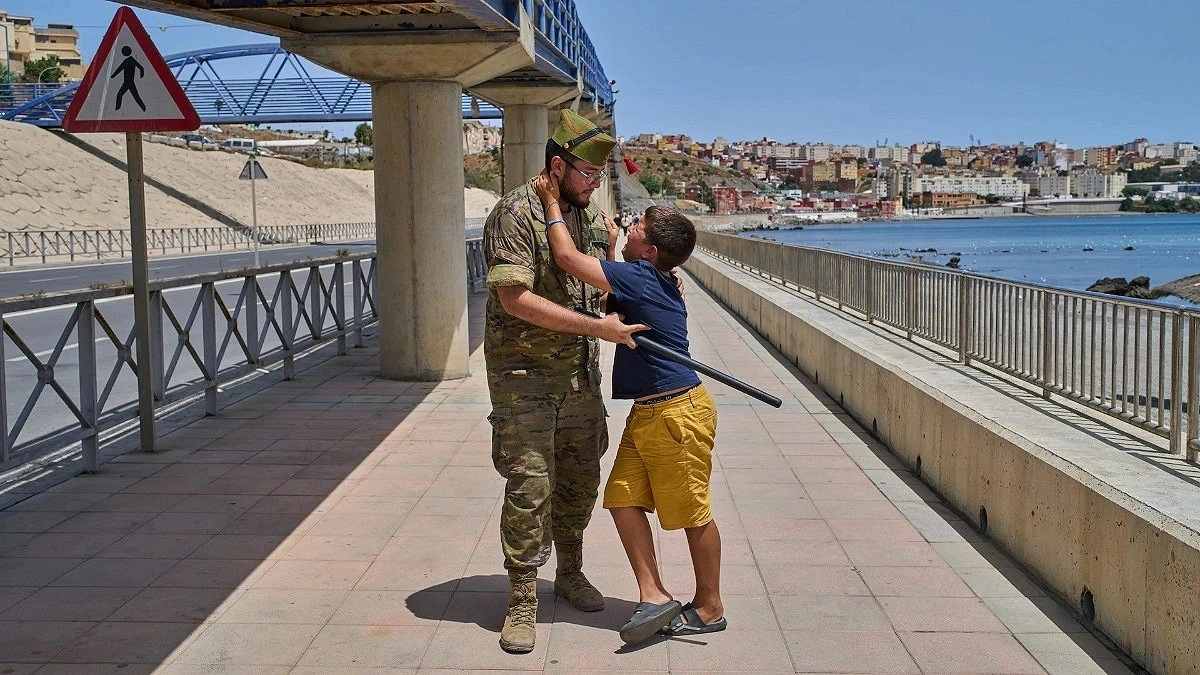
Hundreds of migrant children are still spending their days on the streets after thousands of people entered Spain’s autonomous territory of Ceuta from Morocco last week. Local officials said around 860 children remain stranded in the Spanish enclave. Many of them are begging on the streets for food and water.
Spanish authorities said almost all of the approximately 60,000 migrants who entered Ceuta last Thursday were sent back within 24 hours. However, local authorities said Monday that around 5,000 people were still there.
At least 72 people died while crossing the border. Children were also among those killed.
Under Spanish law, adult migrants can apply for asylum. If their applications are rejected, deportation proceedings begin. However, opportunities for Moroccan citizens to receive humanitarian protection are generally very limited.
On the other hand, Spanish authorities are responsible for protecting and caring for unaccompanied migrant minors.
A 17 year old girl from Tangier told the Associated Press (AP) that her eight year old brother died while trying to swim across the border fence between Ceuta and Morocco.
She also lost her mother amid the chaos. She has been alone for the past four days.
She said some local people gave her food and clothes. A woman took her to her home and allowed her to take a shower. She later went to a government run center for teenagers, but there was no space left.
She said, “I saw people walking over dead bodies. Now we children are begging on the streets.”
An AP journalist saw Spanish soldiers taking a Moroccan child toward the border. The child was crying and pleading not to be sent back to Morocco.
Just a few meters before reaching the border, local residents insisted that the boy was a minor. A lieutenant colonel of the Spanish army then stopped the process of sending him back and handed him over to the Spanish Civil Guard.
The influx of migrants into Ceuta, a city with a population of 84,000, has put the local administration under pressure and also created a political crisis in the European Union.
Spanish Prime Minister Pedro Sanchez’s migration policy has faced strong criticism from leaders of several European Union countries. They will meet Tuesday to discuss the issue.
An open letter signed by leaders from 22 European countries, including Finland and Malta, said a recent court ruling in Spain had “encouraged this attack on our migration and asylum system.”
Ceuta’s migrant center, which has a capacity of 600 people, is completely full. The center is now under lockdown. Staff members are ensuring that people inside cannot pass food or water to migrants waiting outside.
Media reports said there is a severe shortage of food there. Homeless migrants are being forced to spend nights on the streets and use bushes to relieve themselves.
The Times reported that residents of Ceuta have been discouraged from helping migrants in an effort to encourage them to return to Morocco.
Shopkeepers said police had also asked them not to sell food and water to migrants so that they would return quickly.
Spain and Morocco have agreed to urgently implement measures under which those who enter in large numbers illegally will be deported if they do not return voluntarily.
Most adults who came from Morocco have either returned voluntarily or been sent back across the border by Spanish police.
However, a significant number of people remain in Ceuta who fled war torn countries in the Middle East and Africa.
Meanwhile, there have also been reports of tensions and violence between migrants and local residents.
Alongside the police, some self proclaimed patrol groups are also preventing migrants from entering their respective neighborhoods. There have also been allegations that residents are intimidating and chasing migrants.
Mohammad El Pais, 17, from the El Principe area, was shown a video from Friday in which a Ceuta resident could be seen stabbing someone. He said, “Many people were driven out of El Principe. They came here. One of Ceuta’s largest mosques is here. They thought they would find food here.”
Leaders of the Spanish autonomous territory have condemned the incident. They said it reminded them of the events of 2021. At that time, amid diplomatic tensions between the two countries, Morocco allowed around 10,000 people to cross the border over two days.
Morocco has been accused of deliberately creating the border situation to put diplomatic pressure on Spain.
However, Spanish intelligence agencies concluded Monday that Morocco did not plan the mass border crossing, but allowed it to happen.
Longtime conservative leader Juan Jesus Vivas said, “It is terrible. There are 88 bodies in the morgue. There are more bodies on the other side of the border.”
He told El Pais, “People are not seeing this only as a migration crisis. It is essentially an attack, a violation of Spain’s territorial integrity. People felt that even if it was not planned, Morocco had at least encouraged it or allowed it to happen.”
Source: The Telegraph (Adapted)
