
The CJP protest proved that Gandhi still lives

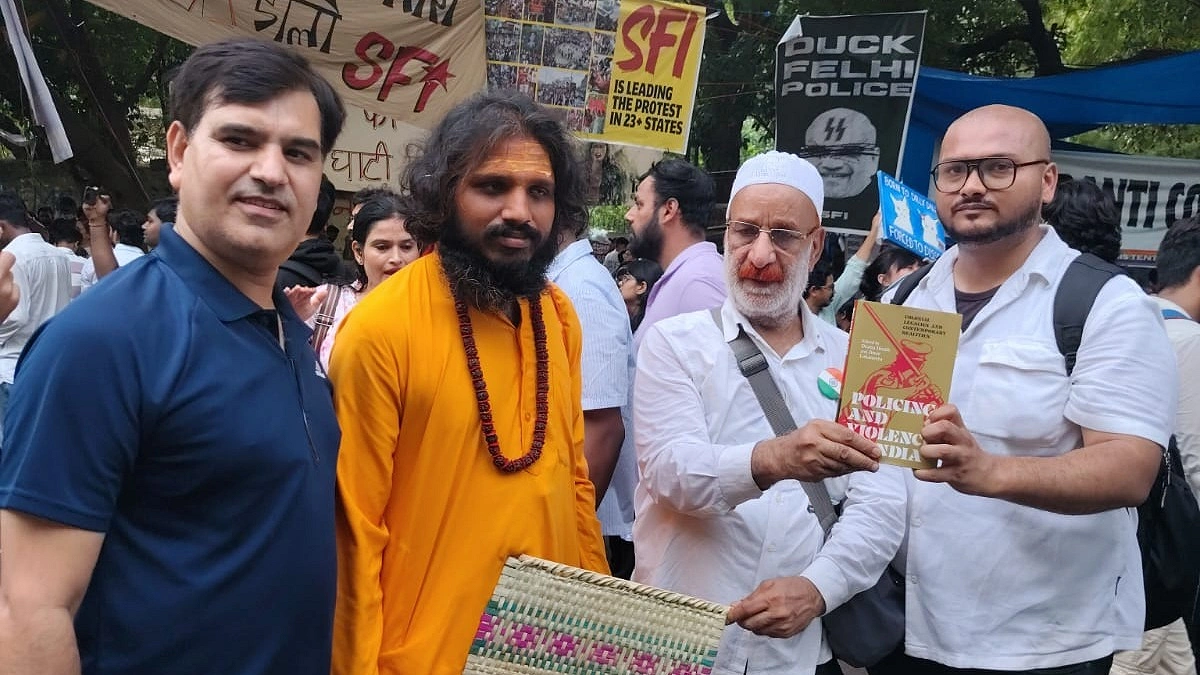
Collected Photo
The Cockroach Janata Party's protest came to an end with the resignation of India's education minister. Reflecting on the movement and its significance, Advocate Sunny Jahdav, a lawyer at the Supreme Court of India, writes for the readers of Agamir Somoy about his experience of the protest.
For years, many have argued that Mahatma Gandhi's philosophy has become irrelevant in contemporary India. Critics claim that his ideals of non-violence, secularism, truth and compassion have been eclipsed by divisive politics and deepening polarization. The Cockroach Janta Party (CJP) protest, however, challenged that assumption. It demonstrated that Gandhi's values are not confined to history books, museums or memorials. They continue to shape the actions of ordinary Indians,especially young people,often without them consciously recognizing it.
One of the most striking aspects of the movement was the role of women. During the freedom struggle, Gandhi encouraged women to leave their homes and participate in public life through Prabhat Pheris , satyagrahas and peaceful demonstrations. They became the moral backbone of India's independence movement. At the CJP protests, history seemed to echo itself. Thousands of women did not merely participate—they led. They raised slogans, formed human chains and stood before police barricades to shield fellow protesters through peaceful means. Their courage recalled the women who stood beside Gandhi during the struggle for independence.
The movement also revived one of Gandhi's most powerful methods of resistance: fasting. Sonam Wangchuk's hunger strike became its moral centre. Equally remarkable was that students from organisations such as the Students' Federation of India (SFI) and the All India Students' Federation (AISF), despite their predominantly Left-oriented ideological traditions, embraced fasting rather than confrontation. Historically, many revolutionary movements have viewed armed struggle as the path to political change. Yet these students consciously chose satyagraha, demonstrating that moral courage can sometimes be more powerful than physical force. Watching them, I found myself asking once again: Why does Gandhi still matter? The answer was unfolding before my eyes.
Many intellectuals have argued that Gandhian secularism has steadily lost ground in recent years, replaced by politics built on religious and social divisions. The CJP movement told a different story. People from different religions, castes, languages and regions stood together with remarkable solidarity. This was secularism not merely as tolerance, but as mutual respect and shared humanity. It reminded us that India's greatest strength lies in its diversity, and that diversity flourishes only when accompanied by compassion.
Young people were unquestionably the driving force behind the protests. They raised the revolutionary slogan Inquilab Zindabad , yet their revolution was profoundly Gandhian. They answered hatred with empathy and confrontation with restraint. Under Delhi's scorching summer heat, students distributed water bottles, shared handheld fans and ensured that strangers remained hydrated. Friends became caregivers, strangers became companions, and the protest evolved into a living demonstration of compassion in action.
The events of July 20 on Sansad Marg reflected this spirit most clearly. Although there were disturbing reports of police violence against peaceful demonstrators, the overwhelming response from protesters remained disciplined and non-violent. Participants constantly reminded one another that theirs was a peaceful movement. Some offered flowers to police personnel who had lathi-charged them. Others handed drinking water to paramilitary personnel who had fired tear gas only hours earlier. Their message was unmistakable: love instead of hatred, peaceful resistance instead of retaliation, and humanity above hostility.
Witnessing these scenes prompted a deeper question. Where did such instinctive compassion come from?
I believe the answer lies in the Gandhian ethos that has become deeply embedded within Indian society. Gandhi's philosophy survives not because every Indian has read Hind Swaraj , but because many of his values have become part of India's collective moral consciousness. This, perhaps, is what it truly means to become Gandhi.
Generation Z formed the backbone of this movement. I often wonder how many of them have actually studied Gandhi's writings. Perhaps very few. Yet long before these protests, I often argued that India is different. Because it continues to carry Gandhi's moral inheritance. The CJP movement strengthened that belief.
For years, political campaigns and social media narratives have attempted to portray Gandhi as outdated or even responsible for many of India's problems. Those narratives have undoubtedly influenced sections of the younger generation. Yet the protests revealed something stronger than propaganda. Gandhi's ideals proved remarkably resilient. As the popular saying goes, "Gandhi kabhi nahin marte" —Gandhi never dies. His physical life belongs to history, but his principles continue to find expression through ordinary citizens.
The creativity of young protesters further illustrated this continuity. Rather than quoting Gandhi directly, they translated his message into the language of their generation through reels, memes, posters and digital campaigns. One viral slogan declared, "Let's bring back Season 1 Player." The "player" was none other than Mahatma Gandhi—a humorous yet surprisingly profound acknowledgment that India once again needed the politics of truth, non-violence and moral courage.
If one element seemed absent, it was the music most closely associated with Gandhi's philosophy. Faiz Ahmed Faiz's Hum Dekhenge became an anthem during the demonstrations, and deservedly so. Yet India also possesses a song that beautifully captures Gandhian secularism and national unity: "Ishwar Allah Tero Naam, Sabko Sanmati De Bhagwan." Few cultural expressions better represent Gandhi's vision of harmony among all faiths.
Despite continuing for more than a month, the movement never appeared to lose its moral energy. Protesters experienced exhaustion, uncertainty and repeated challenges, yet their Atmabal, their inner strength, remained intact. Gandhi repeatedly argued that genuine courage arises from moral conviction rather than physical strength. The protesters embodied precisely that principle.
Volunteers also demonstrated another essential Gandhian ideal: Swavalamban , or self-reliance. Every day they cleaned the protest site, collected waste, organised medical camps and ensured that public spaces remained functional. Doctors and volunteers from across India donated medicines and offered free healthcare. Their quiet service recalled Kasturba Gandhi's often-overlooked work caring for injured satyagrahis during the freedom movement. Food was distributed generously but never wasted. Service became an expression of dignity rather than charity.
Cleanliness was treated with equal seriousness. Volunteers maintained toilets and sanitation facilities with dedication, recalling Gandhi's insistence at Tolstoy Farm and Sabarmati Ashram that sanitation was a moral responsibility, not merely a civic duty. For weeks, the protest site functioned almost like a modern Gandhian ashram—bringing together people from diverse backgrounds who lived, served and struggled collectively.
Ultimately, the CJP movement represented far more than political resistance. It demonstrated that Gandhian values remain deeply rooted in India's social and cultural consciousness. Whether people consciously identify as Gandhians or not, they invoke his philosophy whenever they choose compassion over hatred, dialogue over violence, unity over division and service over self-interest.
Reasonable people may disagree with Gandhi's political ideas, question his methods or debate his historical legacy. Such debates are both legitimate and essential in a democracy. Yet the moral foundations of his philosophy—truth, non-violence, secularism, compassion, self-reliance and public service—remain deeply woven into India's national character. In moments of crisis, they continue to inspire successive generations, often in unexpected ways.
The CJP protest reminded us that Gandhi's greatest legacy was never his statues, anniversaries or place in school textbooks. His legacy survives wherever ordinary people choose humanity over hatred. That is why, despite repeated attempts to diminish or erase him, Gandhi continues to return—not as a single leader, but through the collective conscience of the Indian people.
In that sense, Gandhi never truly left India. He simply waits for moments like these, when a nation once again chooses to become Gandhi.
