


China property crisis deepens despite Hui Ka Yan sentence

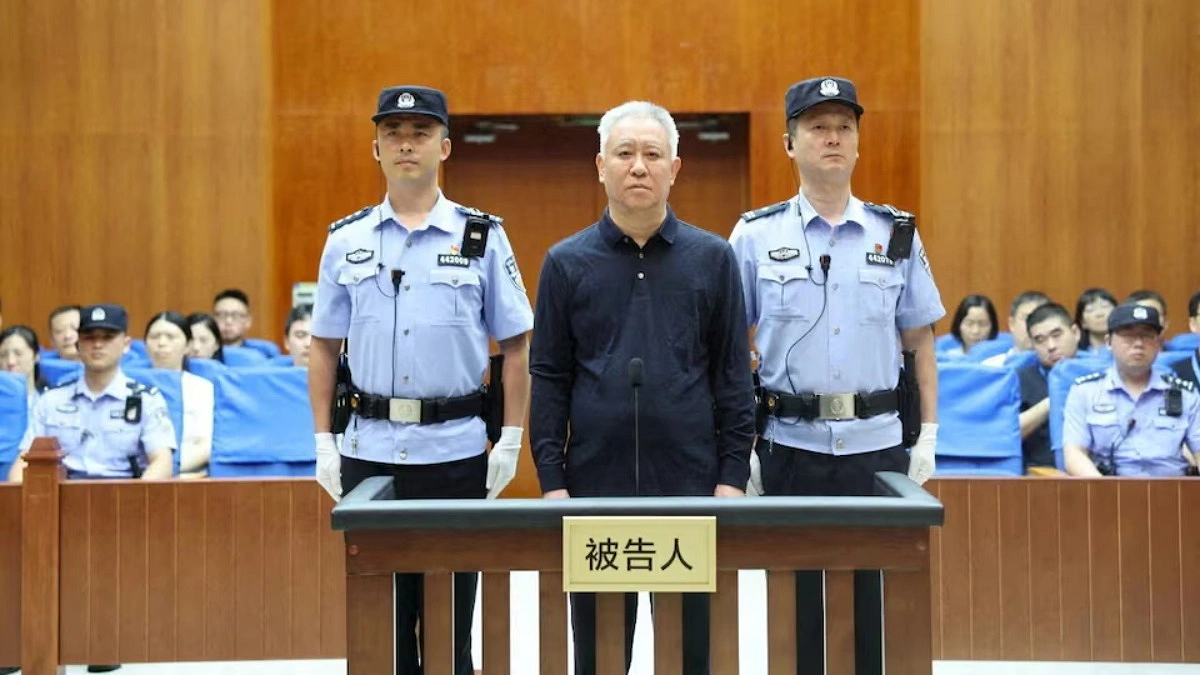
Photo: REUTERS
A Chinese court handed a life sentence last week to the former billionaire who once epitomized the dramatic rise and fall of the nation’s housing market.
Yet, this punishment has done little to ease the country’s grinding property crisis, which is now entering its sixth year. The prolonged collapse continues to drag down the world’s second-largest economy, squeeze millions of households, spark trade friction, and force an export-heavy growth strategy.
Industry analysts see no immediate end to this financial ordeal. On Chinese social media, outraged homeowners and creditors initially posted uncensored questions demanding why the court did not sentence Hui Ka Yan, the founder of China Evergrande and formerly the wealthiest person in Asia, to death following his conviction on charges ranging from bribery to the misappropriation of funds.
The economic pain persists six years after Chinese financial regulators launched a crackdown on the highly leveraged real estate sector. Today, millions of unfinished apartments stand abandoned throughout China, while a recovery in new-home prices has completely stalled in major hubs like Beijing and Shanghai.
At the same time, land sales continue their downward spiral, and declines in both construction and property sales are gathering pace. In smaller, inland cities, second-hand residential prices have plunged by nearly 25 percent compared to 2020 levels, a drop that heavily restricts consumer spending.
This housing slump has severely impacted the broader economy, which grew by just 4.3 percent during the second quarter of this year compared to the same period last year - marking the slowest growth rate in over three years. Because the domestic housing market no longer drives internal demand, China is turning to exports to fuel its growth.
This shift has more than doubled China’s trade surplus since 2019, triggering intense trade disputes with the United States and the European Union. It has also raised widespread fears of a “China Shock 2.0” as Chinese exports begin to push out local manufacturers in partner nations, including those in the Global South.
Resolving this crisis presents massive challenges. Sam Radwan, the chief executive officer of the Chicago-based real estate consulting firm Enhance International, said, “The problem is systemic, and there’s not much you can do about it. You have more homes than households - second homes were used as an investment by over a third of the population.”
Evergrande defaulted on its debts in 2021 and entered liquidation in 2024. Its chief competitor, Country Garden, defaulted in 2023 and has completely halted land acquisitions.
Meanwhile, China Vanke is trying to delay some of its bond payments and has replaced a large portion of its senior management with executives from state-owned enterprises.
President Xi Jinping has attempted to steer state support and bank loans away from real estate toward high-tech strategic fields like semiconductors and robotics. However, analysts point out that these new sectors are still too small to balance out the massive drag of the real estate downturn.
Max Zenglein, a senior economist at the Conference Board Asia, said, “Growth and the benefits of growth are much more narrowly distributed throughout the economy. That’s a key reason why consumption isn’t picking up.”
As a result of widespread defaults among private real estate firms, state-owned enterprises now control the housing market. Observers expect the government to tighten its grip and increase state supervision over the sector.
An employee at a prominent state-owned bank described the lending landscape, “The main consideration is who is behind it - whether it is a central or local state-owned enterprise. In practice, banks have largely stopped lending to private developers for a long time.”
Radwan calculates that developers will need at least 18 months to sell off their current housing inventory. He estimates that home prices must fall another 40 percent from 2025 levels to stabilize the market, a painful transition that could drag on for another decade.
He added, “Chinese citizens are very smart people. They know well enough that they’re nowhere near the bottom but they can’t see the bottom.”
Other experts suggest the worst of the decline may have passed. Christopher Beddor, the deputy China research director at Gavekal Dragonomics, noted, “We don’t expect a substantial worsening from here. But the most likely path is a continued grinding correction in prices that eventually clears the market and paves the way for some improvement.”
Meanwhile, the news of Hui’s life sentence triggered a wave of angry posts across Chinese social media. On Thursday, a hashtag about the court ruling drew more than 370 million views and generated over 72,000 discussions on Weibo, China’s equivalent of X.
For many citizens, the crisis has hit close to home. Jason Wang, a 38-year-old homeowner, lamented, “The pain is unbearable.” He bought an apartment in 2019 in Shandong province, one of the areas worst affected by the collapse, and has watched its market value drop by 25 percent.
He asked, “When people can barely feed themselves, who can afford to buy a house?”
Source: Reuters (adapted)

