


Indiana town struggles 12 days after devastating storm

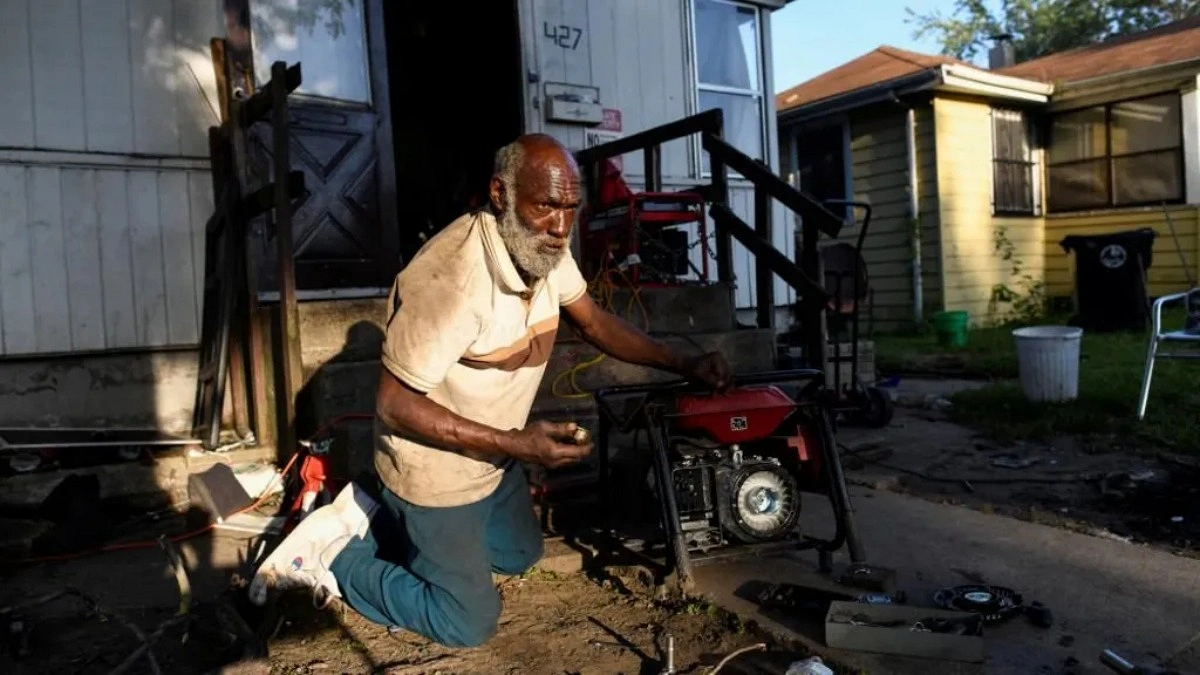
Photo: REUTERS
Nearly two weeks after a destructive storm battered her Indiana town, Terry Dubois, 77, remains among tens of thousands of residents struggling without electricity.
Dubois depends on friends who supply her with non-perishable food. Her son provided a power bank so she can charge her phone and maintain contact with others. Fortunately, mild summer temperatures have spared her from extreme heat, meaning she does not sorely miss her air conditioning.
Recalling the event, Dubois said, “I’ve never seen a storm like that in my entire life. Never, never. It was like a sheer wall of wind.”
On 11 August, sudden and violent storms unleashed floods and spawned tornadoes across the US Midwest, claiming seven lives in Chicago and Indiana. The storm severely battered the former industrial town of Gary, which sits on the southern shore of Lake Michigan. The National Weather Service reported that wind gusts there reached a peak of 99 mph (159 km/h).
Although the worst part of the storm lasted a mere five to ten minutes, severe disruptions persist 12 days later. The regional electricity provider, Northern Indiana Public Service Company (Nipsco), has restored power to more than 345,000 customers since the tempest.
However, the utility reported that around 30,000 customers still lacked electricity as of Sunday morning. During the initial days following the storm, local supermarkets, gas stations, and pharmacies operated without electricity, forcing residents to rely solely on their existing supplies.
As the blackout stretched into its second week, the international food charity World Central Kitchen stepped in to distribute meals to those lacking food access.
While brief power outages occur regularly in this region of the country, blackouts lasting over a week remain highly unusual. The crisis has deeply affected Gary, a former industrial hub that once housed the world’s largest steel mill.
According to US Census data, one-third of the town’s roughly 70,000 residents live in poverty. Besides repairing storm-damaged properties, locals struggle to obtain food and maintain basic hygiene. Reports indicate that some residents cannot refrigerate essential medications, and one wheelchair user had to crawl down stairs because the building elevators remained inoperable.
Kyle Allen, a resident of Gary, said the lack of streetlights leaves local roads “pitch black” at night. Allen has experienced shorter power failures in the past, but this outage presents a greater challenge because he now cares for his 95-year-old father. To cope with the situation, he purchased a generator to support his father and himself since the initial blackout.
Another resident, Shatiya Hardin, described the ongoing ordeal as “absolutely horrible”. She added, “At night we’re sweating, we’re irritable, we have children to look out for, elderly people who need electricity for oxygen tanks.” She stressed, “It’s not OK for us to continually be in survival mode.”
As anger intensifies, residents have initiated a class-action lawsuit accusing Nipsco of failing to properly trim trees, which subsequently crashed into power lines during the storm. In the legal filing, resident Jack Tipold said the power failed while he was undergoing dental surgery.
The blackout forced his dentist to halt the operation, and the clinic sent him home without sufficient pain relief. Tipold told CBS, “I had all my teeth removed and no medication for 48 hours. Let me tell you something, it was a struggle.”
In response, Nipsco denied any negligence and asserted that it would “vigorously” defend its actions in court.
Alarmed by the continuous blackout, local faith leaders organized a press conference on Saturday outside a neighborhood church. Speaking on behalf of the group, a religious leader added, “We come together today with one voice, asking those who have the power... to release the resources to our brothers and our sisters, our mothers and our fathers, because 12 days is long enough.”
Nipsco noted on Sunday that crew members are working to restore electricity to everyone as quickly as possible, projecting that Gary will have its power back by Wednesday. In a public statement, the utility noted, “We recognise how frustrating and difficult it is to be without power for an extended period.”
Indiana Governor Mike Braun criticized the delays on Sunday, declaring that there is “no excuse for these delays”. Governor Braun has urged the Federal Emergency Management Agency (FEMA) to expedite a major disaster declaration, which would release additional federal aid.
As climate change increases the frequency and severity of extreme weather events, experts warn that prolonged electricity blackouts will likely become a more frequent issue. In the meantime, Braun demanded that Nipsco deploy additional teams to restore connections, instructing the company to, “Put every available resource into the field. Get creative.”
Source: BBC (adapted)

