
How capable is Iran of punishing US allies in an ‘economic war’?

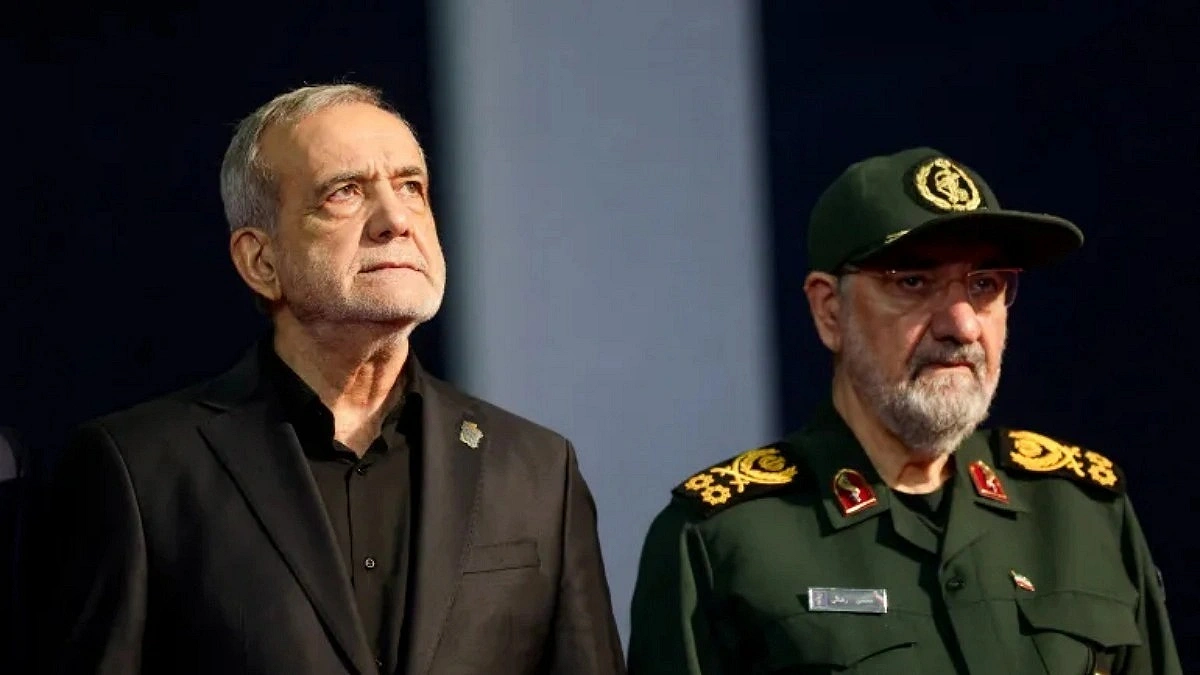
Iranian President Masoud Pezeshkian and Supreme National Security Council Secretary Mohsen Rezaei at the farewell ceremony of Iran’s late Supreme Leader Ayatollah Ali Khamenei. File photo / Reuters
Will Iran’s retaliation also target countries that have joined the US in an economic war?
Iran has warned that it will take retaliatory measures against any country that joins the United States’ “economic war.” Diplomatic efforts to end the war that has continued for several months have stalled. Meanwhile, shipping traffic through the Strait of Hormuz has also declined significantly.
Iran’s top security official Mohsen Rezaei issued the warning on Saturday. At the same time, the United States is preparing to impose new economic sanctions. This could put further pressure on Iran’s already fragile economy.
What Iran has said
Rezaei said Iran would consider any country that joins US economic sanctions against Iran an enemy. He also warned that such countries would face retaliation “like an earthquake.”
Rezaei particularly warned Iran’s neighboring countries. He said if they become part of the US economic war then they will not be allowed to export oil from the Gulf region even through alternative routes that bypass the Strait of Hormuz.
Under normal circumstances, nearly one fifth of the world’s oil and gas exports pass through the Strait of Hormuz. As a result, any new disruption there could have a major impact on global energy markets.
The United States already operates military bases at more than a dozen locations across the Middle East and North Africa. US military facilities are also located in Bahrain, Kuwait, Qatar, Saudi Arabia and the United Arab Emirates. Thousands of US troops are deployed across the region including in Jordan.
How could Iran retaliate?
Rezaei outlined three stages of Iran’s possible response. First, discussions would be held with the country concerned. It would be asked to distance itself from the United States.
If it refuses, he said attacks would be carried out against that country’s interests.
Rezaei also hinted at attacks on alternative export routes outside the Strait of Hormuz. The Bab al Mandab Strait could be important in this regard. It is the gateway to the Red Sea. Saudi Arabia has used this route to export oil after disruptions were created in Hormuz.
Iran has already imposed a blockade on Hormuz. Meanwhile, the United States is conducting a naval blockade of Iranian ports. This is damaging Iran’s international trade.
According to Iran researcher Hamidreza Azizi, Tehran wants to build deterrence in advance to prevent possible attacks. In other words, Iran is sending a message that it could retaliate even if a country prepares to launch an attack.
According to him, two things are clear in Iran’s new strategy. First, it is trying to prevent potential threats before they emerge. Second, if an attack occurs, it wants to increase the cost through a major retaliatory strike.
Will Gulf countries side with the United States?
It is still unclear. The Gulf countries are close allies of the United States. At the same time, they are also neighbors of Iran.
Their economies have been affected by Iranian attacks. They are particularly dependent on the Strait of Hormuz for oil and gas exports.
The United Arab Emirates imposed trade sanctions against Iran last week. The country accused Iran of carrying out missile attacks. Iran has denied the allegation.
Even so, questions remain over whether the Gulf countries will want to become fully involved in a conflict with Iran. Iran is their neighbor. A prolonged conflict would therefore pose major risks to them as well.
Saudi Arabia and Iran normalized relations in 2023 through Chinese mediation. The United Arab Emirates also restored diplomatic relations with Iran in 2022.
According to analysts, Iranian attacks have put these relationships under severe strain. However, they have not completely broken down.
Simon Mabon, a professor at Lancaster University, said the Gulf countries cannot change the geographic reality. They have to remain next to Iran. They do not want instability in Iran that could lead to a prolonged conflict.
Another analyst, Trita Parsi, said confidence in the possibility of ending the crisis through diplomacy is low. However, no country in the region has the capacity to wage another prolonged war.
Global oil reserves are also lower than before. Stockpiles could not be fully replenished during the pauses in the war. As a result, a prolonged war would also pose risks to global energy markets.
Sanctions on Iran are nothing new
US sanctions on Iran have been in place since 1979. The United States imposed its first sanctions after the Islamic Revolution. At the time, the United States halted oil imports from Iran and froze nearly $12 billion in Iranian assets.
In 1995, further sanctions were imposed on trade and investment with Iran in the oil and gas sectors. Later, the United Nations and the European Union also imposed sanctions.
In 2006, the UN Security Council imposed sanctions over Iran’s nuclear program. The sanctions were later tightened further.
In 2015, Iran reached a nuclear agreement with the United States, the European Union, China, Russia, the United Kingdom, France and Germany. Under the agreement, sanctions were to be lifted in exchange for restrictions on Iran’s nuclear program.
However, in 2018, during Trump’s first term, the United States withdrew from the agreement. Sanctions were again imposed on Iran. The Trump administration described the policy as one of “maximum pressure.”
In 2019, the United States designated Iran’s Islamic Revolutionary Guard Corps as a “foreign terrorist organization.” At the same time, sanctions were imposed on various sectors including petrochemicals, steel, aluminum and copper.
In 2020, the United States killed Qassem Soleimani, commander of the Revolutionary Guard’s Quds Force, in a drone strike in Baghdad. More sanctions were imposed afterward.
From 2021 to 2025, the administration of Joe Biden also maintained most US sanctions.
In September last year, UN sanctions related to Iran’s nuclear program also came back into effect.
What could happen next
Iran’s warning is now not aimed only at the United States. Countries seeking to become economically connected with Washington are also being brought within its scope.
This has placed the Gulf countries in the most difficult position. They depend on the United States for security. At the same time, they also have geographic and economic ties with Iran.
Therefore, if these countries fully support US economic sanctions, then the risk of Iranian retaliation will increase. And if Iran attacks Hormuz or alternative oil export routes, the impact could spread beyond the Middle East.
In other words, economic pressure is now a new front in the war. The United States is seeking to pressure Iran through sanctions. Iran wants to use regional trade and energy supplies as tools for creating pressure in retaliation. As a result, if the war continues, the economic conflict could also grow significantly.
Source: Al Jazeera (Adapted)
