
Death toll rises to 68 after two high-speed trains collide in Spain

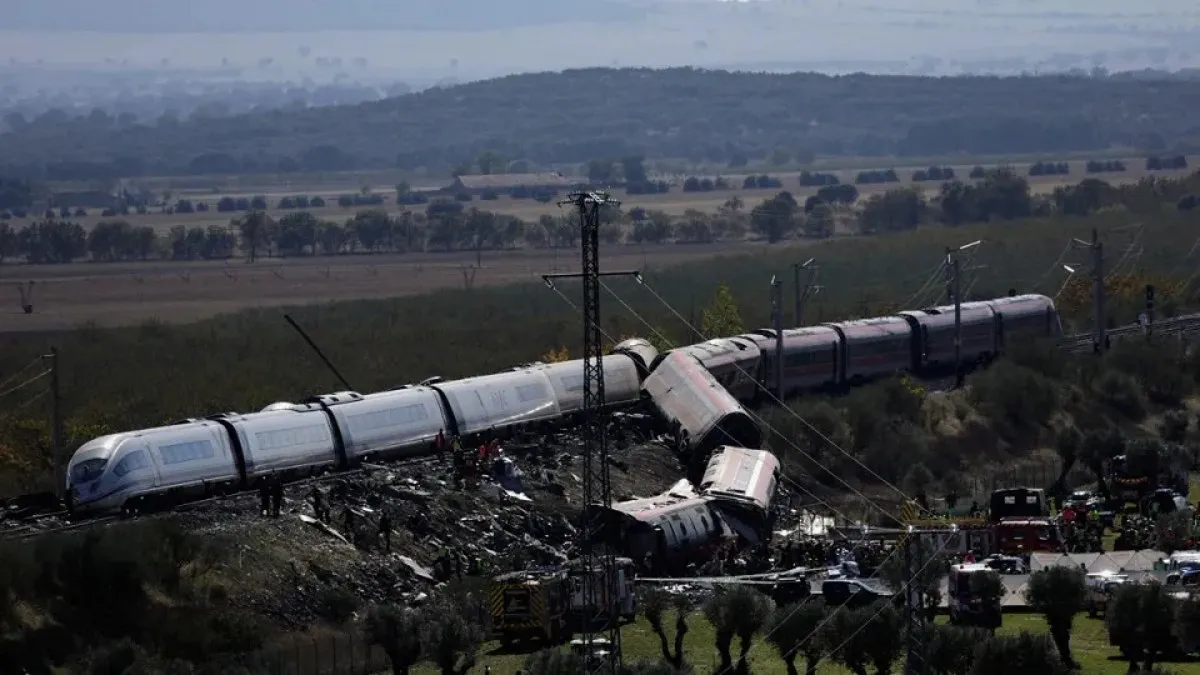
Photo: Reuters.
The death toll from the collision of two high-speed trains in Spain has risen. Authorities have so far reported at least 68 deaths. After the country's second fatal rail accident this year, rescue workers are searching the wreckage for more bodies.
Hundreds of ambulances, body transport vehicles, and helicopters have been stationed beside one of the trains at the accident site. Several carriages of the train remain on the elevated railway. Meanwhile, scattered along the embankment below the track are mangled metal parts, broken panels, and other debris. At least three carriages have derailed and fallen below.
Passengers who had been rescued and moved away were coming out through a road near the accident site. Some had bloodstains on their bodies, while others had wounds bandaged. Others were pulling suitcases. Volunteers were giving them water. Volunteers said the water had been donated from neighboring towns.
Miguel was traveling with several colleagues in a rear carriage of one train. Describing the moment of the accident, he told Cope Radio, "We heard a sound like a massive roar. Then there was such a strong impact that it was felt for nearly 10 seconds. It felt as if the train was about to derail. Through the windows on the right side, we saw a wrecked train."
In a statement one of the trains state-owned operator Renfe said, its train collided with the Iryo train after receiving permission to continue its journey. "We do not know why the Iryo train was stopped," it said.
Renfe said, "As instructed, Renfe's train continued its journey, and at that time the collision occurred. The exact sequence of events, the condition of rail operations, and the cause of the collision must be determined through investigation."
The regional government of Castilla-La Mancha said the death toll had risen to 64 (later 68). Rescue workers are searching every carriage to find out whether any other passengers were killed or injured.
Authorities did not immediately provide the number of injured. However, Health Minister Mónica García, in a post on X, urged people to donate blood. Esther Padilla, spokesperson for the Castilla-La Mancha regional government, said there were 147 passengers on the Iryo train and 397 on the Renfe train.
Spanish Prime Minister Pedro Sánchez is traveling to the accident site in the Urdá area.
The Spanish government said on X that the prime minister will "express support for the work of emergency service personnel and express solidarity with those affected by the accident and their families."
The government also said, "At this moment, the priority is to assist the victims and ensure maximum coordination among the various administrations."
Earlier of this year, 46 people were killed in a high-speed train accident in Adamuz near Córdoba. Before the grief of that accident could subside, Spain has now experienced another loss of lives.
The Adamuz accident also occurred on the same high-speed railway line, but farther south. The death toll from Wednesday's accident near Urdá has now reportedly risen to 64.
Not since July 2013 has Spain seen such a severe rail accident. In July of that year, a high-speed train derailed on a curve on the outskirts of Santiago de Compostela in the country's northwest, killing 80 people.
In that accident, all 13 carriages of the train derailed. Many of them struck concrete barriers. In the latest accident, four carriages derailed. However, this time two trains were involved in a collision. Spain's rail infrastructure, once considered among the best in Europe, will again be closely investigated this time.
Source: Reuters, BBC
