
Why a sudden Trump-Xi-Putin meeting that has never happened before?

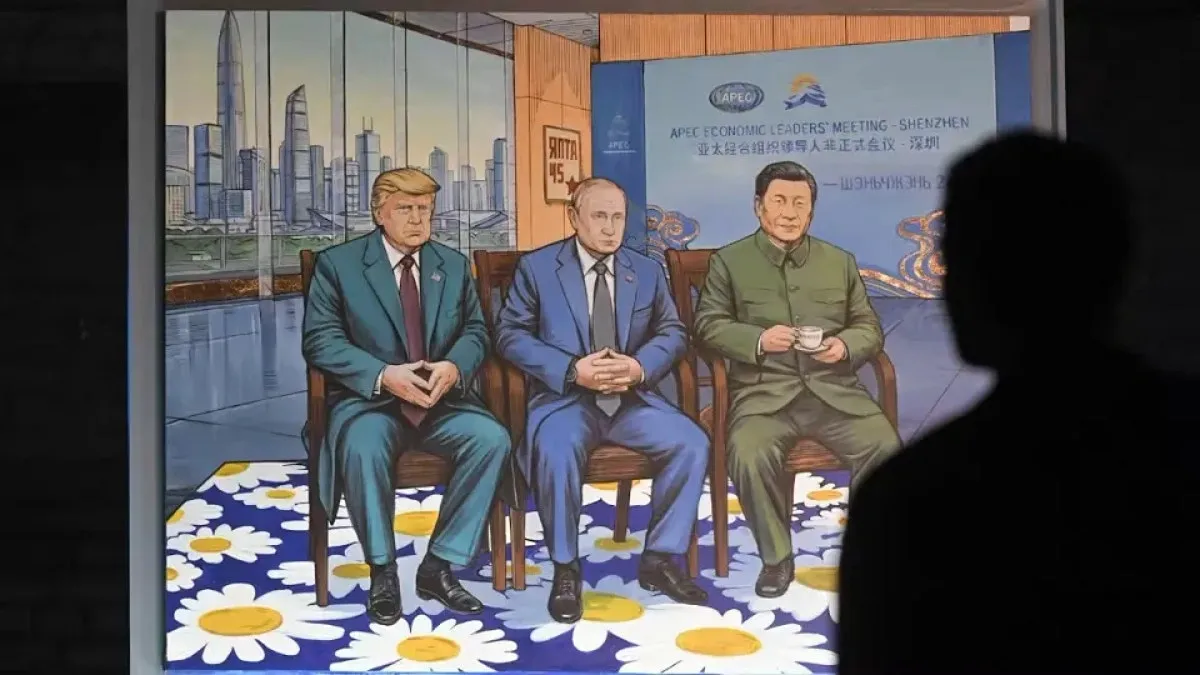
A painting titled ‘Shenzhen 26’ by Russian artist Alexey Sergienko, depicting a meeting between Trump, Putin, and Xi Jinping at the upcoming APEC summit in Shenzhen. Photo: Reuters.
International political discussions have intensified over a possible meeting involving US President Donald Trump, Chinese President Xi Jinping and Russian President Vladimir Putin. The White House announced on Friday that the three leaders could meet on the sidelines of the Asia-Pacific Economic Cooperation (APEC) summit in Shenzhen, China, later this week.
For the first time, the heads of state of the world’s three largest nuclear-armed countries are expected to sit together to discuss preventing the spread of nuclear weapons. Ahead of the proposed trilateral meeting, Trump said it could create an opportunity to reach an agreement concerning the nuclear arsenals of the three countries.
According to a White House spokesperson, President Trump plans to discuss reducing nuclear stockpiles around the world, arguing that the proliferation of nuclear weapons poses a serious threat to global security. The meeting is expected to take place in China next Thursday.
The White House said Trump will begin a four-day tour of Asia on Monday, which will also include the Philippines. However, US officials do not expect any agreement on nuclear weapons to emerge from the discussions.
Meanwhile, a senior Trump administration official said the three leaders would discuss reducing their respective countries’ nuclear arsenals at the upcoming meeting.
According to a report by The Wall Street Journal, Putin was the first to propose such a meeting last month. One of its key objectives was reportedly to discuss an end to the war in Ukraine. However, the White House has said the talks would focus not on Ukraine, but on the war in Iran.
The final arrangements for the meeting have yet to be announced. Nevertheless, the very possibility has created concern across the Western world. Polish Foreign Minister Radoslaw Sikorski has warned against allowing a repeat of the 1945 Yalta Conference.
During the final stages of World War II, Soviet leader Joseph Stalin met US President Franklin Roosevelt and British Prime Minister Winston Churchill at that conference, gaining an opportunity to establish Soviet dominance over Eastern Europe.
US Senator Chris Coons has expressed similar concerns. In his view, if Trump takes a weak position in front of Xi and Putin, it will not create the conditions for meaningful negotiations.
Such concerns are not entirely unfounded. Trump’s past actions have shown that he is interested in developing closer ties with authoritarian leaders. At the same time, he has often been accused of overlooking the interests of democratic allies.
Therefore, protecting the interests of US allies in Europe and Asia will be a major test for Trump if he sits down with Xi and Putin. However, given the differences in the three leaders’ personalities, political objectives and national interests, achieving any major breakthrough could also prove difficult.
Even so, the meeting should take place. No US president has previously held such a trilateral meeting with the leaders of China and Russia. Such a gathering could at least help reduce long-standing diplomatic distance and open the door to much-needed dialogue.
Authoritarian systems will not disappear overnight. Democratic and authoritarian states must therefore learn to coexist. At the same time, they need to work together to reduce global conflicts and address common challenges.
The political systems of China and Russia conflict with the United States’ policy of promoting democracy. Nevertheless, it is important to keep the channels of communication and cooperation open. From that perspective, Trump’s initiative can be described as a bold diplomatic step.
The Goal Should Be Limited Progress, Not a Grand Solution
If the meeting takes place in Shenzhen, Trump, Xi and Putin should keep the scope of their discussions limited. Rather than trying to solve every problem at once, they should give priority to a few important issues.
These include tensions on the Korean Peninsula, the war in Ukraine, the Iran crisis and nuclear arms control.
Even if the meeting does not produce a major agreement, it would not be a complete failure. Instead, it could create a foundation for regular dialogue among the three great powers. Their successors could later build on that path and expand the scope of cooperation.
This could become an informal coordination mechanism among major powers. Its purpose would be to manage geopolitical competition and promote collective initiatives in an increasingly multipolar world. Along with the United States, China and Russia, it could also include India, Japan, the European Union, and representatives from Africa, Latin America, the Middle East and Southeast Asia.
Such an arrangement cannot ensure equal representation for every country. Instead, countries whose exclusion would make it difficult to implement global decisions should be given a place at the negotiating table. Ideological differences should not become a major obstacle. Democratic and authoritarian states alike must work together in areas of common interest.
The greatest advantage of such a framework is that it would not require binding agreements or rigid legal procedures. Decisions could be made through mutual understanding and informal discussions. When institutions such as the United Nations Security Council become ineffective, such an arrangement could play a useful role. It becomes even more important when the United States loses interest in rules-based multilateral systems.
However, the time has not yet come to establish a global framework for coordination among major powers. For such a system to work, member states would need to accept existing geographical borders. They would have to demonstrate strategic restraint, work for mutual interests and resolve disputes through diplomatic means.
But Russia’s invasion of Ukraine in 2022 and China’s support for Moscow have greatly undermined that possibility. On the other hand, Trump’s “America First” policy places greater emphasis on unilateral decisions than on collective initiatives.
In other words, the current three leaders may not be suitable for building such a global framework. Nevertheless, Trump’s unconventional diplomacy is creating a path for the future. He met Putin in Alaska last year and has held two meetings with Xi this year. Those meetings involved more ceremony than tangible achievements.
Even so, the initiative to sit down with the leaders of China and Russia remains important. It could make such diplomatic engagement politically easier for future US presidents. To protect the world from major conflicts, the United States will need to build effective relationships with both China and Russia. Trump therefore deserves credit for initiating this dialogue.
The Role of Three Leaders in Reducing the Heat of War
The first priority for the three leaders at the Shenzhen meeting should be to reduce tensions in major conflict zones. In this regard, the Korean Peninsula could offer the best opportunity. At the United Nations General Assembly last September, South Korean President Lee Jae Myung presented an ambitious plan to normalize relations with North Korea.
One of the key elements of his proposal is to establish a permanent peace arrangement to replace the 1953 armistice agreement. Its foundation would be mutual respect for the political systems of the two countries and acceptance of their differences.
Lee also supports a gradual approach to North Korea’s nuclear disarmament. First, the country’s nuclear weapons development programme would need to be halted. Then, the number of nuclear weapons and ballistic missiles would gradually be reduced. The ultimate goal would be the complete denuclearization of the Korean Peninsula.
The interests of the United States, China and Russia could converge on this proposal. Trump himself is interested in reducing tensions on the Korean Peninsula and has also been seeking a meeting with North Korean leader Kim Jong Un. Meanwhile, although Beijing and Moscow compete to increase their influence over Kim, both want stable relations between the two Koreas.
The three leaders could therefore jointly take steps to halt North Korea’s production of nuclear weapons and advance dialogue between Seoul and Pyongyang. A good beginning would be for the Shenzhen meeting to produce a roadmap for implementing Lee’s peace plan.
Trump Seeks a Way Out of the Iran War
One of Trump’s most important objectives at the Shenzhen meeting could be to bring the war in Iran to an end. The conflict is increasingly pushing the United States into a complicated situation. Instability is growing across the Middle East, while oil prices are also rising in global markets.
Tehran is setting strict and ambitious conditions for ending the war. At the same time, shipping through the Strait of Hormuz and the Bab el-Mandeb Strait is being disrupted. Trump is therefore seeking a way out of the conflict. However, China and Russia have so far shown little willingness to assist him.
China is purchasing Iranian oil and is also providing the country with military intelligence and dual-use technology. Such technology is being used in Iran’s production of drones and missiles.
Russia, meanwhile, is providing Iran with satellite-based targeting information, ammunition, advanced drone technology and logistical support. While Washington remains occupied with the war, both Beijing and Moscow are benefiting politically. Divisions within the United States are deepening, while NATO’s unity is also weakening.
Persuading Russia to stop supporting Iran may prove difficult because Moscow is directly benefiting from rising oil prices. China’s interests, however, are different. As the world’s largest energy importer, Beijing has a strong interest in maintaining normal oil supplies from the Middle East and keeping energy prices low.
China’s large oil reserves have so far provided some protection for its economy, but those reserves have declined significantly. At the same time, the country’s crude oil imports have begun to rise again.
If the war continues for a long time, China’s economy could also come under pressure from high energy prices. As the world’s largest exporter of goods, Beijing would also be harmed by a slowdown in global economic growth.
Xi may therefore be interested in helping bring the Iran war to an end. Trump should urge him to stop, or at least reduce, the supply of Chinese technology to Iran. Washington’s naval blockade and its financial and trade sanctions have already placed pressure on Iran’s economy and military supply system.
If China stops supplying technology, Iran could become even more isolated. That could also make it easier to bring Tehran to the negotiating table. Xi could play another important role by persuading Iran to abandon its unrealistic conditions for ending the war.
Tehran has demanded the withdrawal of all US forces from the Gulf region, the return of seized Iranian assets and the lifting of economic sanctions.
Washington may be willing to offer economic concessions. However, these should form part of post-war negotiations. In return, an effective agreement is needed to control Iran’s nuclear programme. Xi could play an important role in persuading Iran to end the war on realistic terms.
Renewed Talks on Nuclear Arms Control Are Urgently Needed
Alongside efforts to control ongoing wars, steps must also be taken to prevent major conflicts in the future. Nuclear arms control is particularly important in this regard. All arms control agreements between the United States and Russia have expired.
The latest nuclear agreement, New START, also came to an end last February. As a result, there are now no effective limits on the stockpiles of strategic nuclear weapons held by the United States and Russia. There are also no longer arrangements for regular inspections, information exchanges or advance notification of nuclear military exercises.
This is an extremely dangerous situation. Russia’s threats of nuclear attacks during the Ukraine war, along with provocative actions such as sending explosive-laden drones into NATO airspace, have made the situation even more risky.
Last October, Trump rightly proposed that nuclear arms control should be discussed at a meeting of the three leaders. China, however, has long been reluctant to participate in such discussions. Its argument is that China possesses far fewer nuclear weapons than the United States and Russia and therefore should not be subjected to the same obligations to limit its arsenal.
But the situation is changing rapidly. China is expanding and modernising its nuclear arsenal. According to Pentagon projections, the number of China’s operational nuclear warheads could exceed 1,000 by 2030. By comparison, the United States and Russia each possess around 1,800 operational warheads.
In other words, China is also rapidly becoming a major player in the nuclear arms competition. Uncertainty in US-China relations, tensions on the Korean Peninsula and disputes over Taiwan are collectively increasing the risk of conflict in East Asia.
Under these circumstances, China’s participation in discussions on nuclear arms control is essential. In reality, Trump is unlikely to secure a major agreement immediately. However, he can begin the process of dialogue. He could invite Xi and Putin to take part in regular trilateral discussions in the future, led by diplomats and arms control experts.
Future talks should not focus solely on limiting the number of nuclear weapons. They should also include military communication, crisis-management protocols, advance notification of military exercises and measures to prevent the proliferation of nuclear weapons. Such initiatives could help restore strategic stability among the major powers.
It Is Still Too Early to Give Putin Normal Recognition
Trump must also carefully manage the diplomatic optics and messaging surrounding the meeting. Putin is still waging an aggressive war against Ukraine. The time has not yet come to grant such a leader normal international legitimacy.
At the same time, there is a need to build an effective relationship with China. But it is now time for Trump’s claimed “extraordinary friendship” with Xi to produce tangible results.
Therefore, Trump should place greater emphasis on reality and strategic interests rather than emotion during the discussions. He must demonstrate that Washington, Beijing and Moscow can work together for global peace and stability despite their ideological differences.
A possible meeting among the three leaders in Shenzhen will not create a new era of cooperation among the major powers overnight. The meeting could even end without any specific agreement or tangible achievement.
In such circumstances, there is no alternative to dialogue that rises above ideological differences. If Trump, Xi and Putin sit at the same table, that itself would mark the beginning of a necessary new diplomatic journey.
(Translated from Foreign Affairs. Written by Charles Kupchan, Professor of International Relations at Georgetown University and Senior Fellow at the Council on Foreign Relations.)
