
From Other Media
Five Reasons for Trinamool Congress's Electoral Disaster in West Bengal

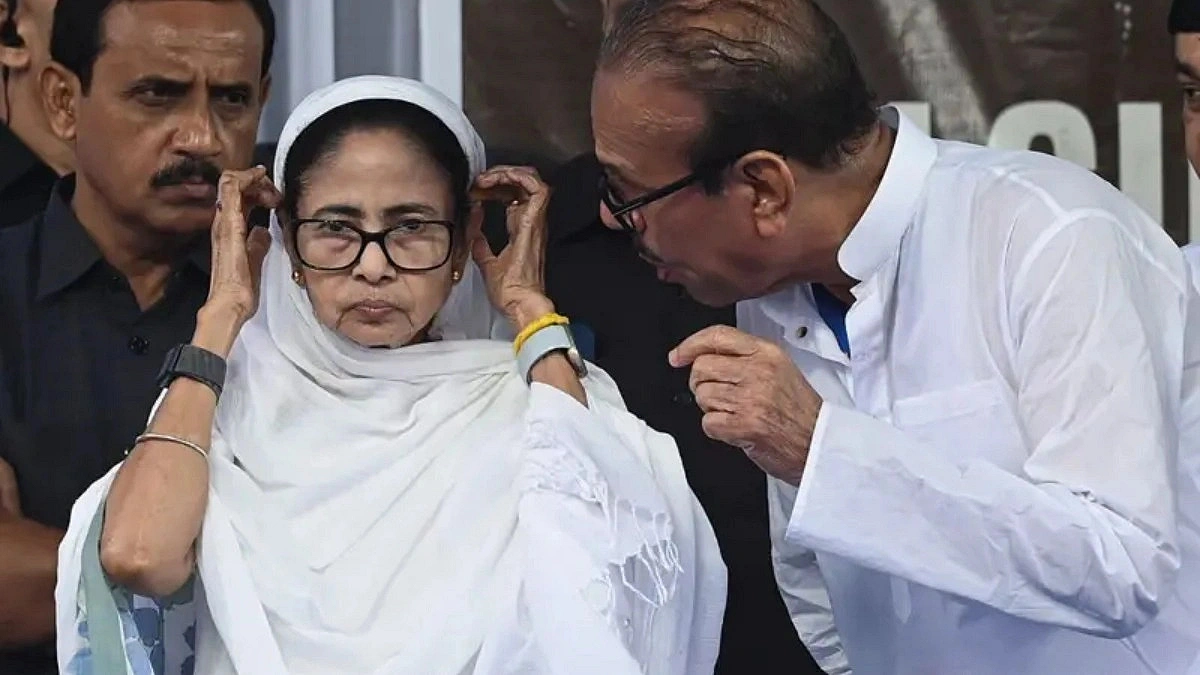
Collected Photo
Although the results have been published following the conclusion of the vote counting in the recently held West Bengal elections, the current Chief Minister and Trinamool Congress leader Mamata Banerjee has not yet officially conceded defeat. Instead, she has alleged that the BJP "looted" at least one hundred seats from them with the assistance of the Election Commission.
Mamata Banerjee and Abhishek Banerjee are scheduled to hold a press conference at Kalighat in Kolkata today, Tuesday (May 5th), at 4:00 PM. Party sources suggest they will provide a detailed explanation of how the Trinamool Congress was "made to lose," reports BBC Bangla.
Clearly, Trinamool is not yet ready to accept that they were defeated by the public's mandate. Instead, they argue that an election where millions of people were removed from the voter list can never be considered fair and free. However, that does not change the reality that the BJP is set to come to power for the first time with a more than two-thirds majority in the state.
Regardless of the arguments provided by the party leadership, what could be the reasons behind this electoral disaster for the Trinamool Congress after being in power continuously for 15 years?
Based on the results received until late Monday night (May 4th) and an analysis of the comparative performance of Trinamool and the BJP across various regions of the state, BBC Bangla has identified the five main reasons, which are detailed below.
Collapse of the Women’s Vote Bank?
There is no doubt that the majority of the female vote in West Bengal (which is over 50 percent) had belonged to Mamata Banerjee's party for a long time. Direct benefit projects like ‘Lakshmir Bhandar,’ ‘Kanyashree,’ or ‘Sabuj Sathi’ (distribution of bicycles among female students) had made the Trinamool Congress government popular among women voters. However, this time, an inevitable crack appeared in that vote bank—a major reason for which could be the Trinamool Congress's total failure on issues such as women's safety.
Two years ago, a doctor on duty at a government hospital in Kolkata was raped and killed. The 'RG Kar movement,' organized to demand justice for 'Abhaya,' certainly had an impact on this election. A major proof of this is that the mother of the RG Kar victim, running as a BJP candidate, won by a massive margin even in a Trinamool stronghold like Panihati.
The Impact of SIR Losses
It is now as clear as daylight that the Trinamool Congress has been the primary victim of the Special Intensive Revision (SIR) of the voter list, which resulted in the removal of over 9 million names in West Bengal.
While an analysis of seat-based results will reveal the full scale and extent of this loss, it is already evident that the BJP has been the overall beneficiary of this process.
It is true that millions of valid voters were excluded from the list, but there is no doubt that many fake or deceased voters were also removed.
The BJP had consistently claimed that the Trinamool Congress had benefited from these fake names for years, and that this practice would now come to an end. It appears that their claim has been largely proven true.
Corruption and Failures of the Mamata Banerjee Government
It is doubtful whether any other era in West Bengal has seen as many allegations of corruption, misrule, the prevalence of "cut-money" and "syndicate raj" in daily life, and administrative failure as the Trinamool Congress’s 15-year rule.
Furthermore, over these 15 years, the Mamata Banerjee government has shown extreme failure in creating new jobs or employment opportunities for the youth. Even the introduction of a monthly allowance of Rs 1,500 for the unemployed just before the election failed to soothe that frustration.
However, using tools like Bengali pride, various social welfare projects for women, and secularism, the Trinamool Congress had no trouble crossing the electoral hurdle in 2016 or 2021.
This time, too, Mamata Banerjee tried to use the immense suffering of millions of valid voters caused by the SIR as a political campaign tool. She spared no effort, including personally pleading the case in the Supreme Court.
In the end, it was revealed that these efforts were not enough to mask the allegations of corruption and failure—and in 2026, the Trinamool Congress had to pay a heavy price.
Hindu-Muslim Polarization?
Many political observers have long argued that a major reason behind Mamata Banerjee's continuous electoral success was the near-exclusive support she received from the state's Muslim population.
Muslims make up roughly 30% of West Bengal's population, and historically, 85% to 90% of their votes consistently went to the Trinamool Congress.
However, it is believed that a counter-consolidation of Hindu votes took place this time, from which the BJP clearly benefited. This is why they secured several seats even in Muslim-majority districts like Malda or Murshidabad.
On the other hand, in an attempt to dismiss the allegations of "Muslim appeasement" against her, Mamata Banerjee recently established several Hindu temples using government funds.
But it is clear that this "Soft Hindutva" did not work; instead, the majority of the state's Hindus chose the "Hindutva-aligned" BJP.
Not Getting the Advantages of Being the Ruling Party
In the political reality of West Bengal, the state's ruling party typically receives certain extra advantages during elections—which the Trinamool Congress virtually did not receive this time.
From the moment the election schedule was announced, the National Election Commission took the reins out of the hands of the state administration, implementing widespread transfers of District Magistrates and Superintendents of Police.
Additionally, more than 240,000 personnel from the central security forces were deployed in the state well before the voting began—a number that was unprecedented.
Many believe that it was due to the presence of this massive security force that the election was so peaceful and that people were able to vote so confidently and without disturbance.
The Trinamool Congress has spent the last month and a half making continuous allegations against the Commission and the central forces—the reason for which can perhaps now be guessed.
In other words, the roles of the Election Commission and the central forces also worked against the Trinamool Congress.
