

Trump bans Chinese humanoid robots over security fears

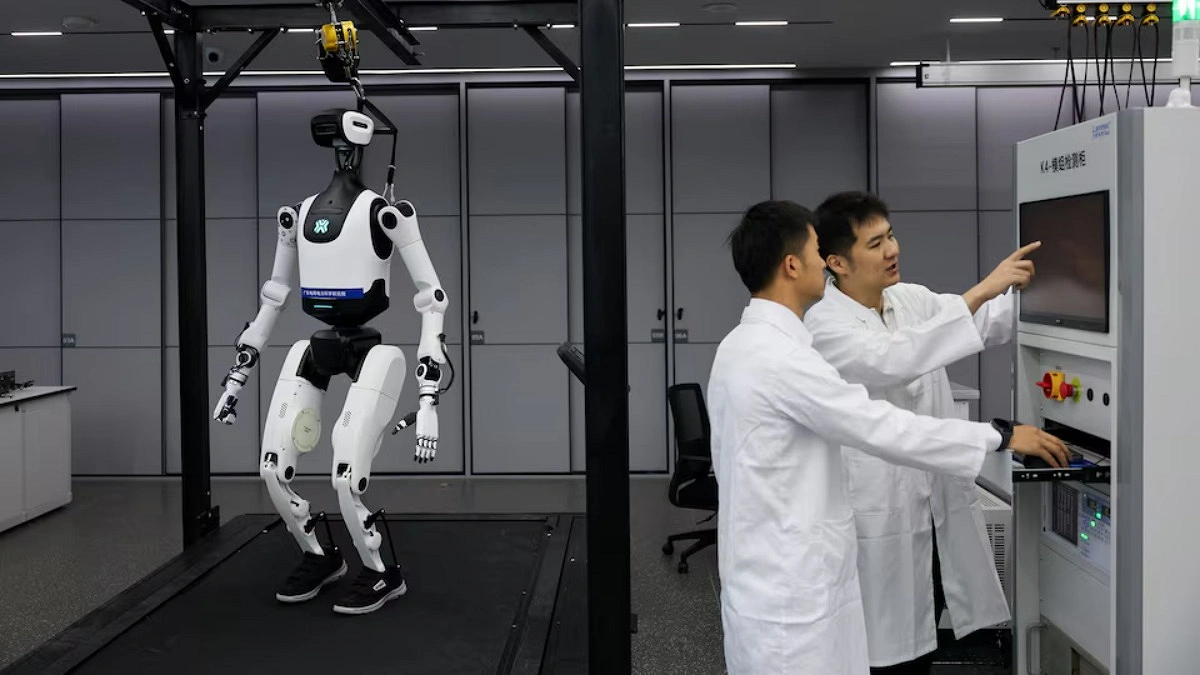
Photo: REUTERS
Trump administration banned the import of new Chinese-manufactured humanoid robots and power inverters on Tuesday.
The move by the Federal Communications Commission (FCC) seeks to defend the United States artificial intelligence infrastructure from national security risks while reclaiming industries poised for massive growth.
Specifically, the new measures block the entry of humanoid and quadruped robots, along with connected power inverters that bridge renewable energy and battery systems to data centers and the national power grid.
The administration aims to insulate the American AI supply chain from the threats of data theft, cyberattacks, and operational disruptions.
Regarding the necessity of these protections, FCC released a statement saying, “These devices could create supply chain vulnerabilities that could disrupt US economic and national security and could create a cybersecurity risk that threatened American critical infrastructure.”
FCC Chairman Brendan Carr reinforced this stance in a press release, adding, “The FCC will continue to do our part to secure America’s critical supply chains.”
In response, the Chinese embassy in Washington issued a call for the US to “heed the objective and rational voices of the business communities in both countries” and to “stop smearing Chinese companies and threatening them with sanctions.”
Beijing warned that it will “take all necessary measures in response to any action that causes material harm to its interests.”
Market analysts predicted that humanoid robots equipped with AI-driven “brains” will soon see widespread adoption in both industrial and consumer markets.
Treasury Secretary Scott Bessent has signaled that the US may also impose sanctions on Chinese AI firms found guilty of stealing American intellectual property.
Officials remain determined to avoid a repeat of the rare earth minerals scenario, where China used its market dominance to gain international leverage.
While the current restrictions are firm, the FCC is expected to grant exemptions to many non-Chinese suppliers, similar to previous actions regarding foreign drones and routers.
Although the measures took effect immediately upon publication, they apply only to robot and inverter models that have not yet been released to the public. However, the FCC maintains the authority to cancel the sales authorization of any models that are already permitted for purchase within the country.
Trump has long emphasized the technological threat from China, previously highlighting concerns over state-sponsored espionage by telecom giants such as Huawei.
Despite a more cautious approach recently due to Beijing's export controls on rare minerals, this new ban places companies like Unitree - a global leader in humanoid robotics with nearly a twenty percent market share - directly in the crosshairs.
Pentagon recently placed Unitree on a list of suspected military-backed Chinese companies, which often signals impending tougher actions from the US government.
Although Unitree recently partnered with Nvidia to utilize its cutting-edge Blackwell chip for robot “brains,” and Nvidia claims that all resulting data remains within the US, security hawks still fear potential espionage.
FCC explicitly warned on Tuesday that these robots “collect data that could be leveraged by malign actors to surveil Americans, enhance the capabilities of foreign intelligence services, or to remotely commandeer the robots.”
US Representative John Moolenaar, a Republican from Michigan who chairs the House Select Committee on China, voiced his support for the move, saying it “protects our country and strengthens our nation’s robotics industry.”
Beyond robotics, the ban targets China’s dominance in the inverter market, currently led by Sungrow Power Supply and Huawei. US authorities are particularly eager to prevent hacking campaigns like Volt Typhoon, where attackers hijacked private routers to target critical American infrastructure.
US Department of Defense is already barred from purchasing inverters or solar equipment from Chinese entities, and companies like Unitree, Sungrow, and Huawei have not yet responded to requests for comment on the new FCC restrictions.
Source: Reuters (adapted)