
If Democrats Fail, Radical Forces Will Intensify


Abul Kashem Fazlul Huq. Photo Collected.
The desire to completely eliminate a specific group from politics is not a practical approach, as history clearly shows it. Politics must be countered with politics. Preventing undemocratic forces is only possible by strengthening democracy through its continuous practices.
In terms of ideology, there is a lack of clarity, especially within the political parties of Bangladesh. The parties that claim to be progressive and Marxist do not possess a well-defined ideology suited for modern times. They are still driven by a form of emotional attachment to the thought processes of past Marxists. However, because those past thinkers had flaws in their ideology, they failed to sustain themselves or progress. If the next generation moves forward with a flawed mindset, they too will head in the wrong direction. From this perspective, progressive parties are moving down the wrong path. Leftists of the past believed that faith-based political parties and organizations would eventually disappear or should be driven to extinction. But the reality is that faith-based parties will not vanish simply by choice, even though they have internal conflicts and differences of opinion. For instance, the Tablighi Jamaat believes that Jamaat-e-Islami's conception of Islam is incorrect. On the other hand, Jamaat-e-Islami thinks that the Tablighi Jamaat does not truly understand Islam and focuses only on rituals and worship. Leftists need to realize that faith-based politics must be allowed to exist because it is a matter of conviction and emotion. Islam is not limited to worship alone; it has a political dimension. Prophet Muhammad (PBUH) was not just a religious leader; he was the head of state who governed the state of Medina. After his passing, Abu Bakr, Umar, Uthman, and Ali (RA) held leadership, and they also engaged in governance. They were heads of state on one hand and spiritual leaders on the other. A close look at their lives reveals they believed that along with worship, political governance must also align with Islamic principles to truly establish Islam. Today's faith-based parties think the same way and sometimes express it publicly. As a result, eliminating religious forces is difficult. However, if democrats or socialists can present a superior, realistic vision to the public and work toward implementing it, religious forces will naturally weaken. They will lose public support. Furthermore, the notion that "only we shall remain, and they must be eliminated" does not seem right, nor is it supported by history. While religion is a deeply personal matter for people, there will always be a segment of people who want to pursue politics based on religion.
In contemporary Europe or America, there is no overt relationship between the state and religion. Religion belongs to the church and is considered a personal matter for the individual. In Islam, however, religion and the state are interconnected and inseparable. It used to be argued that if religion is a personal matter while politics governs society and the state, then Islam and modern politics would inevitably clash. There was indeed conflict at one point, but Islamists do not accept this separation. They believe that the state and religion coexist as one.
Currently, in our country's politics, this concept held by Islamists deeply appeals to devout Muslims. They believe that if the state becomes Islamic, crimes like theft, robbery, adultery, and fornication will disappear, leading to a beautiful society. Yet, history shows that religion alone cannot perfect a state or society. Moral consciousness must be awakened within people. While this moral sense can be awakened through religion, it can also be kindled through logic and reason. If we try to make people ethical solely through religion, it becomes one-sided. Ultimately, it leads to a lack of tolerance for people of other faiths or those who rely on logic and reason. And without tolerance, a state structure cannot survive.
A resurgence of Islamists is now visible in Bangladesh. This rise of religious nationalism is not unique to Bangladesh; it is happening globally. We see Hindutva in India, the far-right in Europe emphasizing Christian values, and similar movements across the Muslim world. In Bangladesh, they are currently active on the streets because they were silenced for a long time. However, whether they can become a mainstream force depends on their own actions and on how effectively the so-called democratic parties, like the BNP and others, can present an acceptable alternative to the public. If people see that the mainstream democratic parties are failing, they will lean even more toward Islamist parties as an alternative. Nevertheless, the biggest challenges for the Islamists remain their internal divisions and the gap between their ideology and the demands of a modern state system.
Looking back at the past few decades, Jamaat-e-Islami has been the most organized and forward-looking among the Islamic parties here. They did not directly oppose English education or Western civilization. In contrast, the ideologies of other faith-based parties are quite weak, showing no progress in either their thinking or their organizational growth. A scenario could emerge where Jamaat gains enough strength to come to power; however, even if they do, their continuity will not last long. This is because their progress in thought is limited and mostly strategic, rather than being adaptable to changing times. Furthermore, their historical anti-Bengali stance serves as a major barrier to holding power in Bangladesh in the long run. Those who do not engage in self-criticism are the ones truly at fault.
The failure and weakness of democrats are the root causes behind the resurgence of religious forces. Democrats assumed that these religious elements could harm nothing and would never stand on their feet. The religious forces were revitalized in reaction to the rhetoric used by the democrats who emerged in the 1980s. They were awakened by perceived attacks. Previously, they existed like a dormant force; but when targeted with aggressive rhetoric, they began to mobilize. Leaders like Sheikh Mujib did not speak in such a manner, nor did Bhashani. However, the post-80s democrats failed in this regard. During the regimes of Hasina and Khaleda, some activists from their respective parties spoke out against religion, and neither Khaleda Zia nor Sheikh Mujib made much effort to restrain them. Hasina often maintained an attitude of letting them speak freely, only to negotiate with religious groups when elections neared. Ultimately, the resentment caused by how democrats neglected the Islamists was directed entirely toward the leftists. Because communists opposed faith-based politics using logic and reason, they became the primary target and were branded as the chief enemy.
Broadly speaking, religious forces do not support Bengali nationalism. They do not even want to accept the word "Bengali." When it comes to nationalism, they only recognize Muslim nationalism or Islamic nationalism, rejecting any identity outside of it. They do not oppose concepts like Muslim nationalism or Bengali Muslim nationalism, but they immediately resist the term "Bengali nationalism." However, under the pressure of circumstances, they superficially accept Bangladeshi nationalism. In 1971, our core foundation was secularism and Bengali nationalism. Those who are currently questioning these foundations or trying to bypass them to introduce a different identity are actually creating a sort of vacuum. Following the 2024 uprising, religious parties are capitalising on the situation, attempting to carve out a space using their active cadres. Nevertheless, the general public of Bangladesh is highly conscious. They might be temporarily confused, but in the final analysis, they will not compromise on the question of their identity and existence—and they never have. The cultural foundation of the people of Bangladesh is incredibly strong. Uprooting a thousand-year-old foundation is not that easy. People can be temporarily agitated, but a state cannot be governed that way.
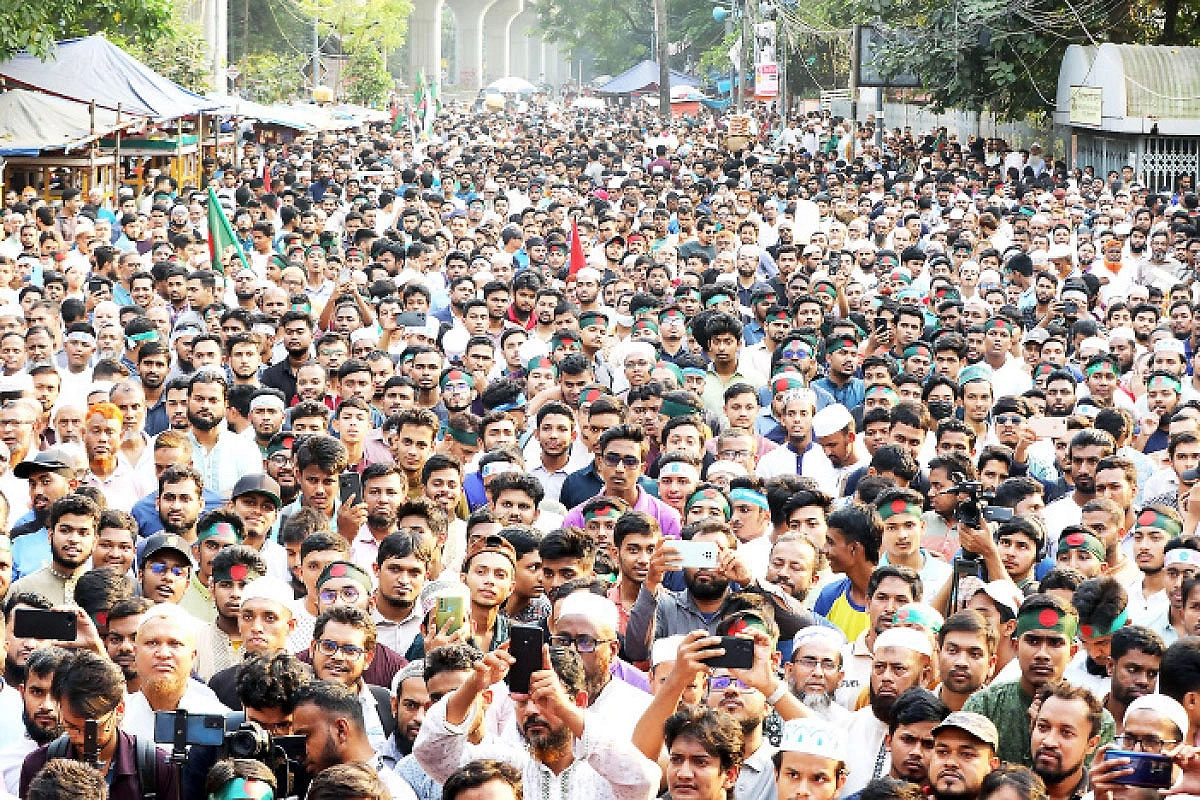
Photo: Mahurar Rahman
In the current social structure, the reality is that one cannot speak by disregarding religion. Doing so will not garner public support. Democrats and socialists must advance the political culture without showing any disrespect toward religion. One thing is clear: whether we like it or not, religious forces will exist in this world and in Bangladesh. However, how influential they become will depend entirely on the success of those who practice progressive or democratic politics. The chaos visible now is largely an expression of long-suppressed anger. But history shows that, ultimately, humanity must return to a rational and humane system.
