
Romance on screen, loneliness off screen
Why is real-life connection becoming harder in Japan?


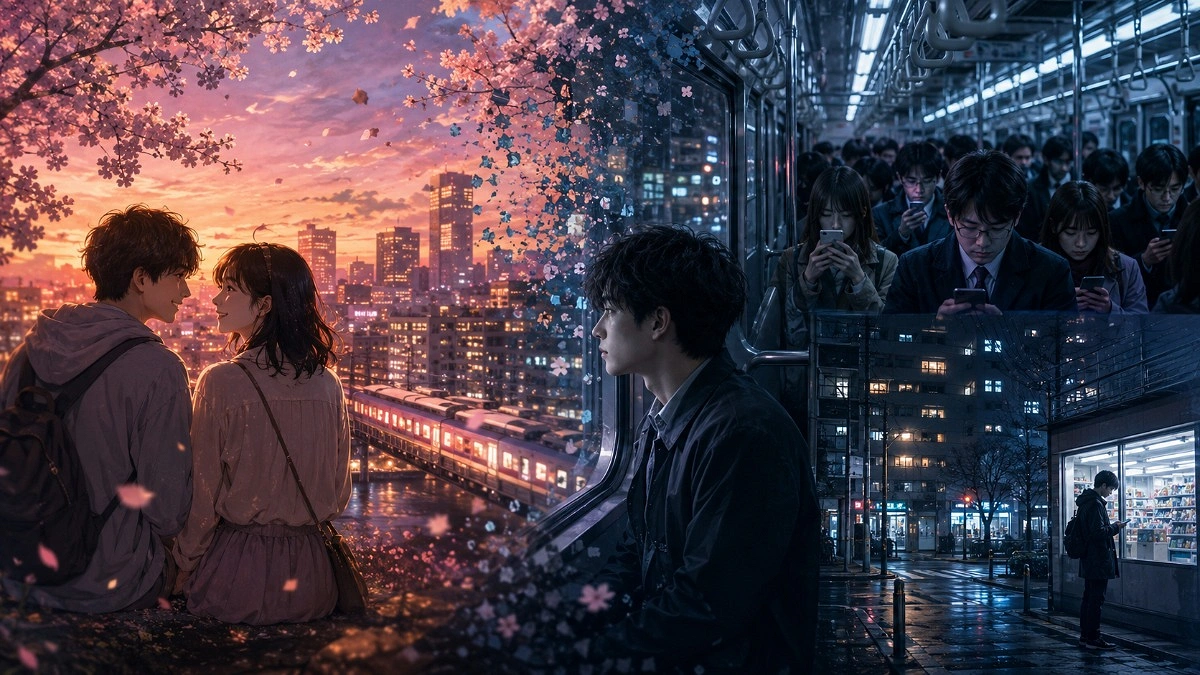
Graphics: Agamir Somoy
I have been watching anime since I was in third grade, back in 2007. I initially started watching anime because I loved how the artists draw the characters’ eyes, how the hair colors are vivid, how the dresses looked pretty and how beautiful the characters looked. The cities and rural areas drawn in anime looked so serene and energetic.
As soon as I came home from school, I turned on the television and went straight to the Animax Asia channel. As I became a teenager and now an adult, my favorite genres of anime became romantic, slice of life, drama and comedy.
On screen, those first meetings, playful banters, slow-burning romance, hate-to-love situations, meaningful gestures, and remembering small details come alive.
We see beautiful dates at amusement park and museum, moments beneath cherry blossoms, quiet train rides, cooking and cleaning together, eating together, taking care of each other when someone is sick, sharing weakness and vulnerability, and making heartfelt confessions.
Sometimes, there is the entry of love triangles, but ultimately, the relationships often lead to a beautiful wedding and a family. There are even tragedies woven in to show how life goes on.
Japan has produced some of the absolute best romantic anime shows and movies such as Horimiya, ReLIFE, My Love Story, Golden Time, A Sign of Affection, Wotakoi: Love is Hard for Otaku, Frangrant Flower Blooms with Dignity, Your Name, Howl’s Moving Castle and the list could go on.
The list would be much bigger than the article itself if I were to name all of the anime shows and movies.
Japan produces emotionally rich and romantic anime that makes viewers feel warmth, dream about it, and wonder if they could have it. The country that has given the world so many stories about falling in love, building relationships and finding a home in another person is itself facing declining marriage rates, falling births and growing loneliness.
Here is the reality of the situation.
According to the Ministry of Internal Affairs and Communications, Japan’s population dropped below 120 million for the first time in 42 years, totaling 119.74 million (down 0.76 percent) as of January 2026. This demographic shift is causing serious labor shortages and a shrinking tax base.
Social Design Strategist Naoya Yokota says a “Marriage-Birth Paradox” has emerged in Japan; while marriages rose for a second consecutive year to 489,119, births continued to drop. Yokota observes, “the naive assumption that ‘more marriages will mean more births’ no longer holds” due to declining married fertility and the average age of mothers at first birth rising to 31.0.
Despite the Children and Families Agency’s 3.6-trillion-yen Acceleration Plan, births fell 2.2 percent in its first full implementation year. Yokota argues this reflects “demographic inertia” and warns that social security systems must be updated as population assumptions are now “off by the same margin” as the projections.
In their 2026 article “Increasing loneliness in Japan 1983-2023: a cross-temporal meta-analysis” researchers Momo Homma and Kenkichi Takase from Chuo University show that loneliness is an urgent concern in Japan right now.
They looked at 81 studies using the UCLA Loneliness Scale. These researchers found that loneliness has gone up over the 40 years. It seems like loneliness is hitting people the hardest.
Loneliness is basically that feeling you get when you do not have the social contact you need. At the time people are talking more about depression due to its economic and societal costs and high rates of suicide.
Even though men consistently reported higher levels of loneliness, the data shows that loneliness among women has been rising recently. COVID-19 pandemic made loneliness even worse as interactions shifted online.
The study also shows that loneliness is linked to people living alone and declining marriage rates. As a result, Japan appointed a Minister of State for Measures for Loneliness and Isolation.
In another 2026 article “A Quantitative Model of Non-Marriage and Fertility,” Economist Kazuharu Yanagimoto of Kobe University identifies leisure technology growth as a driver of Japan’s demographic crisis.
The study reveals that improvements in leisure - like social media - make single life more appealing, creating a marriage penalty on leisure. Yanagimoto’s model explains 21.1 percent of the decline in marriage and 73.1 percent of the decrease in fertility.
The research highlights a child penalty on leisure where wives experience greater leisure loss than husbands. Ultimately, leisure technology growth makes single life relatively more appealing compared to marriage and parenthood.
National Institute of Population and Social Security Research - a government-affiliated body in Tokyo - said the results of its 2021 survey would add to concerns about the low birth rate.
The survey showed a record 17.3 percent of men and 14.6 percent of women aged 18-34 do not intend to marry, which represents the highest figures since 1982.
Children and Families Agency is now consulting youth, with Minister of State for Policies Kato Ayuko asking for their real voices on what prevents them from marrying. Barriers include the high cost of living and a lack of stable jobs.
The agency’s survey shows that 43.3 percent of men and 48.1 percent of women have no opportunity to meet partners. While women value career freedom, men cite concerns over job security and their ability to provide for a family.
Economist Takashi Kadokura argues government efforts fail because the growing number of non-regular workers makes starting a family financially difficult.
The decline is simply not a matter of numbers. Japan is experiencing loneliness, demographic decline, economic uncertainty and changing relationships dynamics. They might produce more stories about idealized intimacy because those stories resonate with people’s desires and hopes.
For me, I think anime is showcasing what is missing in real life. Perhaps anime is an escape - but not necessarily an escape from love. Rather, it is a safe haven after a long and tiring day. These stories remind viewers that love, intimacy and companionship are still worth hoping for.
Even as Japan struggles to rebuild real-life connections, people are still trying to find them. The government’s AI-app TOKYO Enmusubi facilitated 265 marriages and 760 serious relationships among 16,000 members.
Ultimately, romantic anime does not necessarily contradict Japan’s loneliness. Maybe it is reflecting the desire to dive into connection.
