Golapi is now on the roads ...

Collected Photo
In 1978, Golapi, the central character in the film Golapi Ekhon Trene, boarded a train. In 2026, pink buses for women are taking to the roads of Dhaka.
Nearly five decades separate the two scenes. One takes place on a movie screen, the other on real streets. One involves a character named Golapi, the other a pink colored bus. Yet somewhere between the two lies a long line tracing the journey of Bangladeshi society.
In one, there was a poor woman who took to the road to earn a living. In the other, there is a city where millions of women leave home every day for their livelihoods, but the path they take is still not completely safe, comfortable or equal.
So, from Golapi Ekhon Trene to Golapi Is Now on the Roads, this is not a repetition of a character’s story. Rather, it is a story of a society changing while its old problems return.
Amjad Hossain’s film Golapi Ekhon Trene was released in 1978. Based on his own novel Draupadi Ekhon Trene, the film centered on Golapi, a girl from a poor rural family. The struggles of life forced her to take up various jobs. At one point, the train became her workplace. But she was not only fighting poverty; she was also fighting society’s judgment. Her work, movements and way of life were all judged according to the conventional standards of society.
In that sense, the train was not merely a means of transportation.
The train was Golapi’s means of livelihood.
And Golapi represented the marginalized people of that time.
That is where the strength of the film lies. Through the personal suffering of one person, it portrayed a society’s economic structure, poverty, inequality and power relations. Discussions of Amjad Hossain’s films have also repeatedly highlighted their social realism and their portrayal of the lives of disadvantaged people.
Nearly half a century later, a pink colored bus is taking to the streets of Dhaka. This time, Golapi is not a person’s name. Nor is it a character. It is a color, an identity for a bus service. Yet the distance between the women who will board those buses and the Golapi of 1978 may not be as great in reality as it seems.
What kinds of women board a bus in Dhaka every day?
Some are university students. Some are garment workers. Some are bank officials. Some are hospital nurses. Some are schoolteachers. Some work in shops. Some are domestic workers. Some run small businesses. Some travel from one end of the city to the other for their children’s medical treatment. Their social positions are different. Their incomes are different. Their dreams are different. But they have one thing in common: “They have to keep moving.”
This movement is now an important condition of women’s economic lives.
In the 1978 film, Golapi boarded the train because life required it. In 2026, the pink bus is taking to the roads to give a little recognition to that need of women. The train has become a bus.
Whether a woman will work outside the home is no longer merely a family decision. It is connected to household income, children’s education, the urban economy, the labor market and the future of a family.
When a woman works, it is not only her own income that increases. A family’s income rises. When a girl attends university, it is not only her own education that changes. The possibilities for the next generation change as well.
But if that woman has to rely every day on unsafe public transportation to reach her workplace, an invisible relationship develops between her economic independence and the transportation system.
A job advertisement states the salary.
No one writes how far she will have to travel every day to get there, or how much fear she will have to carry with her.
The country’s cities have grown. Women’s workplaces have expanded. Women’s participation in education and employment has increased. But the big question is how much public transportation has changed in step with that transformation.
Finding space on Dhaka’s buses is difficult. Getting on is difficult. Getting off is difficult. Keeping oneself safe in a crowded bus is often difficult. Research has also documented women’s experiences of harassment as passengers. A BRAC study says 94 percent of women in the country face some form of harassment while using public transportation.
In other words, we have told women, “Come out, work, study and stand on your own feet.”
But the city’s streets have not always said, “Come, there is a place for you.” Instead, when boarding a bus, women may hear the opposite: “There is no space.” Although that lack of space is not limited to women.
This contradiction forms the social backdrop for the need for pink buses.
Before the latest pink buses, buses for women had already operated on Dhaka’s streets.
In 1998, the Bangladesh Road Transport Corporation, or BRTC, launched a women’s bus service on a trial basis. In 2001, it was expanded to Dhaka and surrounding areas. The service later nearly shut down. In 2009, an initiative was taken to revive it. In 2018, four buses named ‘Dolonchapa’ were also launched through a private initiative. But after nearly four years, that service too was discontinued in October 2022.
This is where the biggest question surrounding the new pink buses arises. Why did the previous services fail to last?
Does simply putting buses on the roadTare create women passengers?
Or does a service for women have to be designed to fit their lifestyles?
If a working woman gets a bus at 8 a.m. but cannot find one when she returns at 7 p.m., how effective is the service?
A garment worker wants to travel to work at a low fare. A university student wants to reach class at a specific time. A nurse may have night shifts. Their needs are not the same.
A bus for women does not simply mean a separate bus.
It means understanding women’s schedules, understanding their economic capacity and making their safety part of transportation planning.
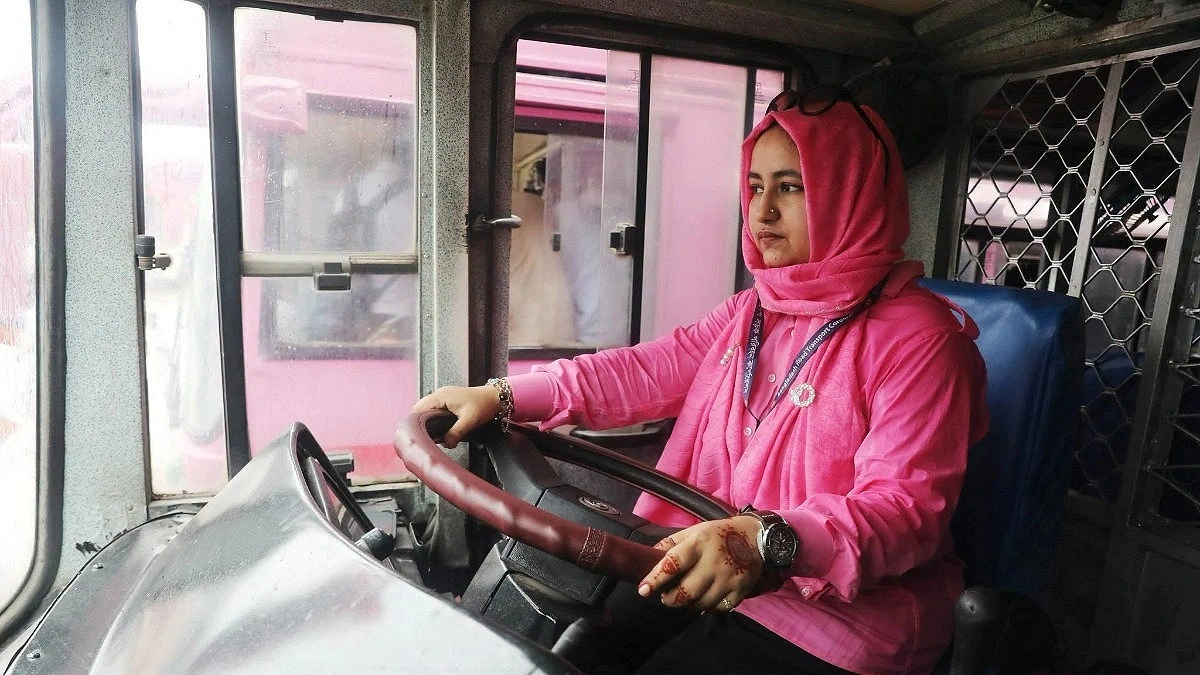
This is another important aspect of the new initiative. The passengers will not be the only women on these buses. Women will also work as drivers and conductors. The BRTC has announced plans to initially introduce 10 pink buses in Dhaka. It has also said the number of buses may be increased in the future based on passenger demand.
This is not only a question of women’s safety as passengers.
It is also a picture of the labor market.
Women are entering professions that have long been considered men’s jobs. They are sitting behind the steering wheel. They are becoming public transportation workers. In other words, there are two possible changes inside the pink bus at the same time: women becoming passengers and women becoming transportation workers.
But even here, opening day photographs are not enough to measure success.
How long will the women drivers remain in this profession? What will their working conditions be like? How much will their safety be ensured? How will passengers behave? Will the service remain regular?
The answers to these questions will determine whether the pink bus will actually become a vehicle for change or another memory after a few days.
The pink color is therefore important here, but also not very important. It is important because the bus can be identified from a distance on the road. It is not important because ultimately, the success of a bus is not determined by its color.
A bus may be pink, but if it does not arrive on time, it will not make women’s lives easier. There may be a woman driver on the bus, but if the route does not match the needs of working women, the initiative will not reach its full potential. The bus may be attractive, but if the service is irregular, the color will eventually become just part of the advertising. So the real change is not on the bus itself. The change has to come through management.
In 1978, society watched Golapi work through suspicious eyes. The path to her livelihood was difficult. The film brought forward the reality of how narrow the path to survival can be for poor people. Women in 2026 have come a long way. They go to offices. They attend universities. They run hospitals. They work in factories. They run businesses. They work in administration. They work at technology companies. They work for newspapers. They go to court. But they too need a train, a bus, a rickshaw and a road. Because economic independence does not end after crossing the door of the home. Economic independence also requires a transportation system.
A woman gets a job, but if traveling to the office is unsafe, how sustainable is that job for her? A student enrolls in university, but if the fear of traveling every day leaves her exhausted, how complete is that educational opportunity? A mother wants to work, but if she has to make a long and unsafe journey after leaving her child behind, how easy is that decision for her?
The sum of these small questions is actually the socioeconomic reality of a country. The pink bus is therefore not a solution by itself. It can open a door, but the path on the other side of that door must also be created.
Safe public transportation is necessary for women. At the same time, the safety and discipline of the general public transportation system must also be ensured. Not every woman will always board a pink bus, nor will every woman be able to do so. The ordinary buses used every day by most women in a city must also be safe.
For this reason, the success of the pink bus should ultimately not be measured only by the number of passengers on 10 buses. It should be measured by how many women gain regular access to transportation. How many women are able to reach their workplaces. How many students can safely reach their classes. How many women get jobs in the transportation sector. And most importantly, how much the idea changes that women’s movement on city streets is an additional arrangement rather than a normal right.
Golapi Ekhon Trene reminds us that even inside a train compartment, the story of a country’s class, poverty, power and deprivation can be hidden. Today, a pink bus is taking to the streets of Dhaka. There will be a city’s story inside this bus as well. Some will board for their livelihoods. Some for education. Some for their families. Some for their own dreams.
As the bus moves through traffic, the same Dhaka may be visible outside: high rise buildings, crowded sidewalks, shops, busy people and rushing vehicles. But inside the bus will be the possibility of a small change. A girl may sit beside the window and think that she too has a place in this city. A woman driver may sit behind the wheel and turn the steering wheel, and perhaps her presence alone will make another girl think that this profession could belong to her too. Then the pink color will no longer be just a color.
But there is still a long way to go. Because putting a bus on the road is easy. Keeping a bus service running is difficult. And making a service part of people’s lives is even more difficult. In the 1978 film, Golapi boarded the train because life required it. In 2026, the pink bus is taking to the roads to give a little recognition to that need of women. The train has become a bus. The village has become a metropolis. The nature of livelihoods has changed, but the need to keep moving in order to survive has not changed.
Now the question is whether the pink bus will only change the color, or whether it will also change, even slightly, the reality of women’s movement on Dhaka’s streets. Because ultimately, the question is not about any Golapi, nor is it about any pink bus. The question is: Who are the streets of this city really for?
Author: Senior Reporter, Agamir Somoy