
Warehouse break in to take fertilizer is a major warning

Graphics: Agamir Somoy
There is no way to view the recent administrative instability in the Ministry of Food and the severe fertilizer shortage at the field level separately. Although they may appear to belong to different areas on the surface, the roots of both crises are the same. The lack of policy making stability in our political and administrative system is being reflected in the country’s agriculture and food sectors.
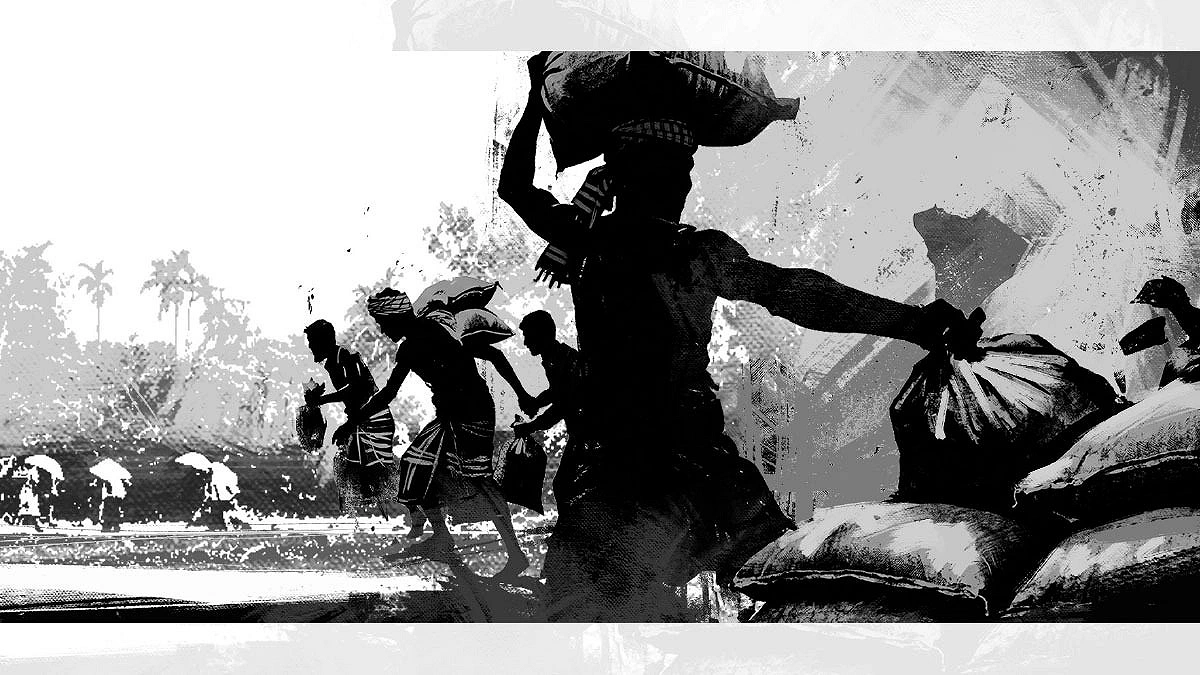
Recently, farmers broke the door of a government warehouse at Dhaldanga Bazar in Bhurungamari of Kurigram and took away fertilizer. The incident is a major warning for the entire country. The act cannot be supported legally or socially. However, if we fail to deeply understand the psychological and social factors behind this unwanted incident, it will never be possible to find the right solution to the crisis. Farmers have gone to dealers’ doors day after day and waited in lines but failed to find fertilizer. At the same time, plenty of fertilizer is available in the open market or black market if they pay extra money per bag. This chaotic situation has created extreme frustration and uncertainty among farmers. During the peak season of transplanted Aman rice, if farmers cannot apply fertilizer to their fields at the right time, the seedlings will not grow and the entire crop will be destroyed. Farmers will then have to face the prospect of starving with their families. It was mainly from deep frustration and a desperate attempt to survive that farmers were forced to take such an extreme step as breaking the law. This is an expression of farmers’ accumulated distrust and deep anger toward our government distribution system.
Amid this situation, the government and the Ministry of Agriculture are claiming that there is no fertilizer shortage in the country. Rather, almost the entire demand is reportedly stocked in warehouses and in some cases, there is even a surplus of fertilizer. The question is, if the national supply and stock of fertilizer are adequate, why are farmers in rural areas not getting fertilizer at the field level? The answer is that the crisis is not caused by an inadequate supply of fertilizer. Rather, it has been created by the extreme failure of our distribution system and the lack of oversight.
Fertilizer is a subsidized product in our country. The government keeps fertilizer prices low by providing billions of taka in subsidies to support farmers. Government appointed dealers receive a small fixed commission per bag. Instead of being satisfied with this small profit, they create artificial shortages in the market. They collect fertilizer from government warehouses but do not distribute it on time. They also secretly sell fertilizer allocated to their own areas to other areas or in the black market. There they can sell it for Tk 300 to Tk 700 more per bag than the fixed price. To prevent this, a specific committee and monitoring structure for overseeing fertilizer distribution exists from the national level down to the district and upazila levels. Unfortunately, these monitoring committees are failing to play an effective role at the field level. Data on how much stock is available and where may be visible on computers at the national level. But information on how much fertilizer reaches a dealer’s shop and whether it reaches farmers is not publicly available. Dishonest groups are taking advantage of this lack of transparency.
The real concern lies even further ahead. If we cannot quickly manage the crisis during the current Aman season, the situation could become disastrous during the upcoming Boro season.
Some agricultural officials are claiming that the crisis is being created because farmers are using two to three times more fertilizer than they need. This tendency to put the blame on farmers during a crisis is not acceptable at all. The responsibility for spreading scientific knowledge among farmers about how much fertilizer should be applied to which field, in what combination and at what time lies with the Department of Agricultural Extension. If such a large department has failed to make farmers aware of the balanced use of fertilizer, it is not the farmers’ fault. Rather, it is an institutional failure of the Department of Agricultural Extension itself.
During the Aman season, there is high demand for fertilizer in the elevated areas of the northwest such as Rangpur, Dinajpur, Rajshahi, Bogura and the Barind region. Therefore, it is extremely important for the ministry or department to prepare detailed regional planning and a distribution map showing when and how much fertilizer will be needed in each area. If fertilizer is distributed indiscriminately without properly assessing regional demand, shortages will inevitably appear in one area while fertilizer will remain in surplus in another.
The real concern lies even further ahead. If we cannot quickly manage the crisis during the current Aman season, the situation could become disastrous during the upcoming Boro season. This is because most of the country’s total food production comes from Boro rice and around 60 percent of the fertilizer used across the country is required during the Boro season alone. Preparations for Boro begin in November. If the current regional or local shortages are not dealt with immediately through firm administrative action, agricultural production across the country could collapse during the Boro season.
At the same time, the global situation is also sending extremely adverse signals for us. Fertilizer prices are already rising in the international market. China was one of the major sources of fertilizer for our country. In particular, a large portion of DAP fertilizer used to come from China. But China has stopped fertilizer exports to meet its domestic demand. Alongside this, the effects of ‘El Niño’ are becoming evident worldwide due to climate change, which will reduce global agricultural production. If food prices and fertilizer prices rise at the same time in the global market and domestic production in our own country is disrupted at that very moment, it is frightening to even think about how severe the situation could become. If our Boro and Aman production collapses, it may not take long for us to move toward a crisis similar to the extreme economic and food crisis we saw in Sri Lanka in 2022.
Therefore, the government’s main and only priority at this moment should be to give full attention to food production. As an immediate solution to the crisis, district and upazila level monitoring committees must be activated strictly without delay. Transparency must be ensured by displaying dealers’ fertilizer stock and sales information at the local level. Fertilizer must be immediately redistributed from areas where there is a surplus to areas facing shortages. The fertilizer market must also be controlled by taking action against dishonest black marketeers.
In the long term, agreements to import fertilizer from alternative international markets must be finalized now with the Boro season in mind so that disruptions in global supply do not affect our country. At the same time, our closed fertilizer factories must be reopened. For example, production at the Ashuganj Fertilizer Factory must be resumed by ensuring gas supplies on a priority basis. Ensuring that fertilizer reaches farmers is now the biggest task of national security.
Author: Economist and agriculture and food security expert
