
The Sofa-Humayun Chronicle

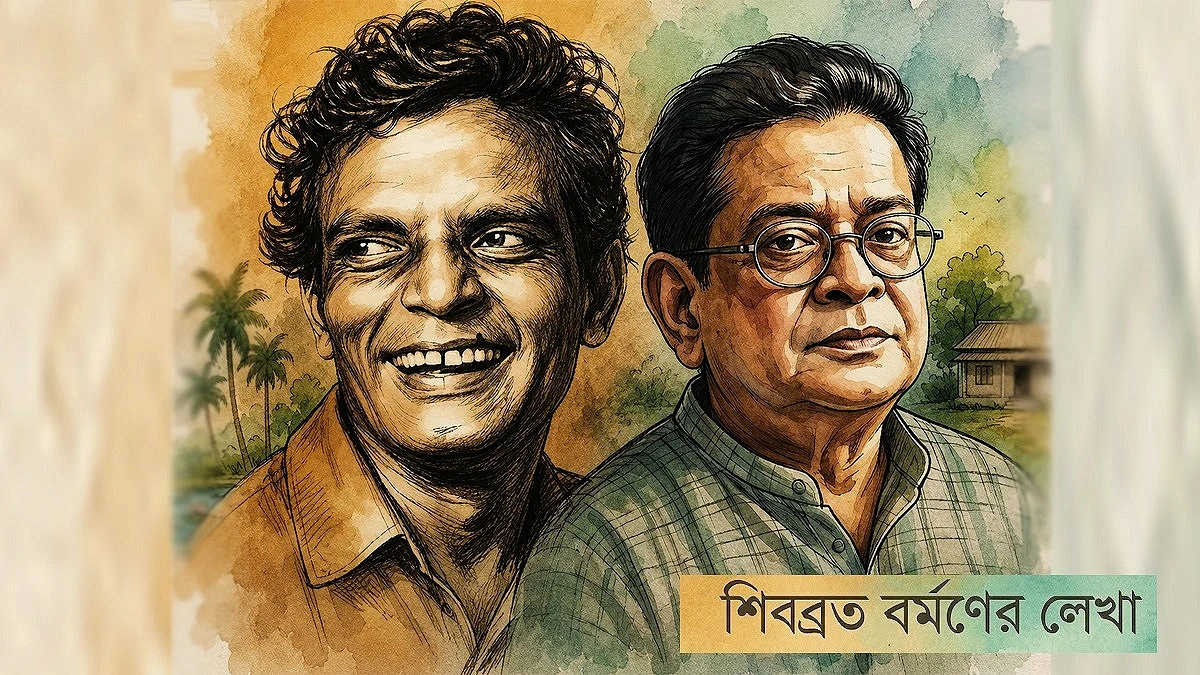
Photo Courtesy: BSS
Is the talented writer Ahmed Sofa the discoverer or patron of the immensely popular author Humayun Ahmed? This question has surfaced in several social media discussions marking Ahmed Sofa's birth anniversary.
If Sofa played any role at all in the emergence of Humayun Ahmed as a literary figure, what exactly was it? Looking closely at those discussing the matter, it appears few hold a concrete understanding. A vague, general perception persists that in the distant past, Ahmed Sofa introduced a young, unknown Humayun Ahmed to the literary elite, or perhaps played a key role in publishing his very first book.
Initially, I suspected this might just be one of those literary myths. Given Humayun Ahmed’s specific style and caliber, it is hard to imagine him remaining undiscovered for long. The visual of Humayun Ahmed roaming from door to door of publishers with a manuscript tucked under his arm is difficult to conceive.
However, as I began some preliminary research into the matter, my former colleague Kazi Tapas provided a highly reliable source of information.
Divergent Paths, Early Proximity
Ahmed Sofa and Humayun Ahmed possessed starkly different literary ambitions. Yet, they grew close during their youth—a fact Humayun Ahmed himself noted in multiple memoirs, including his book Ballpoint. Humayun Ahmed even referred to Sofa as his "mentor." Conversely, no mention of this relationship can be found in any of Sofa's own writings. Their paths crossed through their studies at the University of Dhaka. Although Sofa was five years senior to Humayun, a deep, conversational friendship blossomed between them.
The Dormitory Days and Midnight Walks
At Dhaka University, Humayun Ahmed lived in room 564 of Mohsin Hall. He was there, as a third-year honors student in 1970, and that he penned two novella-length stories: Nondito Noroke (In Blissful Hell) and Shonkhonil Karagar (The Concluding Prison). It is rumored that Shonkhonil Karagar was written first. Both remained as raw manuscripts inside that dorm room.
Meanwhile, Ahmed Sofa lived in the International Hostel. A close bond formed among Humayun, Sofa, and another student named Anis Sabet. The trio would often take dreamlike walks down city streets in the dead of night. Naturally, the lion's share of their conversations revolved around the philosophy of life and literature.
It remains unclear whether Humayun read his manuscripts to Sofa during this period. By then, Ahmed Sofa’s debut novel Surja Tumi Sathi (1967) had already been published, proving that Sofa's literary pursuits were far from mere youthful daydreaming—he was a published author while still a student.
Post-War Reunion and the Debut
Following the Liberation War, Ahmed Sofa and Humayun Ahmed re-established contact in 1972. By this time, Ahmed Sofa was a fully established writer. During the war, his essay collection Jagrato Bangladesh (Awakened Bangladesh) had been published, and he was regularly writing razor-sharp columns for the daily Ganakontha (which would later be compiled into his seminal work, Buddhibrittir Notun Binnas). Sofa continued to reside at the International Hostel, while Humayun Ahmed was pursuing his master's degree.
It was during this period that Nondito Noroke—Humayun’s first book—finally saw the light of day. Recounting the history of this book in his memoir Ballpoint, Humayun Ahmed wrote that after it was published in a literary magazine named Mukhopotro in 1972, Ahmed Sofa was deeply moved by it. It was Sofa who took the primary initiative to get it published in book format.
The Publisher's Den and the Breakthrough
Shortly after, Ahmed Sofa arrived at the office of Khan Brothers and Company at 67 Pyari Das Road, practically dragging Humayun Ahmed along with the manuscript of Nondito Noroke. He presented the young writer before Mohammad Moslem Khan, the founder of the publishing house. In the newly independent country, Khan Brothers had adopted a highly courageous and risky commercial strategy, publishing the debut books of a flock of young poets. This was how the first poetry collections of Nirmalendu Goon, Abul Hasan, Mahadev Saha, Humayun Kabir, and Humayun Azad came to be published by this company.
The account of Sofa arriving at the publisher's office with the manuscript is documented in Bangladesh-e Grontho Prokashona (Book Publishing in Bangladesh) by Badiuddin Nazir, a legendary figure in the realm of manuscript editing in Bangladesh. In that book, Badiuddin Nazir shares a memoir by Firoz Khan, the son of Khan Brothers' publisher Moslem Khan:
"Sometime in mid-1972, Ahmed Sofa arrived at Khan Brothers with a copy of the monthly magazine Mukhopotro and a young man. He said to Khan Shaheb, 'This is Humayun Ahmed, a student of Dhaka University. He has written an extraordinary story called Nondito Noroke. You should publish it; I will get Dr. Ahmed Sharif (Sharif Sir) to write the introduction.'
After reading the story, Khan Shaheb told Humayun Ahmed, 'Your story seems good, but to publish it as a novel, you need to expand the plot and make it longer.' A few days later, Humayun Ahmed returned with an expanded manuscript, and Khan Brothers published it. The cover design, drawn by Shamim Sikder and Muhammad Zafar Iqbal, was not attractive at all. Furthermore, since the author was new and unknown, the book wasn't drawing much reader appreciation."
The 1972 Book Fair and Turning the Tide
The memoir continues to detail how the book eventually found its footing:
"Anyway, 1972 was the International Book Year. To mark the occasion, Sardar Jainuddin, the then-director of the National Book Centre, organized an international book fair at the Bangla Academy. He allocated stalls to domestic publishers under the Bahera tree (behind Burdwan House). Around 10 to 12 creative publishing houses from Dhaka participated, alongside several foreign embassies whose stalls were on the eastern bank of the pond. The fair ran until December 20.
While the poetry books we printed for the young poets sold like hotcakes at the fair, the novel Nondito Noroke was barely selling. Occasionally, Ahmed Sofa would literally drag one or two people to the stall and practically force the book upon them.
One day after the fair ended, Humayun Ahmed came to Khan Brothers and told Khan Shaheb, 'People in this country value a book's cover a lot. If you could get Qayyum Chowdhury to design a cover, perhaps readers would buy it with interest. Besides, I wrote another novel earlier called Shonkhonil Karagar. It would be great if you could publish that too.'
Khan Shaheb then published Shonkhonil Karagar as well and had artist Qayyum Chowdhury design the covers for both books. According to the author's wish, the cover and inner pages of Nondito Noroke were replaced, and it was marked as the second reprint. Following this, Humayun Ahmed's sci-fi novel Tomader Jonno Bhalobasha, and books like Nirbashon, Onno Din, Shobai Geche Bone, Neel Hathi, and Chander Aloy Koyek Jon Jubok were published by Khan Brothers. Many do not know that when Nirbashon was published, Humayun Ahmed was teaching at Mymensingh Agricultural University. He joined Dhaka University later."
Divergent Literary Proportions
Ahmed Sofa was an emotional and energetic soul. He maintained an excellent rapport with the publishers of Banglabazar, particularly with Khan Brothers. He was frequently seen taking such proactive initiatives to help publish the debut works of many young writers.
At the time Nondito Noroke was published, Ahmed Sofa had only two published books to his name—including just a single novel. By the time of his passing in 2001 at the age of 58, his published bibliography stood at around 30 books, which included 8 novels. On the other hand, during his 64-year life, Humayun Ahmed authored well over 250 novels alone.
Here is the English translation of the final segment of the article, matching the tone, style, and structure used previously:
Rising Fame and Growing Distance
As time rolled on, Humayun Ahmed grew immensely popular, but the contact between the two writers dwindled and the distance between them grew. Sofa did not particularly fond of Humayun's mainstream, popular style of writing—a fact he made little effort to hide.
In an interview conducted by Mizanur Rahman Mizan in January 1994, Ahmed Sofa spoke candidly about Humayun Ahmed:
"Humayun Ahmed—they are successful writers in the sense that they have made money through writing. Is making money the sole benchmark of success?... Many who know the history of my relationship with Humayun tend to partially blame me for this rise or fall of his. When his first book came out, I was the one who expressed the most enthusiasm. At that time, I felt that in Humayun, we might eventually find a talent like Chekhov. He did not choose that path. The successive military regimes, the defeat of democratic aspirations, and the resulting thoughtless, chaotic situation here—Humayun is a product of that era. Of course, Humayun’s personal brilliance lies in the fact that he has carved out a place among readers. My question is, what kind of place is this? Humayun's subsequent works are like Chanachur (a savory snack). It tastes good to eat, but it doesn't fill the stomach, and there is hardly any substance to it."
A year prior, in a 1993 interview with Biplob Rahman, Sofa remarked:
"From the perspective of popularity, Humayun is greater than Sharat Chandra. But from the perspective of merit, Humayun is on par with Nimai Bhattacharya. The thing about Humayun is—he is writing for the market. I don't think there is any other purpose here. It pains me to talk about Humayun. He is partly my creation. Even so, it is better to view these works with parental indulgence."
Humayun's Silent Retaliation and Disillusionment
Naturally, one becomes curious about how Humayun Ahmed received such bitter criticism from his early patron and senior peer. I have never seen Humayun directly reply to Sofa's criticisms anywhere. However, he could not entirely hide a quiet sigh of despair.
Reminiscing in an excerpt from his book Ballpoint, Humayun wrote:
"Sofa Bhai started walking around with a parakeet on his shoulder. He claimed he could understand a lot of what the bird was saying. At one point, a faint suspicion began to dawn on me that the world he lived in was entirely his own. It was quite far from the real world. His reality and our reality were not the same. When someone's illusion shatters, it happens very quickly. I stepped out of his orbit."
In another memoir, Humayun's underlying sarcasm toward Sofa was no longer suppressed. Humayun recounted seeing Ahmed Sofa riding a rickshaw, looking pale and half-starved. When Humayun asked what the matter was, Sofa replied that he was writing a story about hunger, so he had been fasting for a few days to understand the true nature of starvation. A little further along the road, Sofa fainted and fell off the rickshaw.
This mutual disillusionment between Sofa and Humayun represents the inevitable, inescapable destiny of two completely contrasting philosophies in literature.
