
A generation without an address grows up in Rohingya camps

Collected Photo
Fire raged from village to village. Gunshots echoed all around. Clutching their children's hands, people fled toward the border to save their lives. On that night of August 25, 2017, Jamal Hossain and Sokhina Khatun fled Myanmar's Rakhine State with their nine children and took shelter in Bangladesh. After seven days of crossing hills, jungles, and rivers, they found a place in the Kutupalong refugee camp in Cox's Bazar.
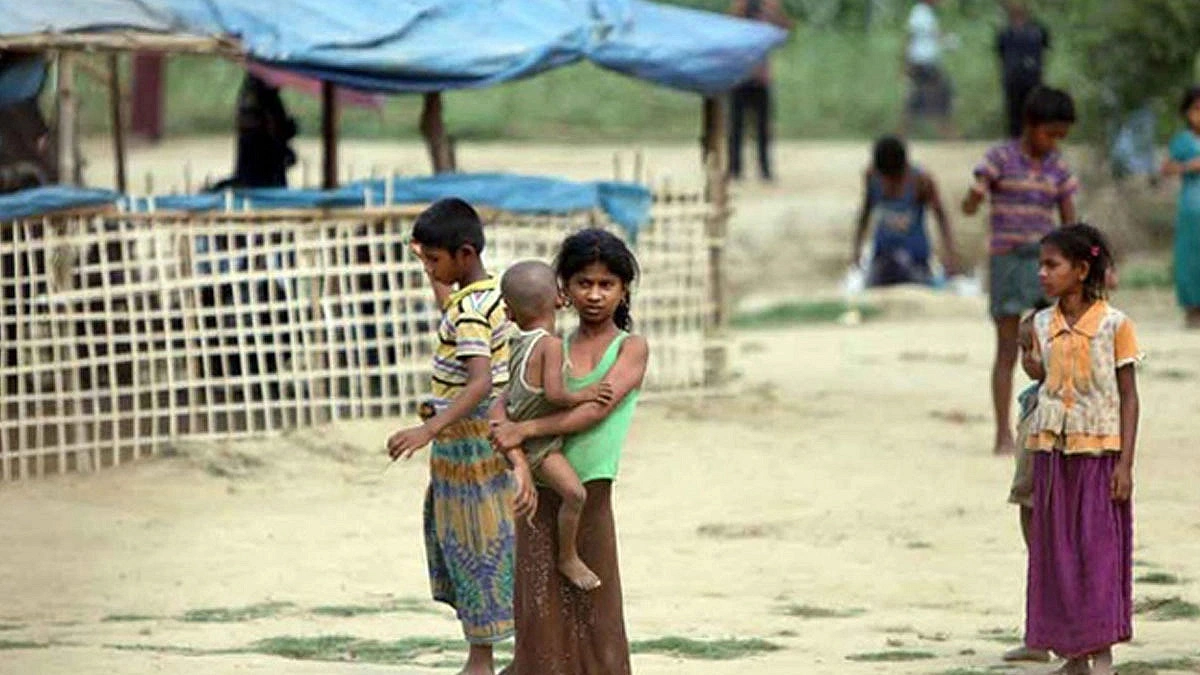
Nine years have passed since then. The couple who arrived with nine children now have a family of 14 members. Three more children have been born in Bangladesh. They live crammed into a tiny 150-square-foot room. But it is not just Jamal's family—over these nine years, a new generation has grown up in the Cox's Bazar refugee camps. They have never seen Myanmar, yet Bangladesh is not their country either.
Today is August 25, Rohingya Genocide Remembrance Day. After nine years, repatriation has not begun. Instead, new children are being born in the camps, the older generation is growing older, international aid is decreasing, and the list of uncertainties is getting longer. What was meant to be a temporary shelter seems to be slowly turning into a permanent wait.
On the afternoon of August 23, sitting in his room in Kutupalong Camp-3, Jamal Hossain said, "When I was in Myanmar, I had nine children. After coming to Bangladesh, three more children were born. The family has grown, but food aid has decreased. There is no opportunity for income either. It is very difficult to run the household."
Jamal said that the monthly food aid they receive is not enough for a family of 14. Toward the end of the month, they also face a fuel crisis. His eldest son is ill, another son works as a day laborer, and one has gone to Malaysia by sea. Some of his daughters have married and moved out, some have dropped out of school, and some still go to the camp's learning center.
Like Jamal, Mohammad Arifullah came to Bangladesh in 2017 to save his life. He was young then. Now he is 28. For nine years, life behind barbed wire has been his reality. Yet his country is still Myanmar.
Arifullah said, "I came to Bangladesh to escape the military's brutality. Even now, remembering those days brings tears to my eyes. But Myanmar is my country. I want to return there one day."
Most Rohingyas share the same wish. They do not want to stay permanently in Bangladesh. They want to return to Myanmar if they are guaranteed safety, citizenship, and the right to live with dignity on their own land. But that environment has not yet been created.
Syed Ullah, a member of the UCR's Presidential Panel and a Rohingya rights activist, said, "We are grateful to Bangladesh. This country has given us shelter and saved our lives. The international donor community has also supported us. But we are not permanent here. We must one day return to our own country. For Rohingyas, the only lasting solution is repatriation."
Bangladesh and Myanmar have held multiple discussions over repatriation. Lists have been submitted, and identity verification has been carried out. Myanmar has verified more than 300,000 Rohingyas from Bangladesh's list as residents of Rakhine State. Yet not a single Rohingya has been repatriated.
Because the questions remain exactly where they were. There are no clear answers to whether they will get security if they return, whether they will be granted citizenship, whether they can go back to their own villages, or whether they will get back their homes and land.
Amid this long wait, the face of the generation in the camps is changing. Many of those who were children in 2017 are now young adults. And thousands of children born over the past nine years have never seen Myanmar.
Marcel Colun, head of the UNHCR sub-office in Cox's Bazar, said, "The Rohingyas have the aspiration to go back. But due to the ongoing conflict, it has not been possible to formulate a concrete plan for how repatriation would be implemented. The conflict must stop first."
According to Refugee Relief and Repatriation Commissioner Mohammad Mizanur Rahman, despite family planning programmes, 20,000 to 30,000 new children are being born in the camps every year. In other words, behind the barbed wire, a generation is gradually taking shape—one whose motherland is not Bangladesh, yet the country they are told is their own, Myanmar, is not a reality they have ever seen.
