
Crepe Ginger: The quiet beauty hiding in wildlands

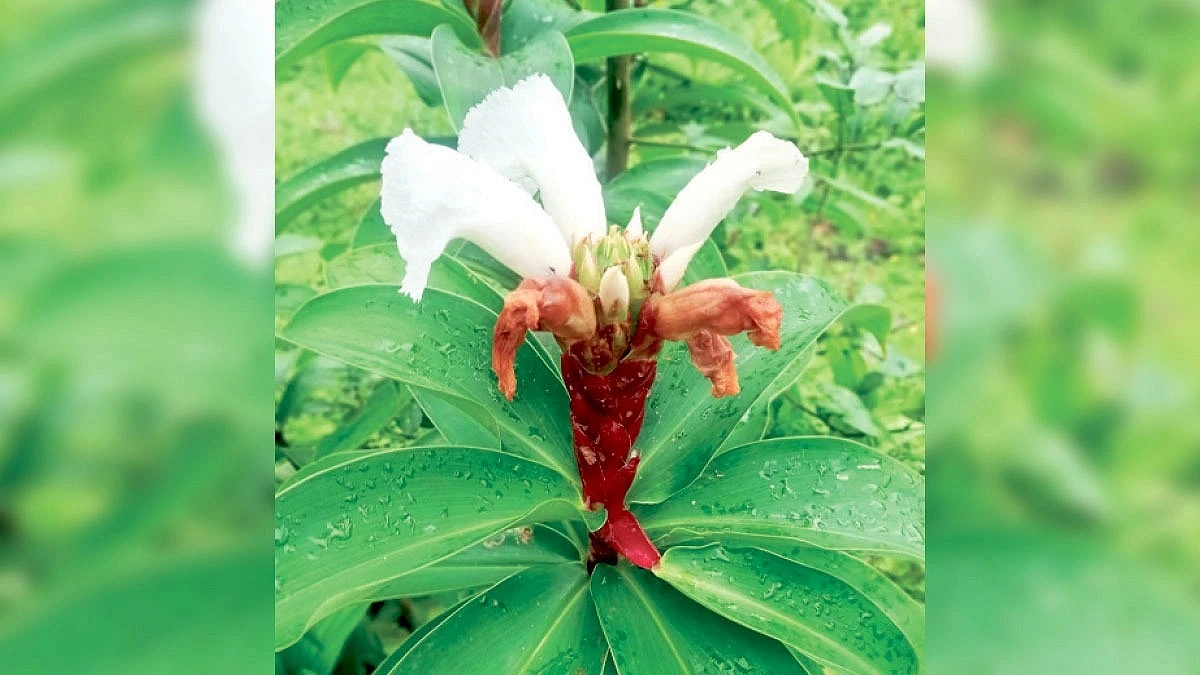
Collected Photo
There are some flowers whose beauty steals the heart at first sight, and Crepe Ginger is one such flower. Enchanted by its appearance, many compare it to the White Ginger Lily upon first seeing it, as the Crepe Ginger possesses a serene, enchanting beauty.
However, although called a flower, it cannot quite be termed an ordinary flower. In botanical terms, it is an inflorescence that blooms in clusters, featuring a red color. Each inflorescence contains triangular, thin petal-like structures, and small, microphone-shaped white flowers peek out from inside those triangles.
Despite being so visually appealing, the flower has almost no fragrance. Introducing Crepe Ginger in his book Banglar Bonoful (Wildflowers of Bengal), naturalist and renowned photographer Nawazesh Ahmed wrote, “My name is Keu (Crepe Ginger) or Keomul. Finding me is not difficult at all. Past Bhaluka on the way to Mymensingh, my tall clustered plants will easily catch the eye in the ditch on the right side of the road.”
The author’s first encounter with the flower, however, was not on the pages of a book, but along a field path. In 2003, while conducting research on medicinal plants at Bangladesh Agricultural University (BAU), Mymensingh, funded by a fellowship from RDRS Bangladesh and GTZ (German Technical Cooperation), the author traveled from fields and riverbanks to village after village.
During one such journey, upon stepping out of Aditmari Railway Station in Lalmonirhat, the plant caught the author’s eye inside an old grave. Standing in that secluded environment, the appearance of the unfamiliar wild flower instantly drew attention, sparking a fresh realization that such exquisite beauty could lie hidden in a quiet corner of nature.
The name of Keu is quite diverse, being known variously as Keu, Keo, Keomul, Kushma, or Kemuk depending on the region. To the people of the Marma community, its name is Kraitong Mui, while in Chattogram, it is called Tiatoi.
The scientific name of the plant is Costus speciosus, belonging to the ginger family (Zingiberaceae). Shaded locations, dense thickets, or damp environments are suitable places for Keu to grow. It is a perennial shrubby plant, forming dense thickets as multiple branches emerge from underground roots. The height of a mature plant can reach five to six feet, with a green, firm stem up to one and a half inches thick, from the top of which one or two branches usually sprout.
The leaves of the Keu plant are also quite attractive, displaying a green color, an elliptical shape, and a smooth surface. A single leaf can measure five to ten inches long and three to four inches wide around the middle, remaining somewhat thick yet soft.
However, the most surprising aspect is the leaf stalk, which is not narrow like many other plants, but broad like a ribbon that wraps around the stem like the pallu of a sari. This characteristic, crafted in nature’s own design, easily distinguishes Keu from other plants.
Writer: Agriculturist and researcher
