
Shuvendu Adhikari: New Chief Minister Takes Mammoth Step to Erect Birbed Wire Along Border
- West Bengal orders land transfer to BSF, process begins Monday
- Decision may create fresh pressure on India–Bangladesh diplomatic ties

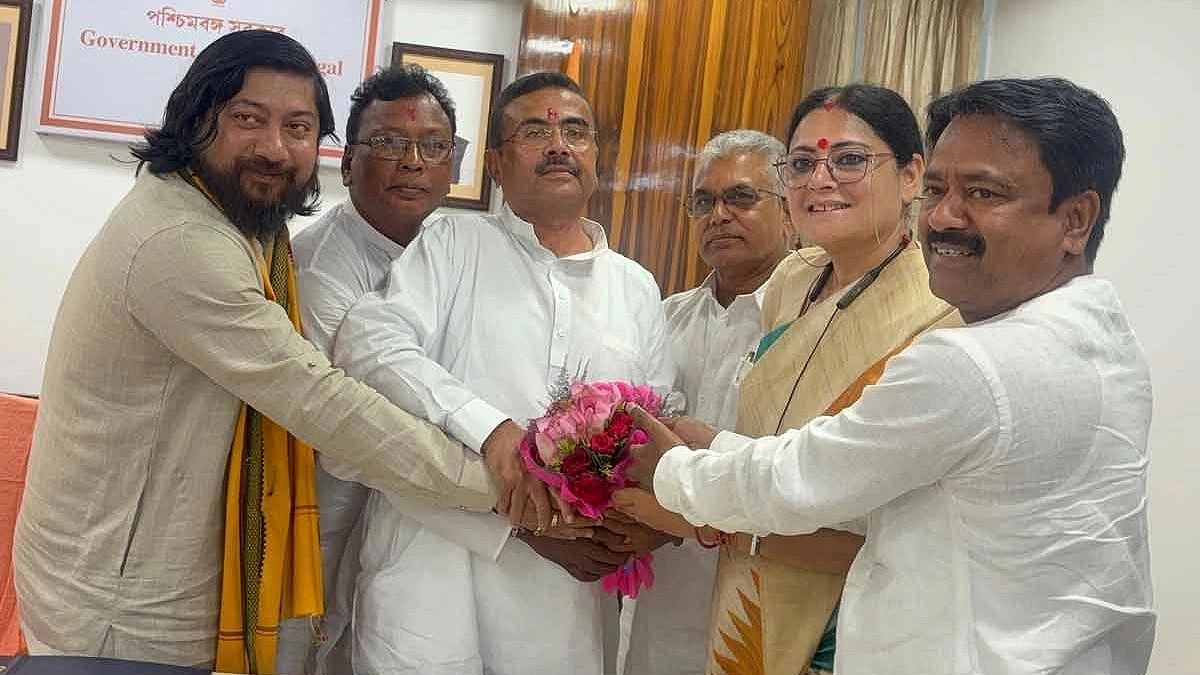
Five newly elected BJP ministers in Nabanna with West Bengal Chief Minister Suvendu Adhikari. Photo: Collected
At its very first cabinet meeting after taking office, the government led by Chief Minister Suvendu Adhikari took a major decision regarding the Bangladesh border.
At the cabinet meeting held on Monday at Nabanna, the West Bengal Government approved the transfer of land to the Border Security Force (BSF) for the construction of barbed-wire fencing along the India–Bangladesh border. Chief Minister Suvendu Adhikari said the process would begin on Monday itself, with a target to complete it within the next 45 days.
Speaking to journalists after the meeting, Adhikari said the decision to hand over land to the BSF was taken to strengthen security along the Bangladesh border. “The process is starting from today,” he said. Political circles see the decision of the new government as highly significant, as barbed-wire fencing projects had long been stalled in many border areas of West Bengal.
A large stretch of the India–Bangladesh border passes through West Bengal. In several districts—including Cooch Behar, North Dinajpur, Malda, Murshidabad, Nadia and North 24 Parganas—many areas still lack complete fencing. The construction work had repeatedly stalled due to land-related complications, administrative approval issues, and objections from local residents. The BJP had long turned the issue into a political matter, frequently criticizing the previous Trinamool Congress government over border security and illegal infiltration.
Upon assuming power, Suvendu Adhikari prioritized this long-pending issue. According to a section of political observers, the decision to expedite barbed-wire fencing is being seen as the implementation of one of the BJP’s key electoral promises.
However, the move has also raised concerns among sections of residents in border areas. People in many border-adjacent villages depend on nearby areas for farming, access to agricultural land, and daily livelihoods. There are fears that rapid construction of fencing could disrupt their normal way of life. Local sources claim that uncertainty is particularly growing among poor and minority Muslim families living in the border regions.
The BJP says the move is essential to strengthen border security and prevent illegal infiltration. However, political observers believe that taking such a decision focused on the Bangladesh border at the very first cabinet meeting of the new government is likely to further intensify political tensions.
Experts also warn that the move could create fresh pressure on India–Bangladesh diplomatic relations. In the past, Bangladesh has expressed concerns over the construction of barbed-wire fencing within 150 yards of the border, increased surveillance, and restrictions on the movement of border residents. As a result, any renewed tightening of border controls could have repercussions for Dhaka–Delhi relations.
At the same time, some human rights activists fear that heightened activity by security forces along the border could lead to an increase in clashes or shooting incidents. Controversy has already emerged following the recent killing of two Bangladeshis in firing by the Border Security Force along the Tripura border. Against this backdrop, the decision to construct new fencing and strengthen surveillance along the West Bengal border may become a new source of concern in Bangladesh as well.
