
The Last Ride

Graphics: Agamir Somoy
One
Rokib had been riding for Pathao for two years and three months. By his mother’s calculations, which measured time not in prayers but in nights, he had been drenched in the rain exactly four hundred and twelve times.
Dhaka’s rain has a personality of its own. It does not just fall; it makes an announcement. It beats down on corrugated tin roofs as if it is running late for an appointment, turning Mirpur Road into a rushing river the color of over-milk tea. Rokib knew every single pothole from Shyamoli to Mohammadpur solely by the complaining groans of his bike's suspension. He knew which flyover joints pooled with water, which alleys flooded ankle-deep, which rickshaw pullers would curse him for splashing them, and which ones would simply laugh it off.
Two years on the night shift had taught him that Dhaka after eleven o'clock is a completely different country. The daytime Dhaka of blaring horns, street vendors, the smell of frying piyaju, and buses fighting over two centimeters of asphalt packs up and goes home by midnight. In its place emerges a quiet, surreal city. The streetlights hum to themselves in the dark. Stray dogs become the rightful owners of the concrete. The city slowly takes a deep breath.
Truth be told, Rokib actually liked the night shift. Ride cancellations were rare. Clubgoers and airport passengers tipped generously. There was also something else, something he never told his roommate Habib or mentioned to his mother over the phone: when the rest of the world slept, there was a profound peace in being awake, as if he had been granted access to a secret schedule of existence.
That peace shattered on the ninth night of the Bengali month of Ashwin, though he did not know then that this night would carry a date he could never forget. He only knew it started as a typical four-thirty morning ride.
He was half-asleep, leaning against his bike near Rayerbazar with his phone resting on the petrol tank, when the notification chimed. He almost ignored it. His eyes felt like they were full of sand, his neck ached, and he told himself his last ride of the night was already done. That had been a college kid he dropped off at Dhanmondi Road 27, who had given him a forty-taka tip and said, "Brother, ride safe," with a sincerity that felt a bit too intense for the circumstances.
But forty taka would not pay for his sister's tutoring fees, and Rokib’s thumb moved before his exhausted brain could finish the argument.
Pickup: Rayerbazar Martyred Intellectuals Memorial Road.
Drop-off: No address, only coordinates.
This was strange. Pathao pickups almost always had a landmark, a name like "in front of Rupali Bank" or "next to Star Kabab." While a pin dropped on a dark road was not entirely unheard of, it sent an unnecessary jolt through his stomach. He chalked it up to exhaustion and steered his bike toward the pin.
The memorial grounds stood dark and silent beneath a moonless sky, where the only illumination was a sliver of cloud stained orange by the sodium streetlights below. Rokib had ridden past this place hundreds of times without a second thought. Everyone in Dhaka did. It was a place to pass by, not a place to stop, unless it was the sixteenth of December and you were holding flowers with a solemn face.
Tonight, a woman was standing near the gate.
She wore a white saree with a light gray border, the kind widows wear, though she did not look old. Her hair was unbraided and fell all the way to her waist, in a manner that no respectable woman would ever display in public, day or night. She stood remarkably straight, hands clasped in front of her, staring directly down the road as if she had been waiting for the exact second of Rokib’s arrival.
"Pathao?" Rokib called out, stopping his bike a few feet away with the engine idling. It was a habit of his. It was never wise to get too close to a stranger at four in the morning, regardless of whether they were male or female, respectable-looking or not. Two years of night rides had taught him at least that much.
She did not speak. She simply nodded and walked toward him. As she drew closer, Rokib noticed how quiet her footsteps were. There was no sound of sandals on the damp road. There was no sound at all, even though the ground was slick from the evening rain and every other passenger that night had left wet footprints on his back footpegs.
He reasoned that she was barefoot and walking cautiously. That had to be it.
"Sister, where to?" he asked, handing her the second helmet. It was the mandatory extra helmet, which usually went unused because ninety percent of passengers rejected it, citing ruined hair, a rush, or general disregard for rules.
She took the helmet without a word. That action, at least, felt normal enough to quiet Rokib's racing pulse. It was just superstition, he told himself. An exhausted mind seeing ghosts in every loose strand of hair.
"Uttara," she said. Her voice was soft, unremarkable, and sounded like any ordinary woman's voice. "Sector Eleven. I will show you the way."
"Alright," Rokib replied. It was a long trip, about forty minutes on empty roads at this hour, but a long trip meant good money, and Rokib was in no position to be picky. He waited for her to mount the back seat. He felt the bike dip slightly under her weight, a small detail that his mind registered with relief because ghosts, if one believed in such things, were not supposed to have weight. With that comfort, he pulled out onto Mirpur Road.
Two
For the first fifteen minutes, the ride was perfectly normal, and that normalcy allowed Rokib to forget his unease. The city was passing by in its early morning state. Shops were locked tight with their steel shutters down. A solitary tea stall glowed under a bare bulb where two rickshaw pullers shared a single cigarette. A police checkpoint let him pass without so much as a glance. The rain had stopped an hour ago, but the streets still held its memory in long, silvery puddles that shattered his headlight reflection into bright fragments.
"Sister, can I confirm your phone number?" he asked, more out of habit than necessity. The app was glitching, showing no profile picture or verified number, only a gray silhouette where the passenger's photo should be.
"You do not need my number," she said. "You already have my destination."
Her tone was not harsh, but it carried an absolute finality. Rokib did not ask again.
They passed Farmgate, then Bijoy Sarani. The flyover was empty except for a lone CNG auto-rickshaw sputtering along in the slow lane. With nothing to do but watch the road, Rokib's tired mind began to drift toward things best left unthought.
He remembered the stories his grandmother used to tell. She did not tell them to frighten him, she always insisted, but to warn him. She claimed there was a difference, though as a child, Rokib never quite believed her and would lie awake with the blanket pulled up to his chin. She spoke of petnis, the spirits of women who died with unfulfilled desires, clinging to the world like wet clothes and wandering the night streets in search of what they were owed. She spoke of shakchunnis, who were even more dangerous because they could mimic living women so perfectly that husbands sometimes did not realize their wives had been replaced until it was too late.
Most of all, she spoke of a rule so ancient that no one remembered its origin. After midnight, never offer a ride, a seat, or a passage to a woman standing alone at a crossroads or a cemetery, unless you are prepared to go where she truly wants to go.
"The memorial is not a crossroads," Rokib muttered to himself, his voice barely audible over the engine. "It is a monument for our martyrs. It does not count."
"What did you say?" the woman asked from behind.
"Nothing, sister. Just talking to myself. It has been a long shift."
"You should rest more," she said. "Boys your age wear themselves down into the dirt for money that will still be there tomorrow. But some things cannot wait for tomorrow."
The words were strangely maternal, yet spoken in a voice completely devoid of warmth. Rokib felt the hair on his arms stand up, even though the night was humid and warm. He remained silent and kept his eyes on the road.
Somewhere past Mohakhali, he glanced at his rearview mirror out of habit to check for non-existent traffic. For a fraction of a second, a mere blink of an eye that his mind immediately tried to argue away, the mirror showed the back seat empty. There was no woman and no white saree. There was only the sodium-lit road stretching out empty behind them.
He looked again. She was there, sitting exactly as before with her hands clasped in her lap. Her eyes, he realized with a shock, were not looking at the road ahead. They were fixed on the back of his head, positioned in a way that made the mirror feel less like a reflection and more like a window looking directly at him.
"Sister," he said, his voice thinner than he intended, "is everything alright?"
"You ask as if you expect the answer to be no," she replied.
"Just asking out of politeness."
"One should be careful about what they invite with politeness," she said. "Politeness is often the key that opens doors that should stay closed."
Rokib decided right then, as the dark shopping complexes of Mohakhali slid past, that he did not like this ride. He resolved to drop her off in Uttara, take whatever money she offered, and never accept another nameless pin drop again.
But decisions made at four in the morning have a way of being tested before the sun rises.
Three
They reached the Uttara intersection, and the woman began giving directions in a voice that had grown strangely close, as if she had leaned right next to his ear without moving from her seat.
"Left. Now right. Slow down here."
At this hour, Sector Eleven was a series of dimly lit houses and boundary walls. An occasional guard dog barked from behind a gate and then went silent, as if even the animals had decided this was not a ride worth announcing.
"Stop," she said.
She pointed to a house where no lights were on, not even the faint corridor bulb that families leave burning for someone returning late. The iron gate was rusted and locked, clearly unopened for a very long time. An old rickshaw with flat tires and rotted woodwork leaned against the boundary wall, half-swallowed by a wild, thorny bougainvillea bush.
Rokib’s stomach plummeted like a swing pushed too high.
"Sister, is this your home?"
"It was," she said.
For the first time, Rokib turned around to look at her directly, rather than stealing glances through the mirror. In the weak sodium light spilling from a broken street lamp a few houses down, he saw her face clearly.
She was young, perhaps twenty-two or twenty-three. She was much younger than her voice, hair, and formal posture had suggested. She had the kind of face that should have been laughing over street food with friends on a Friday evening. But her eyes were wrong. They were not cloudy or red, nor was there anything overtly supernatural that Rokib could point to. They were simply too still. Human eyes constantly move to check reflections, blink, or look away when annoyed. Her eyes did none of these things. They remained fixed on him with the patience of a photograph.
"Sister," he said, his voice cracking slightly, "my fare..."
"You want to know if this is real," she said, cutting through his request as if she had heard the underlying question he was too terrified to ask. "You want to know what I am."
"I want to know if I can go home," Rokib replied, surprised by his own honesty.
Something shifted in her expression. It was not a smile, but a softening, the way a stone might soften if you watched its erosion over a century compressed into a single second.
"You can always go home," she said. "That is the one thing I cannot do. Do you know what happened in this house?"
He did not want to know. Every muscle in his body screamed at him to kick the bike into gear and speed away, to forget the fare, forget the app rating, and run. But something older than his fear, the part of him that grew up listening to his grandmother's warnings, held him to the seat. He understood that a spirit interrupted mid-tale might turn its unfinished sorrow upon the one who cut them off.
"No, sister," he said. "I do not know."
"Six years ago," she said, "I lived here with my husband. We had been married for eight months. He worked at a garments office in Tejgaon and usually came home late, just like you. I would wait for him and keep the food covered on the table. It would grow cold because he always said that eating cold food with me was better than eating cold food alone. He said hot food had no taste when eaten in solitude."
She paused. In the silence, Rokib heard the distant call of a night bird he did not recognize. Beneath that sound lay absolute silence, with no traffic or generator hum, as if the entire neighborhood was holding its breath with them.
"One night, he did not come home. I waited until two, then three in the morning. I kept calling his phone until it stopped ringing and went straight to a voice recording saying the number was unreachable. In the morning, his colleague came to tell me there had been an accident. A bus was driving too fast in the rain on the Mohakhali flyover, right where we just rode. He said it happened so quickly that my husband felt nothing."
"I am so sorry, sister," Rokib whispered, and he meant it. For a moment, the reality of her grief eclipsed his own fear.
"They did not let me see the body," she continued, as if she had not heard him. "They told me it was better to remember him as he was. My mother-in-law agreed. My own parents were three hundred kilometers away in Rangpur and could not arrive in time because our customs require a swift burial. So I never saw him again. I never saw his face, his hands, or the small burn scar on his left wrist from a childhood kitchen fire that he always hid beneath his watch. I was told he was buried. I was told where. But I was never allowed to see."
She looked at Rokib with an expression that resembled a plea, as much as such a still face could.
"For six years, I have not been sure," she said. "Not sure enough to find peace. A wife should see her husband laid in the earth. Without that, some deep part of you always keeps the table set for a man who is not coming back. I waited near the memorial because that was the last place I knew for certain he was alive, the last landmark on his way home where I could imagine him still walking toward me. I hoped that someone driving late enough, someone tired and kind enough to stop for a stranger, would finally take me where I could not go on my own. Not Uttara. Uttara was just the address the app required."
"Then where, sister?" Rokib asked, even though every instinct warned him never to ask a spirit where they truly wanted to go. Every old tale agreed on one point: you do not want to be the one who delivers a ghost to its final destination, because such service always carries a price.
"Take me to the flyover," she said. "Where it happened. I could never go there on my own. Something keeps me tied to the memorial, like a leash holding a dog to a post. I do not know why, but perhaps grief marks a place the way blood stains a floor, refusing to let you leave until it is washed away. But you are alive. You can carry me past that limit."
Four
Rokib sat on his idling bike in front of a house with a dead garden and a rusted gate, deep in an Uttara sector where sleeping families would soon wake up to alarms for morning prayers and school. He knew he faced a decision for which no training video had prepared him.
He could say no. He could say, "Sister, I am just a driver, I cannot help with this, please find someone else." Another night driver might have made that choice, and Rokib could have gone home to sleep, convincing himself in the morning that it was all a vivid nightmare brought on by exhaustion and old stories.
Instead, he turned the bike around.
He thought of his twelve-year-old sister who wanted to be a doctor, whose school fees were due by the fifteenth. He thought of his mother's voice on the phone, always asking if he had eaten, always worrying about a son in a city that swallowed boys like him without a trace. He thought of his grandmother, who had passed away three years ago, who used to say that the difference between a blessing and a curse often depended on which side of midnight you met it.
"Get on," he said at last. "I will take you."
If she was surprised, her still face did not show it. She climbed onto the back seat, and this time the bike did not budge at all under her weight. Rokib turned the bike back toward Mohakhali, riding the reverse of their journey toward the flyover where a speeding bus had claimed a young husband’s life six years ago.
The ride back felt entirely different. It was not faster or slower, but the world around them seemed stretched thin. Sounds arrived a fraction of a second late, and the streetlights flickered in patterns that had nothing to do with faulty wiring. Rokib gripped the handlebars tight, kept his eyes locked on the road, and did not look at the mirror even once.
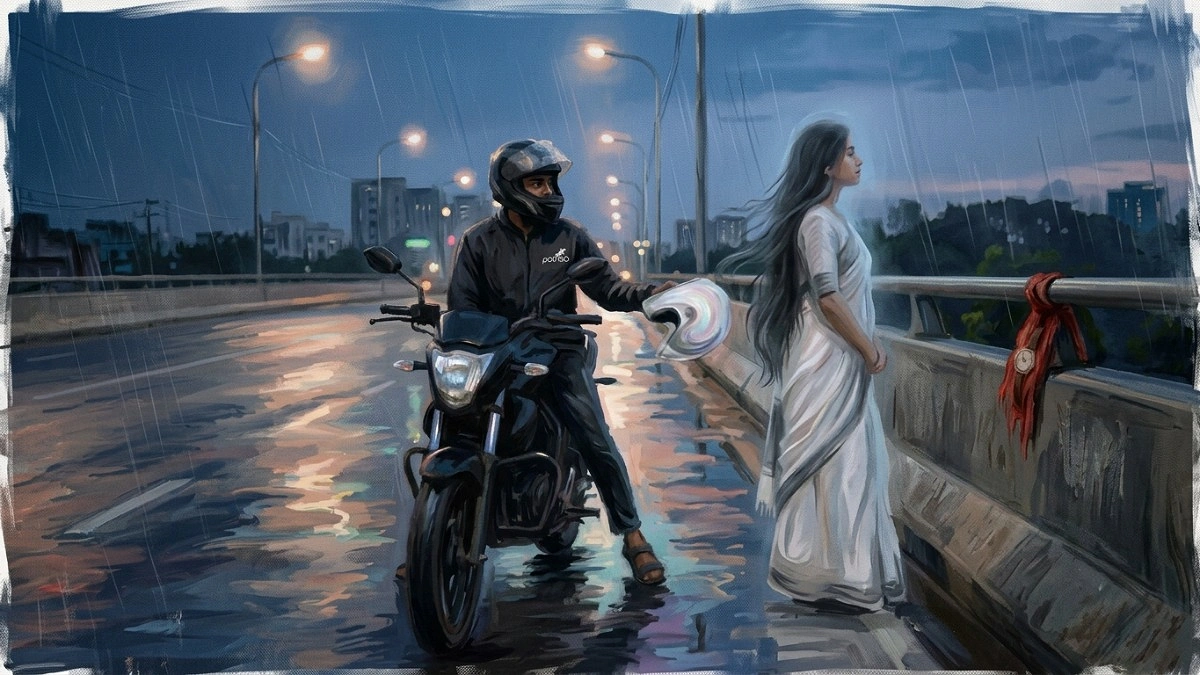
They reached the flyover just as the eastern sky was beginning to soften from black to a deep, bruised blue, signaling the approaching dawn. Rokib slowed the bike near the middle span of the flyover. There, tied to the railing, was a small, tattered piece of cloth faded to the color of old bone. It was the kind of informal marker families sometimes leave at accident sites, an unspoken monument to a grief that no one else remembers but everyone understands.
"Here," she said.
Rokib stopped the bike but did not put both feet down, keeping himself balanced and half-ready to flee. The woman dismounted without assistance. The bike did not register the loss of her weight. She walked toward the railing where the faded cloth was tied.
She stood there for a long time. Then she turned back, and for the first time since Rayerbazar, something resembling an expression crossed her face. It was not joy, but a weary, painful relief, the look of someone finally setting down a burden they had carried for so long they had forgotten what it felt like to stand up straight.
"Thank you," she said. "You did not have to be kind tonight. Most people are not, especially to a stranger who cannot even pay a proper fare. But you were, and it allowed me to see what I could not see for six years."
"Sister," Rokib said, his throat dry, "did you just see him?"
"I saw the truth," she said. "That is enough. He does not need to be standing here for me to believe he is gone. Sometimes a road is enough. Sometimes standing on the road that took someone away is the only farewell possible, and it takes a stranger to get you there. Grief alone cannot walk you to this place. It needs a living hand on the handlebars."
She reached into the folds of her white saree, and Rokib flinched, bracing himself for something terrible, like a hand that was not a hand. But what she pulled out was simply a small cloth pouch, the kind his own mother used to keep coins.
"Your fare," she said, holding it out.
Rokib did not want to take it. Every story of the dead warned against accepting anything from their hands, whether food, money, or flowers, because it bound you to them in ways the living could not undo. Yet her hand did not waver, and something in her stillness told him that to refuse her now, after the ride was done and the journey complete, would be an insult that might turn her gratitude into something else entirely.
He took the pouch.
"Stay well, sister," he said. It was the standard politeness he offered to any passenger, yet here it felt profoundly right.
"You too," she said. "Ride safe. The roads at this hour carry more passengers than the living account for. Not all of them will be as easily satisfied as I was."
Then she was gone. Rokib would spend the rest of his life trying to find the words to describe that moment. She did not vanish into smoke or dissolve into mist. She simply ceased to be there, the way a held breath is released, or the way a sustained note stops being a note the moment the bow lifts from the string. One moment a woman in a white saree stood by the railing. The next moment there was only the faded cloth, the railing, the lightening sky, and Rokib alone on his idling bike, listening to the loud beat of his own heart.
Five
He did not open the pouch until he reached his mess room. He sat on the edge of his bed while his roommate Habib slept and snored with comforting, human normalcy. His hands trembled as he untied the small cloth knot.
There was no money inside.
Instead, there was a man’s wristwatch. It was old, with a leather strap cracked with age and a scratched glass dial. Yet the hands were moving, keeping perfect time as if it had been wound that very morning. Rokib turned the watch over with trembling fingers. On the back, engraved in small, neat letters, was a name he did not know and a date from six years ago. Beneath the strap, where it sat against the wrist, was a faint discoloration in the leather, exactly in the shape of a small burn scar.
Rokib did not sleep that night, nor the night after. He never told anyone the whole story. He did not tell Habib, who would have laughed it off as a dream brought on by exhaustion and too much tea. He did not tell his mother, who would have worried and demanded he quit the night shift. He did not even tell the imam of the local mosque, though in the weeks that followed, he began going there more often, praying with a devotion he had not felt since he was a boy sitting beside his grandmother.
He kept the watch wrapped in cloth in a drawer. He never wore it, but something prevented him from selling it or throwing it away. He kept it with the understanding that it was not truly his to dispose of, but merely his to keep safe, the way you leave a door unlocked for someone walking a half-step behind you.
Rokib still rides for Pathao. He still takes the night shift because the fares are good and the roads are quiet. To the part of him that no longer disbelieves his grandmother's old warnings, he knows that some nights, the city needs a driver who is willing to go to places the app cannot name.
But he has one rule now, which he has never written down or spoken aloud to the Pathao office. It exists only in his mind alongside his knowledge of the potholes, flooded alleys, and flyover joints.
If a pickup pin drops without a name near a cemetery, a monument, or a crossroads after midnight, he still goes. He will always go, because between Rayerbazar and Uttara on that rainy night, he learned that the kindness owed to the dead is no different from the kindness owed to the living. A boy on a bike, no matter how tired or poor, holds more power than he knows to ease a lingering sorrow.
But he always, without exception, offers the extra helmet.
And he always listens to the very end of the story, no matter how long it takes, or how close the sky gets to dawn. He learned on that wet road that some rides are not measured in kilometers or taka. They are measured in the simple, terrifying, and sacred willingness to carry a stranger the rest of the way home.
Sometimes, in the dead of night, other Pathao drivers in that part of the city see a strange request pop up on their screens. A pickup near the memorial, with no address, only coordinates. It appears for a minute and then vanishes from the queue, never accepted, as if someone had placed the order and then decided at the last second that it was better not to ask a stranger for such a ride.
Most drivers swipe it away without a second thought, tired and hurrying to catch their next fare.
But occasionally, if you ask around the tea stalls where night drivers gather to smoke between rides, you will find one or two who remember taking it. They remember a woman in a white saree. They remember a flyover, a faded cloth tied to a railing, and a watch that keeps perfect time though no living hand has wound it in six years.
They do not talk about it much. But they always, always offer the extra helmet.
