
A city that still feels like home

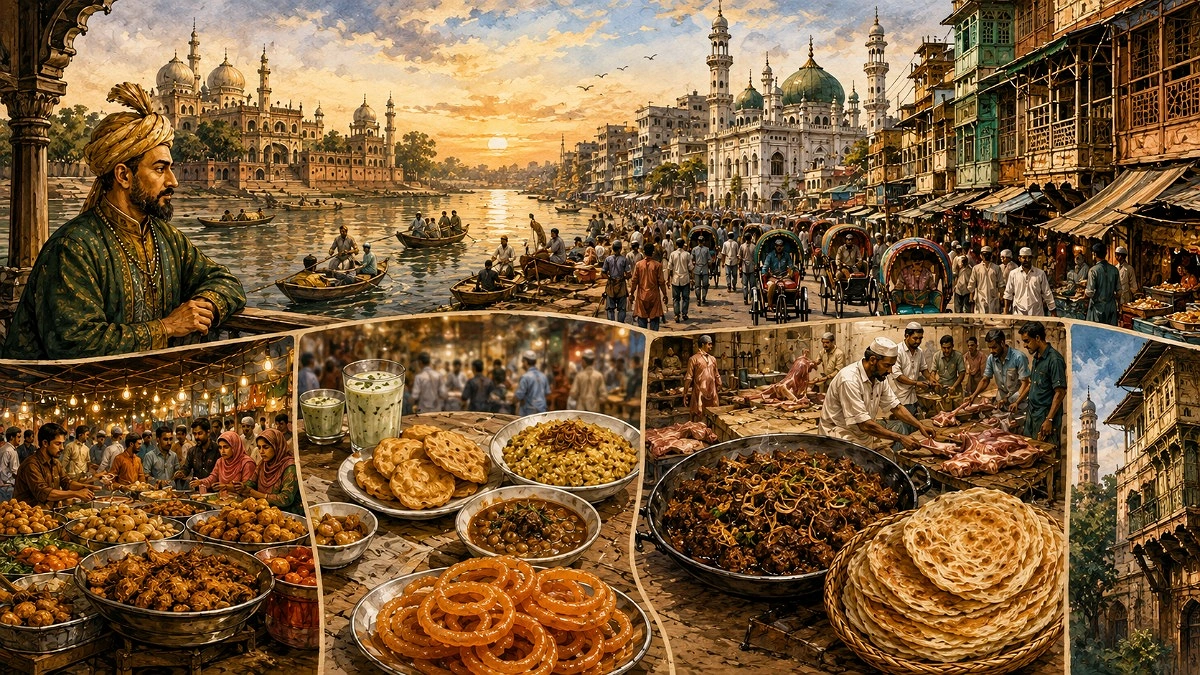
Graphics: Generated By AI
Every year, somewhere between the azan calling the city to Fajr prayer and the first rickshaw bell of the morning, Dhaka quietly adds another year to its age.
This year the number is 416, a figure historians trace back to around 1610, when the city was raised from a river town into the provincial capital of the Bengal Subah under the Mughal Empire. It is a number too large to hold in the mind all at once. Four centuries and more of monsoons, conquerors, traders, poets, rickshaw pullers and mosque muezzins have passed through the same narrow lanes that still exist today in the old quarters of the city.
For someone who has spent nearly a quarter of a century living inside those lanes, the number 416 is not just a line in a history textbook. It is the smell of hot oil rising from a roadside stove in Chawkbazar during Ramadan. It is the sound of a butcher’s cleaver on Eid morning. It is the particular, unmistakable crunch of a Baborkhani bread bought fresh and warm from a shop that has probably been standing on the same street corner since before independence. This is the story of that city, told through the lens of history, and through one resident’s own plate.
A CAPITAL BORN ON A RIVERBANK
Dhaka’s transformation from a modest settlement into an imperial capital did not happen by accident. In the early seventeenth century, the Mughal Subahdar Islam Khan Chishti was tasked with strengthening the empire’s grip over Bengal. The existing capital, Rajmahal, sat exposed on a riverbank and was considered vulnerable to attack. Islam Khan, a descendant of the Sufi family of Fatehpur Sikri and reportedly a childhood companion of Emperor Jahangir, set out on a journey along the Ganges in search of a safer, more strategic seat of power. He eventually chose Dhaka, a town already connected by water to much of Bengal through the Buriganga river and its tributaries.
In 1608, Dhaka was declared the new provincial capital, and Islam Khan renamed it Jahangirnagar in honour of the reigning emperor. Under Mughal rule, the city grew rapidly. Mosques, forts and administrative buildings rose along the riverbank. Traders from Persia, Armenia and beyond arrived to do business in a city that had suddenly become one of the wealthiest trading centres in the region, famous even then for its fine muslin cloth. Some historians point to settlements in the area going back a thousand years or more, tied to the legend of the Dhakeshwari temple, but it is the Mughal period that gave the city the shape, and much of the culture, that still defines its old quarters today.
The name Jahangirnagar did not survive long after the emperor’s death, and the city reverted to being called Dhaka. Even the question of when exactly the city was founded has never been settled among historians. Some argue that a settlement existed on the site for close to a thousand years before the Mughals arrived, tied to the legend of Raja Ballal Sen and the ancient Dhakeshwari temple. Others insist that Dhaka as a proper city, with the administrative weight and population that the word implies, began only with Islam Khan’s decision in 1608. The Asiatic Society of Bangladesh, in a major study published in 2011, largely supported the view that the city’s meaningful history as an urban centre begins in the early seventeenth century, which is why the anniversary marked today counts forward from around that period.
Centuries later, under British colonial rule, the city expanded well beyond its Mughal boundaries. New roads, courts and educational institutions were built, and Dhaka grew from a provincial river town into one of the major administrative centres of Bengal. After the partition of the subcontinent in 1947, it became the capital of East Pakistan, and after the Liberation War of 1971, it became the capital of an independent Bangladesh. Through all of it, one part of the city held on most stubbornly to its Mughal character. Locals call it Puran Dhaka, Old Dhaka, a tangle of narrow streets, mosques, old merchant houses and food stalls that has resisted the flattening effect of modern urban planning. Skyscrapers and shopping malls have reshaped much of the newer parts of the city, but in Puran Dhaka the skyline is still dominated by domes, minarets and the sagging wooden balconies of a hundred year old building line. It is here that the deepest layers of the city’s culinary memory still survive.
LIVING INSIDE THE OLD CITY
I have lived in Puran Dhaka since 2001. I moved there as a child, and what I remember most from those early years is not any single grand monument but the texture of daily life. The lanes were narrow enough that two rickshaws could barely pass each other, and yet somehow they always did. Old buildings with wooden balconies leaned over the streets, and beneath them ran a constant undercurrent of trade, spice sellers, cloth merchants, sweet shops that had been run by the same family for generations. Neighbours knew each other by name, and by the smell of what was cooking in their kitchen that evening.
Growing up there meant growing up inside a food culture that had been passed down almost unbroken since the Mughal period, adapted slightly with each generation but never abandoned. Old Dhaka’s residents, sometimes called Dhakaiyas, have their own dialect, their own festivals, and above all their own kitchen. To live there is to eat according to a calendar that has as much to do with food as with faith. Ramadan meant one set of dishes. Eid ul Fitr meant another. Eid ul Adha, the festival of sacrifice, meant something else again. Each one left its mark on me, and each one is tied to a very specific taste that I can still recall exactly.
THE IFTAR THAT BUILT A NEIGHBOURHOOD
Nothing captures the personality of Old Dhaka quite like its Ramadan afternoons. From around three in the afternoon, the streets around Chawkbazar begin to fill with makeshift stalls selling every kind of fried, roasted and syrup soaked food imaginable. This market is not a recent invention. Local historians describe the Chawkbazar Iftar bazaar as more than a century old, a tradition that has survived wars, floods and the transformation of the city around it, largely unchanged in spirit even as prices and crowds have grown.
Among the most famous items sold there is a dish with an almost mischievous name, Boro Baper Polao Khai, which loosely translates to something only the son of a wealthy father can afford to eat. It is a rich mixture of minced meat, potato, egg, brain and spices, cooked together and sold by weight, and it remains one of the signature tastes of an Old Dhaka Iftar table. Alongside it sit trays of piyaju, beguni, dal puri and alu puri, simple fried snacks made from lentils, potato and flour that have fed generations of fasting families at the exact moment the sun goes down.
My own Iftar plate always had its own version of this. We called it Khetapuri, a potato filled fried bread that we ate almost every evening during Ramadan, torn apart and dipped into a bowl of spiced chola or eaten simply on its own with a squeeze of lemon. It sat on our table next to a glass of borhani, the tangy, spiced yogurt drink that Old Dhaka claims as one of its own inventions, and a plate of khichuri, the soft, comforting mix of rice and lentils that so many Bengali households turn to when the fast finally breaks. There is something about that first bite after a full day of fasting, the softness of the khichuri against the crunch of the fried puri, that no restaurant recreation has ever quite matched for me.
As evening deepened into night, the real showpiece of Old Dhaka’s Ramadan would appear, the Shahi Jilapi. These are not the small, delicate jilapis found elsewhere in the country. Shahi Jilapi, said to have originated in the kitchens of the Dhaka Nawabs, are coiled sweets that can weigh well over a kilogram each, so large that they are usually shared between three or four people rather than eaten alone. Watching the halwais twist the batter into wide golden spirals and lower them into boiling oil was, for me and every child on our street, one of the great free entertainments of the Ramadan evening. We would gather around the stall, watch the jilapi puff and darken, and wait for the moment it came out dripping in syrup, still too hot to hold properly, and had to be passed quickly from hand to hand until it cooled enough to eat.
What struck me most, even as a child, was how this entire ritual was not really about the food alone. It was about the street becoming a shared kitchen, families cooking at home but also buying from neighbours, sending plates of food across rooftops and through open windows to relatives a few houses away. Ramadan in Puran Dhaka has always felt less like a private act of fasting and more like a communal performance repeated every single evening for a month, with food as its central language.
THE MEAT OF EID UL ADHA
If Ramadan belongs to fried snacks and shared sweets, Eid ul Adha belongs entirely to meat. The festival marks the story of the Prophet Ibrahim, commanded to sacrifice his son Ismail as a test of faith, a command that was ultimately replaced with the sacrifice of a ram. Muslims around the world mark the day by sacrificing livestock, usually a cow, goat or sheep, and dividing the meat into shares, one portion for the family, one for relatives and friends, and one for those in need.
In Old Dhaka, the days before Eid ul Adha have their own atmosphere entirely separate from the rest of the year. Cattle markets spring up on open ground across the city, and children spend their school holidays wandering from one to another, comparing the size of the cows, feeding them leaves, arguing about whose family had bought the best animal. On the morning of Eid itself, after the prayers, the sound of butchers at work becomes the defining noise of the neighbourhood, replacing the usual traffic and street vendors for a few hours.
What comes after the sacrifice is, in many ways, the real heart of the festival for those of us who grew up eating it. Families across old Dhaka would prepare what is known locally as Jhuri Mangsho, though in my own household we always called it Jhura Mangsho. The meat is cooked slowly, fried down with onions and spices until it turns dry and deeply concentrated in flavour, a preparation method that in earlier decades, before refrigerators were common in every home, served a practical purpose as much as a culinary one. It kept the meat edible for days without spoiling. Even now, with freezers in most homes, many families in Old Dhaka continue to make it this way simply because nothing else tastes quite like it.
For me, Jhura Mangsho was never eaten on its own. It appeared on the table alongside warm Baborkhani, the flaky, layered bread that has been associated with Old Dhaka’s Nawabi kitchens since at least the middle of the eighteenth century. According to local legend recorded by the writer Nazir Hossain in his book on the folklore of Dhaka, the bread takes its name from Aga Bakar Khan, a general said to have served under the Nawabs of Bengal, and Khani Begum, a court dancer he was deeply in love with. The story tells of a rival who abducted Khani Begum, a false rumour that Aga Bakar Khan had killed the man, and a punishment that saw him imprisoned. It was during that imprisonment, so the story goes, that he first created the bread, combining the two names, Bakar and Khani, into the word Baborkhani that Dhaka still uses today. Whatever the true origin, the bread itself, baked in large clay ovens until its many thin layers turn crisp and golden, has become inseparable from the Old Dhaka breakfast table, especially on the morning of Eid.
Tearing off a piece of warm Baborkhani and eating it with a spoonful of Jhura Mangsho, the dry, richly spiced meat clinging to the bread’s flaky layers, is one of the clearest food memories of my childhood. It is not a dish found on restaurant menus outside the old city in quite the same form. It belongs to home kitchens, to grandmothers and mothers who learned the recipe from the generation before them, adjusting the spice slightly each year but never changing the method. Eating it always felt like eating something that had survived, quietly and without fuss, through every political change and every new building that had gone up around our neighbourhood.
WHAT FOUR HUNDRED SIXTEEN YEARS TASTES LIKE
There is a strange comfort in realising that the dishes on my family’s Eid table, and the fried snacks that lined our Iftar plate every evening of Ramadan, are not new inventions. They carry traces of Mughal kitchens, of Nawabi courts, of a city built deliberately on a riverbank for strategic reasons that no longer matter to anyone eating jilapi on a plastic stool in Chawkbazar today. Dhaka has been a capital under the Mughals, a colonial administrative centre under the British, and the capital of an independent nation since 1971. Empires have risen and fallen around it. What has remained constant, at least inside the lanes of Puran Dhaka, is the rhythm of the food calendar, the shared plates, the smell of oil and spice that marks each religious season.
Living in Old Dhaka since 2001 has meant living inside that continuity, sometimes without fully realising it. As a child eating Khetapuri at Iftar or Jhura Mangsho on Eid morning, I was not thinking about Islam Khan Chishti or the founding of Jahangirnagar. I was thinking about whether the jilapi stall would run out before we got there, or whether my share of the Baborkhani would be big enough. It is only now, looking back at 416 years of the city’s history, that the connection becomes obvious. The food is the history. It is the part of the past that never needed a museum or a monument to survive, because it was cooked fresh every single year, in every single home, and passed down simply by being eaten together.
Every anniversary of the city brings its own small wave of newspaper articles, television segments and social media posts revisiting the story of Islam Khan and his choice of a riverbank capital. Historians will debate, as they always do, exactly how many years should be counted and from which precise year the clock should start. For most residents of Puran Dhaka, that debate matters far less than the far simpler fact that the neighbourhood is still here, still cooking the same dishes, still filling the same narrow lanes with the same smells every Ramadan and every Eid. The city’s official age is a matter for historians. Its lived age, the one that matters at a dinner table, is measured in recipes that have not needed to change.
As Dhaka marks another year of its long life, the old city continues to do what it has always done best, feeding itself according to memory rather than instruction. The cattle markets will return before the next Eid ul Adha. The Chawkbazar stalls will set up again as soon as the next Ramadan moon is sighted. And somewhere in a kitchen in Puran Dhaka, a new generation of children will watch a jilapi puff up in hot oil, or tear into a warm piece of Baborkhani, and begin building the same kind of memory that has kept this four hundred and sixteen year old city tasting, in its oldest quarters at least, remarkably like itself.
