
The night before the Goddess: Inside Bhoot Chaturdashi


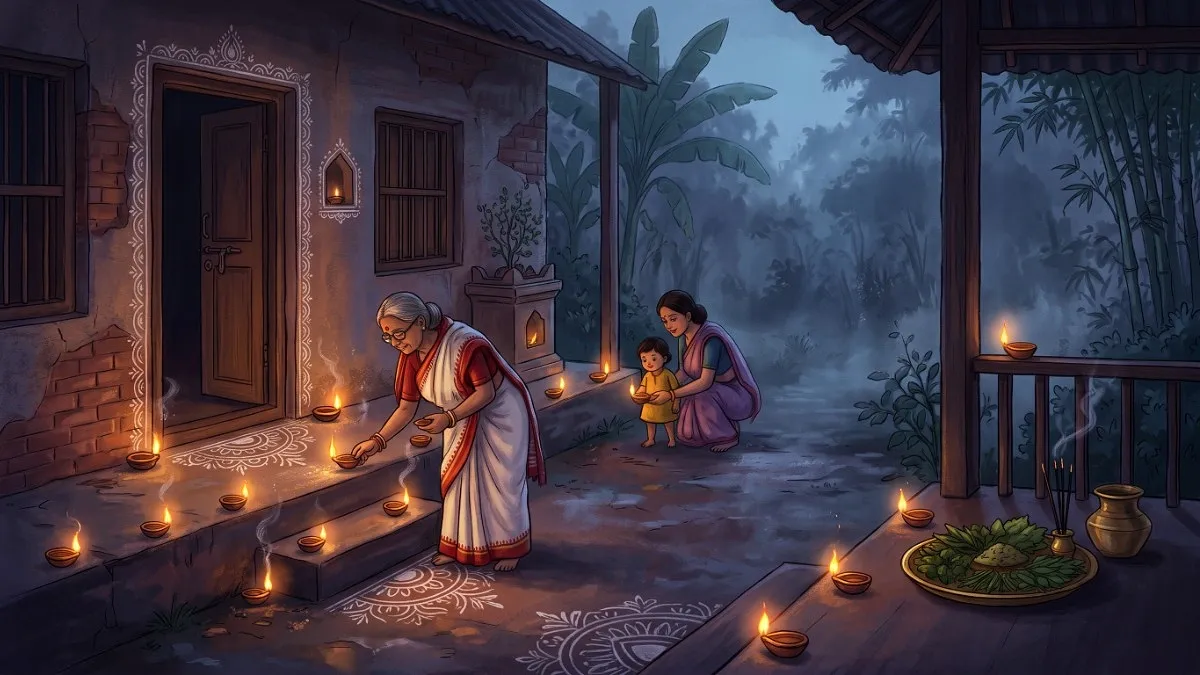
Generated by AI
Every year, as autumn thins into the first cool evenings of Kartik, Bengali households prepare for a night that belongs to the unseen. Bhoot Chaturdashi is a ritual of memory, fear and food, and it arrives just before Kali Puja. It is part ancestor worship, part folk medicine and part ghost story, and it asks the living to remember that they are never entirely alone in their own homes.
A date written in the moon
The festival follows the lunar calendar. It falls on the fourteenth lunar day of the dark fortnight in Kartik, and Bengali Hindu families mark it by lighting fourteen lamps at dusk and eating fourteen kinds of leafy greens. The timing is deliberate. It comes the day before Kali Puja, which is held on the new moon night that coincides with Diwali. Elsewhere in India the same day is known as Narak Chaturdashi or Kali Chaudas, and it is sometimes called the small Diwali.
That placement matters. The fourteenth day is the last stretch of waning light before the darkest night of the month, the moment when the moon has almost vanished and the boundary between worlds is said to be at its thinnest. Bengal chose to meet that darkness with small flames, bitter leaves and the names of the dead.
Welcoming the ancestors, warding off the rest
The belief at the heart of the festival is gentle. Tradition holds that the veil between the living and the dead grows thin on this night, and the spirits of fourteen ancestors return home for a brief visit, to see whether they have been remembered rather than to frighten anyone. These fourteen forebears are known as the choddo purush, and each lamp is often understood as a welcome for one of them.
But the night has a second purpose. Families welcome their forebears but also try to keep out unholy spirits that might follow them in. The house becomes a threshold. Lamps are set along doorways, corners and courtyards, so that the ancestors find their way in while anything unwelcome finds nothing to hold on to. It is a protective ritual and a reverent one at once, and Bengali folk belief has never seen a contradiction in that.
The plate that carries the tradition
Food holds the ritual together, and it is where the festival feels most practical. The meal usually features rice, lentils, greens and vegetarian dishes, and some homes begin with something bitter or skip fish and meat entirely. The bitter opening is an old Bengali habit, a way of clearing the palate and, as many grandmothers would insist, the body.
The fourteen greens are the signature of the day, and they are tied to the turning season as much as to belief. The custom is linked to nature, seasonal change and older herbal practice. The weather is shifting from the damp of the monsoon toward the dry chill of winter, a time when colds, stomach troubles and skin complaints were once common. Some of the greens are credited in traditional medicine with aiding digestion and easing joint pain and skin complaints. Which fourteen appear on the plate varies from household to household, but the principle is constant. A spiritual practice and a seasonal health practice sit side by side, and nobody feels the need to separate them.
Light as a language
The lamps deserve their own attention. Fourteen small flames, usually clay lamps filled with oil, are a modest thing, yet they do the work of an entire liturgy. They mark the house as occupied by people who remember. They say to the ancestors that the family has not forgotten and say to the shadows that this threshold is guarded. In a season when darkness arrives early, the act of lighting them is also simply human. It is a way of answering the dark with something small and steady.
The Bengali Halloween, with a difference
The festival is often called Bengal’s Halloween, and the comparison is hard to resist. Both fall in the shadowed weeks of autumn and both involve the dead. But the resemblance is shallow. Halloween runs on costumes and sweets, while Bhoot Chaturdashi is a quieter observance built around remembrance, protection and the rhythm of the seasons. It is not a recent import either, and it predates the modern Western fascination with ghouls and goblins. It is a night for sitting with the dead, not dressing up as them.
A festival that has found new stages
Even so, the modern world has pulled the ghosts into the spotlight. In Kolkata’s Kumartuli, the idol makers’ neighbourhood, a market for clay ghosts does lively business on this day, drawing Kali Puja committee organisers who come for goddess idols and stay to browse the spectral figures. The ghosts, in other words, are now a craft, a commodity and a crowd puller.
Television has joined in. A Bengali reality show staged a special episode this year with a scripted haunting task for its contestants, including a ghostly face appearing suddenly in a mirror. It is a long way from lamps in a courtyard, yet it shows how comfortably the festival fits into popular entertainment.
The ghost on the Bengali screen
Cinema has been the festival’s most loyal companion. Media outlets now compile lists of Bengali ghost films for the occasion, and they note that Bengali affection for ghost stories, from the shankhchunni to the petni, has never faded and has simply moved onto the screen. Those ghosts have frightened audiences, made them laugh and become tangled in the strange mysteries of ordinary lives. Titles such as Kankal and Manihara, both drawn from Tagore’s tales, regularly appear on such lists, a reminder that the Bengali ghost story is also a literary tradition with deep roots.
What makes the Bengali ghost distinctive is how personal it is. These spirits are rarely faceless horrors. They are a grandmother’s cautionary figures, a drowned bride, a neighbour who never quite left. They live in the same villages and lanes as the living, and that closeness is exactly what Bhoot Chaturdashi celebrates.
Why it endures
Bhoot Chaturdashi lasts because it does something few festivals manage. It lets a community be afraid and affectionate in the same breath. The ghosts are frightening and also family. The bitter greens, the fourteen flames and the quiet roll call of ancestors are how Bengal keeps a conversation going with those who came before.
In an age of constant noise, there is something almost radical in a tradition that asks a household to light a lamp, eat simply and remember. It does not demand belief in ghosts. It only asks that, for one night, we make room for the past.
