
I created the format of the book fair

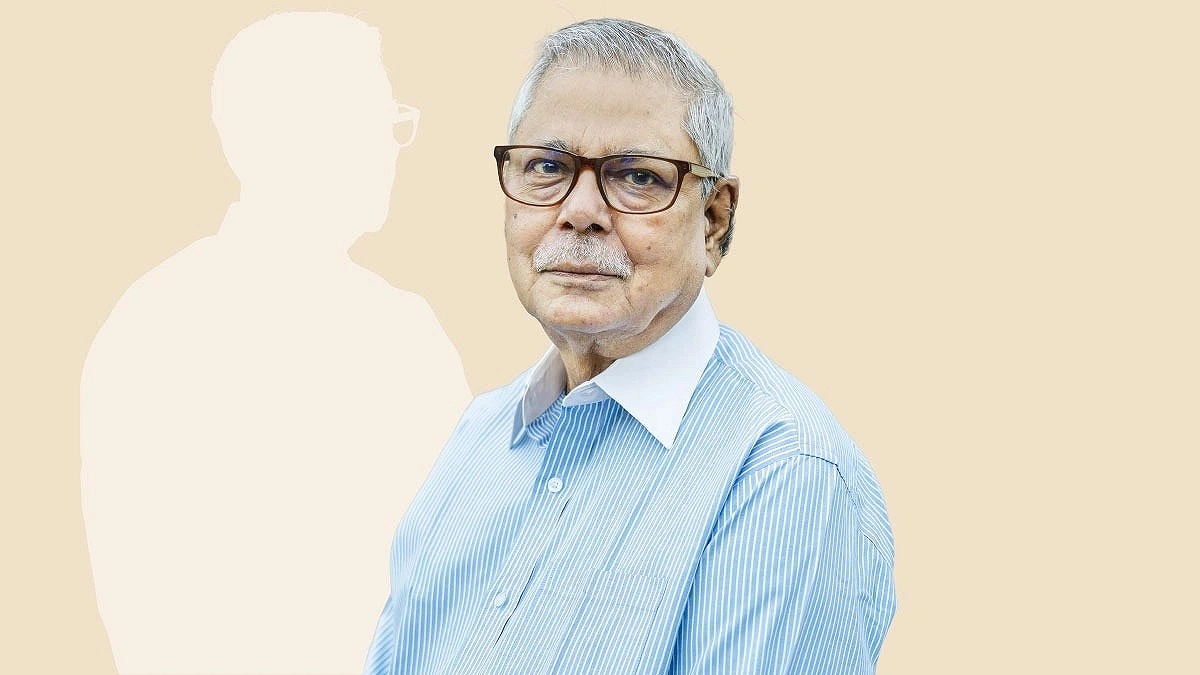
Photo: Sazzad Hossain
In 1972, in independent Bangladesh, he worked behind the scenes to organize Dhaka's first international book fair. He also organized the book fairs of the National Book Centre. He was a consulting editor at UPL. Omar Shahid and Aklaku Zzaman Anik spoke with book expert Badiuddin Nazir about his career.
How did you become acquainted with books?
I was born in Kolkata. There was a culture of studying at home and we also had a home library. My mother was a very good reader. I finished reading Bankim Chandra's works by the time I was in eighth grade. So my childhood was very enjoyable. There was a magazine called ‘Poygam’. I also used to write for it. But my mother died when I was 13. From then on, my life turned upside down.
Why did you come to this country?
I left after having an argument with my father. I was studying for an honors degree in anthropology at Calcutta Science College. I left in 1968 without completing my studies. I stayed at the home of my younger paternal uncle P.A. Nazir. He was a CSP officer. He was the chairman of DIT (Dhaka Improvement Trust). I left his home after the mass movement of 1969. I did many odd jobs during that period.
How did you join the job?
In 1972, many intellectuals from Kolkata came to the February 21 program at Bangla Academy, including Manoj Basu, Prabodh Sanyal and Sunil Gangopadhyay. I was joking around a lot with Manoj Basu. Sardar Jayenuddin, acting director of the National Book Centre, was also there. He called me and said, ‘Hey, what do you do?’ I said, ‘I do nothing. I am unemployed.’ He said, ‘Then come to our National Book Centre.’
The National Book Centre was on the second floor of the Scout Building on the northern side of Baitul Mukarram. I went there. Sardar Jayenuddin asked me to join. I was not very interested because by then some friends and I had started a primary school in Malibagh. I was busy with those things. Still, I joined.
What did you do at first?
In 1972, an ‘International Book Fair’ was held on the Bangla Academy grounds here to mark UNESCO's ‘International Book Year’. I became deeply involved in that work. I decided that foreigners would have stalls on one side and local publishers on the other. There were cultural programs. There were stick fighting performances, poetry battles and various other events. A lot of people attended. It was a very successful fair.
The publishers must have been very happy, right?
Of course. This was the first of its kind in Bangladesh. It had never been held before. Foreign publishers did not sell books. Only the local publishers sold books and they had good sales. They were very happy. As a result, when the book fair was held in 1974, publishers joined without hesitation. While doing this work, I became involved in various activities of the National Book Centre.
What kind of work did you become involved in?
Sometimes I worked in sales and sometimes in other areas. Later, the National Book Centre established the ‘Mahanagar Pathagar’. It has since been removed. The library was in a red building opposite the Golap Shah Mazar in Gulistan, Dhaka. I was the founding librarian. The position was between the director and deputy director of the National Book Centre. Then the ‘Book Development Project’ of the National Book Centre was launched. I was transferred there as its head.
An important work was done by me. The introduction of ISBN in Bangladesh. Without this, books cannot be exported abroad.
You also contributed to the first national book fair of the National Book Centre.
In 1974, I was the exhibition officer of the National Book Centre. That year, Bangladesh's first national book fair was held through my efforts. Before that, fairs were never organized with individual stalls arranged like racks and shops. The government gave the National Book Centre Tk 100,000 to organize the fair. The previous year, Sardar Jayenuddin had gone to the Frankfurt Book Fair and brought back some literature. It described what their stalls looked like and what rules applied when participating. In 1974, we organized the first national book fair by adapting the rules and regulations that were possible for us to adopt. The following year, I organized it in Chattogram. It was excellent. The year after that, it was held in Khulna. After a long time, in 1994, the national book fair was reorganized on a larger scale under the name ‘Dhaka Book Fair’. I also prepared its blueprint, plan and program.
Were you also involved in the Bangla Academy book fair?
Interestingly, the ‘Amar Ekushey Book Fair’ of Bangla Academy was called the ‘Ekushey Book Fair’. It officially began in 1979 and ran from February 8 to February 28. I was also responsible for it because the National Book Centre had organized the first year. From the following year, however, Bangla Academy began organizing it itself. The current format of the Bangla Academy book fair was created by me. All the rules were taken from the first year. It is still operating according to those rules.
How did the idea of holding a book fair at Bangla Academy come about?
Publishers used to arrange book sales on their own initiative at Bangla Academy to mark Ekushey. In 1979, Fazle Rabbi was the director. The publishers went to him and requested that a fair be held here. He agreed to the publishers' request. Bangla Academy Director General Ashraf Siddiqui was also present at that meeting. He said, ‘Okay, I will also cooperate.’ But the fair was held entirely with funding from the National Book Centre. It cost Tk 40,000 to organize the fair at that time. Justice Abdus Sattar inaugurated it. Bangla Academy only allowed its grounds to be used. Publishers participated with their own books.
Since 1974, the National Book Centre's fairs had a pattern. We would build the stalls ourselves. Even the shop banners. Publishers would simply bring their books and sell them. They would take the books away afterward. They would pay rent for the space. Publishers did not have to do anything themselves here. This model came from the Frankfurt Book Fair. Fairs are organized this way in all countries around the world. But because the 1979 fair took shape and had good sales, Bangla Academy itself took responsibility for the fair in 1980. The National Book Centre could not take responsibility because it had other work related to organizing National Book Week across the country. In this way, the fair began with funding from Bangla Academy.
No writer in Bangladesh thinks anyone has the right to interfere with their writing. Improving the quality of writing is very difficult in this situation.
Did you do any other work at the National Book Centre?
While I was there, I did various kinds of research. The important work was the introduction of ISBN in Bangladesh, which I personally handled. ISBN means International Book Number. The number printed on a book was introduced in Bangladesh through my efforts.
Why did you do this?
Without it, books cannot be exported abroad. The ISBN number is basically a file number. All the issues related to a book are recorded under its name. There is no need to create a separate number for it. It is generated automatically. This number is such a thing that no matter which country you go to, the number of a book will never be different. Two books will never have the same number. Wherever you go in the world, this number will refer to this particular book.
You also organized poetry readings at the book fair.
At the 1972 fair, I kept about 45 minutes for Bangladeshi poets to read one or two of their poems. We could not give space to every poet in Bangladesh. We selected about eight people. I had only suggested Abul Hasan's name so that he could read his poems.
The famous poet Abul Hasan?
Yes, he died young. He was my friend and a very close one. We could spend a lot of time chatting. He used to swear at me a lot. He was one year older than me. I was an admirer of his poetry. But because of addiction and other things, he ended his life prematurely. He was sent to Germany for treatment. They sent him back from there too. They said there was no way for him to get better. After returning to Dhaka, he again became involved in those unhealthy habits and neglected his health. That was how he died. He was very open hearted. His handwriting was very beautiful. He always had blue and sky-blue writing pads with him. If someone asked, he would write a poem for them.
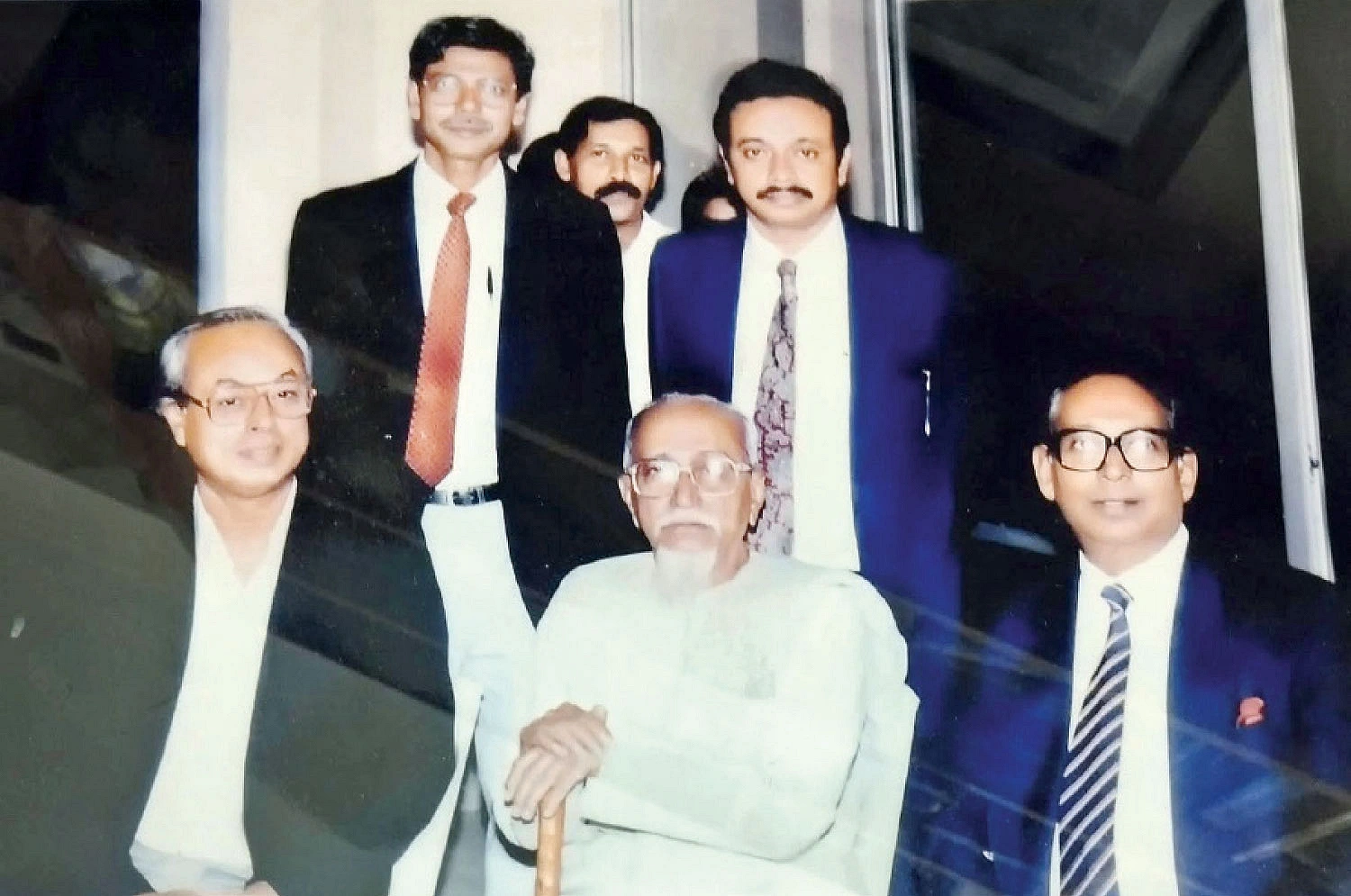
[In a photo taken at an event in 1991, from left, writer and researcher Maidul Hasan, National Professor Abdur Razzaq, UPL head Mahiuddin Ahmed, and in the back Badiuddin Nazir, Dr. Kamal Siddiqui and printer Toffazzal Hossain]
How did you become associated with UPL?
My relationship with UPL (University Press Limited) dates back to 1972. I went to Delhi in 1980 for two years of training. After completing my studies and returning, Mahiuddin Ahmed, the owner and managing director of UPL, appointed me as one of their resource persons. It was not a job. A publisher may have economics books, history books, mathematics books and sociology books. It is not possible for an editor to look after all of them. What the publisher does is give them to people in their pool. University professors, government officials and many others used to work for UPL by reviewing manuscripts. In this way, I practically worked at UPL for half a day. I could not do it for four years because I had left the National Book Centre and worked as a program coordinator in the Material Development Unit of Gonosahajjo Sangstha. UPL's office was in Motijheel and my workplace was on Asad Avenue. Then I returned to UPL.
What kind of work did you do there?
I joined UPL as a ‘Consulting Editor’ in 1999. I had to work on how books could be produced, how they should be produced, who should be assigned to do the work, who should be asked to write a book and how a manuscript should be evaluated when it was submitted. I also had to determine whether it was suitable for publication and what additional editing was needed before publication. Then the book would be printed. After Mahiuddin Bhai, I had to handle almost all the responsibilities of the organization at UPL. I did everything except accounts. I stayed there until 2016.
How did you get ‘Prodoshe Prakritojon’, published by UPL?
The first volume of ‘Prodoshe Prakritojon’ was published in Bichitra. The book has two volumes. I was studying in Delhi at the time. I bought Bichitra and read it while traveling because I planned to read on the road. After completing my studies and returning, one day I saw Shawkat Ali visiting the National Book Centre to spend time with us. I said, ‘How is your book doing?’ He said, ‘What can I say, Nazir? It is difficult to find a good publisher in Bangladesh. I cannot find anyone.’ I said, ‘Leave it with me. I will not tell you now which publisher will publish it. I will arrange it.’ Shawkat Bhai left it with me. I went to UPL and told Mahiuddin Bhai, ‘Publish this book. The story is set in a very old period and the prose is distinctive.’ I explained the book's strengths to him. I was their resource person at the time. Their editor was Naeem Hasan. I briefed Naeem as well. ‘Prodoshe Prakritojon’ was published.
‘Chhilekothar Sepai’?
When ‘Prodoshe Prakritojon’ was going to be published, Shawkat Ali told me, “Nazir, Akhtaruzzaman Elias is writing a serial called ‘Chhilekothar Sepai’ in weekly Robbar. Publish it. It is very good.” His writing was not finished at the time. I went to UPL and told them, ‘When the book is finished, acquire it and arrange to publish it by any means necessary.’ Hasan ran around and arranged everything. Akhtaruzzaman Elias did not have a single book before that. Nobody knew him. Why would they publish his book? Because of Shawkat Ali's recommendation, it was published easily.
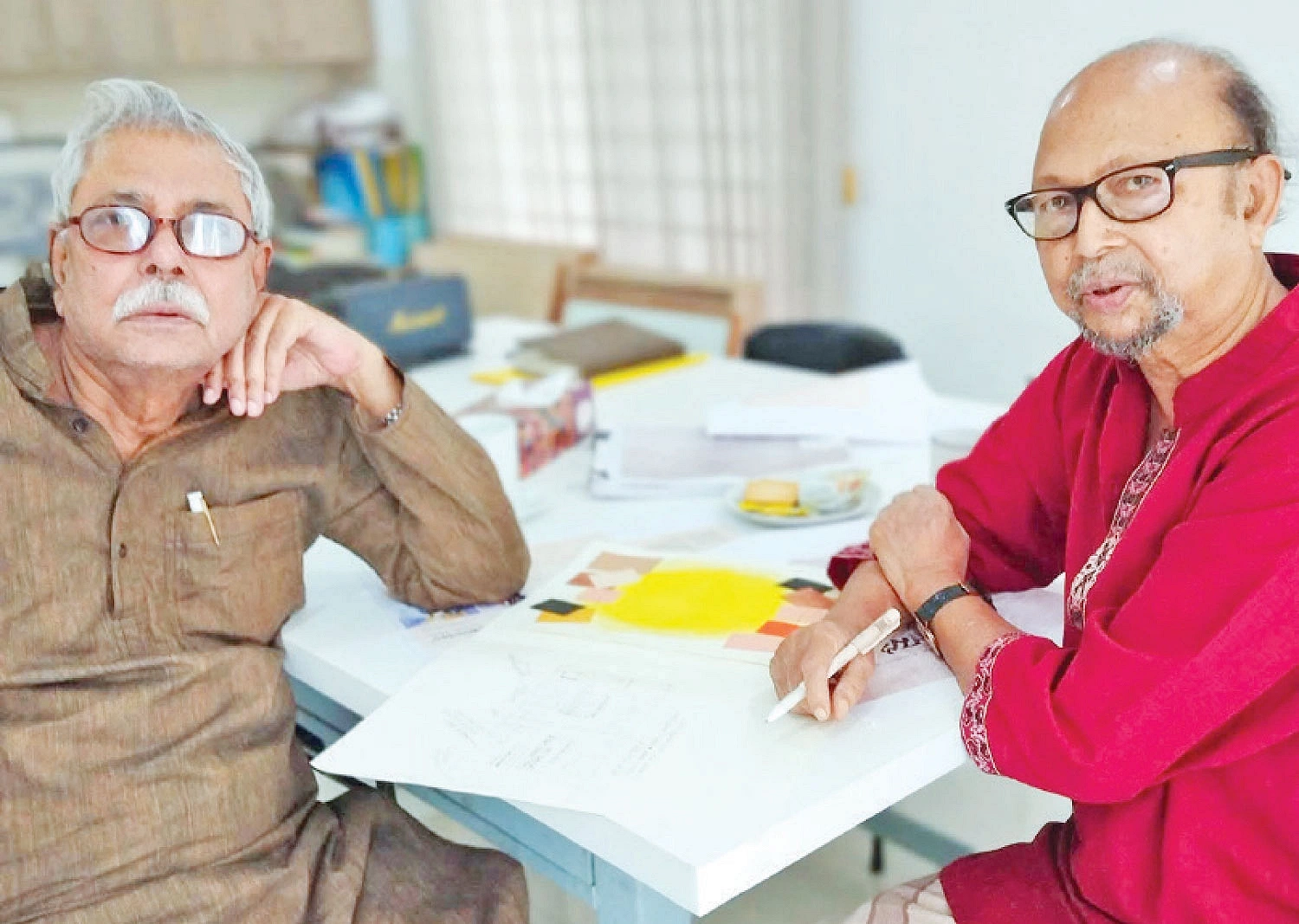
[Renowned artist Hashem Khan with Badiuddin Nazir]
You also contributed to ‘Porarthoporotar Orthoniti’.
Akbar Ali Khan was the finance secretary at the time and a very good friend of Mahiuddin Bhai. He had gone to the Secretariat to meet him. Akbar Ali Khan handed him the manuscript. Mahiuddin Bhai said, ‘This will end up in Nazir's hands. I cannot say what he will do.’ Mahiuddin Bhai really wanted me to publish the book. As soon as I read it, I understood that the book had a future and I also worked on the book a little.
What kind of work?
I prepared a ‘glossary’. The author was not willing at all. But it benefited the readers. Interestingly, when ‘Porarthoporotar Orthoniti’ was reviewed in the magazine ‘Desh’, the first two paragraphs were about that glossary. Then they discussed the book. Akbar Ali Khan realized then that the book had been improved. As an editor, I provided this input. He acknowledged that he benefited from my advice. He also wrote about it.
What other work did you do at UPL?
While I was at UPL, I introduced the ‘Grand Sale’ in Bangladesh for the first time in 2001. They had accumulated many old books. Instead of selling them by weight, the books were sold at a discount. After UPL did it for a few years, everyone followed the practice. When I joined UPL, there was no counter or sales center in Banglabazar. I established the Banglabazar sales center to make buying and selling books easier. Their sales increased as a result. Many others later established sales centers.
How did Mahiuddin Ahmed view you?
He treated me like a younger brother. We had a friendly relationship. He paid me a salary, but he never treated me like an employee. He was an educated man. He stood first in first class in English journalism at Punjab University. He joined there as a lecturer. From there, he joined the editorial department of the Karachi branch of Oxford University Press Pakistan. After independence, he established UPL.
How did you improve the quality of books?
Look, no writer in Bangladesh thinks anyone has the right to interfere with their writing. Improving the quality is very difficult in this situation. When writers allow it, you have to change sentences while working on their writing. If necessary, you have to remove paragraphs and write new ones. Perhaps the writer could not draw a proper conclusion. You have to write the conclusion yourself. Sometimes you can get the work done by telling the writer directly.
What was the main work of your career?
Book development. I devoted my life to the development of books in Bangladesh.
What is your advice for those of us who want to write books?
It is difficult to explain everything one by one. That is why I wrote a book called ‘Author's Preparation for Book Publication’, detailing everything that needs to be done from beginning to end. The second one is ‘Book Publishing in Bangladesh’. Then I wrote ‘Book Development in Bangladesh’. The book was written to explain how the actual development of books should be done.
You have also written books for children, right?
I have several books of fairy tales. About five children's books have been published this year alone. There must be 10 to 12 books in total.
(June 30, 2026, Dhanmondi, Dhaka)
