
Humayun in the nights of Dhaka

Graphics: Agamir Somoy
Humayun Ahmed’s many narrative works have sparked debates over whether they should be classified as novels or novellas. ‘A Few Young Men in the Moonlight’ could invite a similar discussion. Given its short length, the work can conventionally be called a novella. However, despite its limited scope, the portrayal of characters, psychology and society presented by the author is quite extensive. For many years, it has remained one of my favorite stories.
Humayun’s storytelling has always been remarkably effective. In this narrative from the 1980s, the characters gradually come into view. Readers first get a glimpse of who they are before the author draws them into the story. It is somewhat similar to his television series ‘Aj Robibar’. As readers become acquainted with the characters, they gradually find themselves immersed in the story without realizing when it happens. ‘A Few Young Men in the Moonlight’ begins in much the same way. There is no rush anywhere in the narrative. At first, the storytelling technique is not particularly noticeable. However, by the end, readers realize how meticulously every incident has been arranged.
The narrative revolves around a full moon night in the Bengali month of Ashwin. In keeping with its title, it could be called a story touched by the moon. Humayun takes readers into the atmosphere of that night.
The city’s moon, rain-soaked streets, a few disillusioned young men and the experiences of a man returning home after many years combine to create a world where something unusual lies waiting within the ordinary.
The novelist’s description reads: “October 12. A full moon evening. In the city, the full moon cannot be seen as soon as evening sets in. One has to wait quite a while. City dwellers do not bother much about the full moon. Full moon and new moon are not urban concerns.”
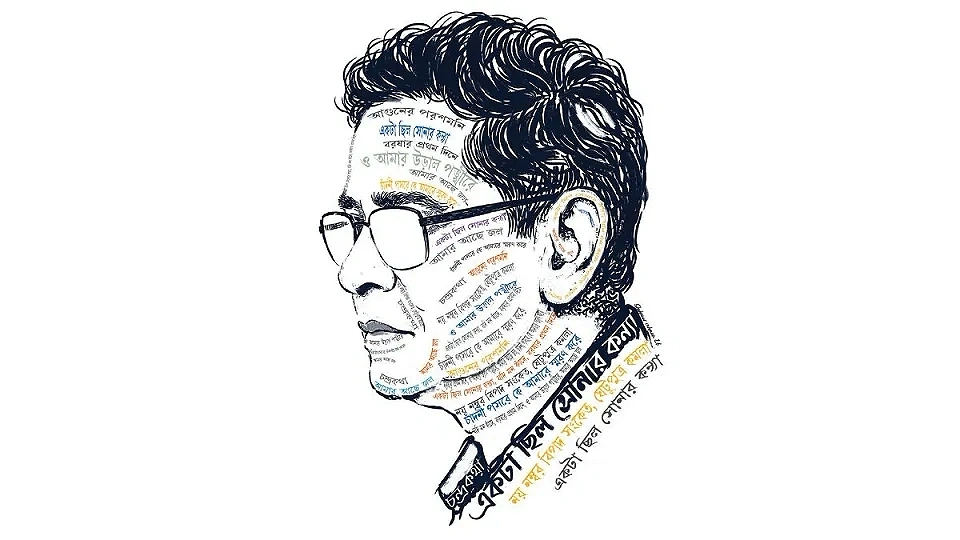
Humayun Ahmed (November 13, 1948 to July 19, 2012). Illustration: Sohanur Rahman
Critics have long accused this celebrated post-independence Bangladeshi fiction writer of leaving the contemporary social and political realities of his time largely absent from his writing. The story ‘A Few Young Men in the Moonlight’ is set during the rule of General Ershad. The influence of that period is reflected in the characters’ conversations and various incidents throughout the narrative. Reading the book gives the impression that the author wanted to capture not only the lives of a few young men but also the time they lived in.
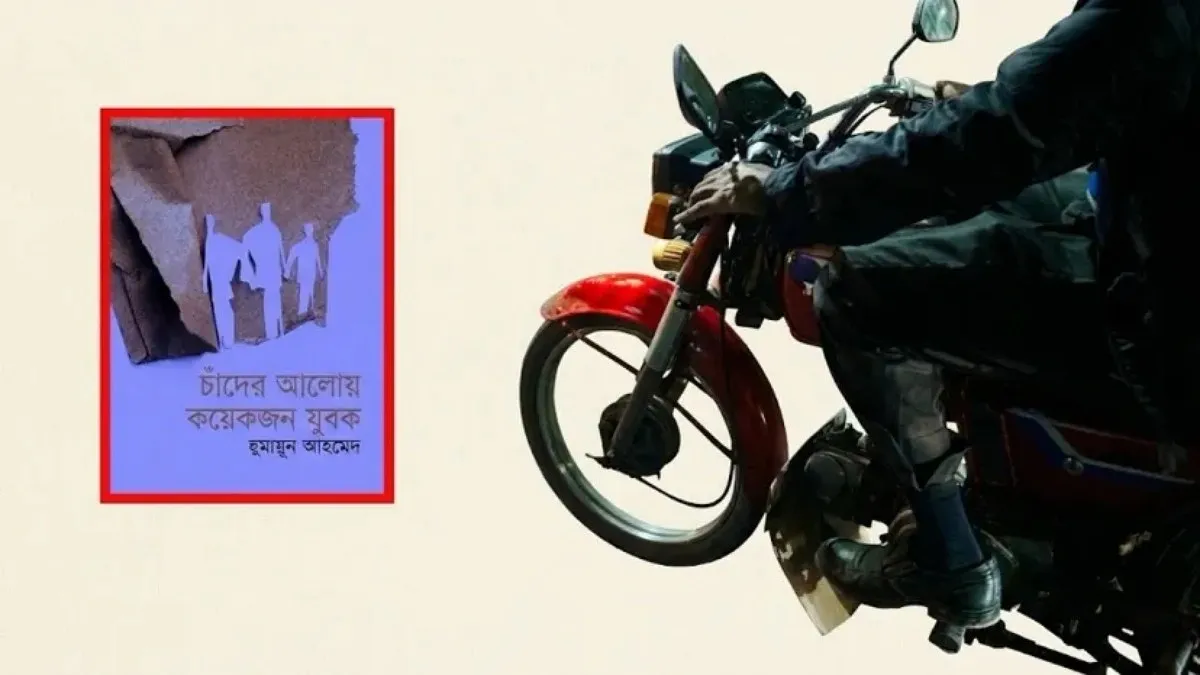
The book’s cover was designed by Mashuk Helal. In one of his writings, he recalls exploring Dhaka at night with Humayun during the 1980s. According to him, Humayun would occasionally venture out to see the city at night. Mashuk sometimes accompanied him. They visited railway stations and wandered through the streets. It can be assumed that these experiences informed the writing of ‘A Few Young Men in the Moonlight’. This is because nighttime Dhaka is not merely the backdrop of the narrative. It almost functions as a separate character.
The story centers on three young men: Alam, Majid and Mahin. Each of them has some irregularity, frustration or discomfort in his life. They have not come together simply because of friendship. They are isolated and distressed by various personal, family and social problems. Their decision to spend the night together stems from an attempt to forget everything.
Mirza Saheb eventually joins the three young men. He has returned to the country after many years, accompanied by his 13-year-old daughter, Pauline. They are staying at a hotel in Dhaka.
Mirza Saheb leaves his daughter at the hotel and goes out to explore the city at night. Within a few hours, his path crosses that of the three young men. Before this encounter, readers see the city through Mirza Saheb’s eyes.
Humayun’s famous character Himu presented nighttime Dhaka to readers from a different perspective. Photo: Omar Faruk
“The sky is cloudy. Lightning flashes from time to time. Does the sky over Bangladesh remain cloudy at this time of year? Today is October 17. I wonder which Bengali month it is. The English calendar tells you nothing. The Bengali months bring scenes straight out of a painting. Shravan means drizzle falling gently. The kuchu plants are a soft green. Water has collected here and there. The sky is gray. In Chaitra, the sun blazes fiercely. The sky is deep blue and so clear that the eyes seem to slip across it. Kites fly in the sky.”
Among the three young men, Majid is the most unusual character in this narrative. He is intelligent and courageous but unsuccessful. He considers himself an idiot. He has no formal education and lives by relying on others. He steals and gets beaten for various reasons. There is something unusual about his speech and behavior. Whenever someone annoys him, he says, “I will kill you.” It is important to remember that he is a character created by Humayun. Saying something like this directly is difficult for him. So, Majid reverses the words and says, “Nokhu rek bolfe.” At first, this seems amusing. But as the story progresses, the disturbing implications behind Majid’s words become increasingly clear.
At first, Majid may seem somewhat out of place as a character. However, the author’s intentions for him are different. The anger, helplessness and restlessness accumulated within him eventually lead to a terrifying outcome. He becomes involved in a murder. But before that, he steals a razor from a barber’s shop. This single razor is enough to keep readers on edge. Mirza Saheb eventually finds himself confronting it in the story.
Humayun does not give readers any direct hints. Instead, he gradually builds a sense of unease within the narrative. The story takes on a new dimension after Mirza Saheb meets Majid and his friends. Through his eyes, the city seems familiar in one sense, while the night feels increasingly unfamiliar. Humayun, however, has already informed readers:
“The signs of the heavy storm and rain that had taken place in the evening had completely disappeared. The sky was clear. A bright moon had risen. Water had collected here and there on the wet streets. The moon’s reflection could be seen in the water. It was a wonderful sight. He felt that the moon of one city was not quite the same as the moon of another city.”
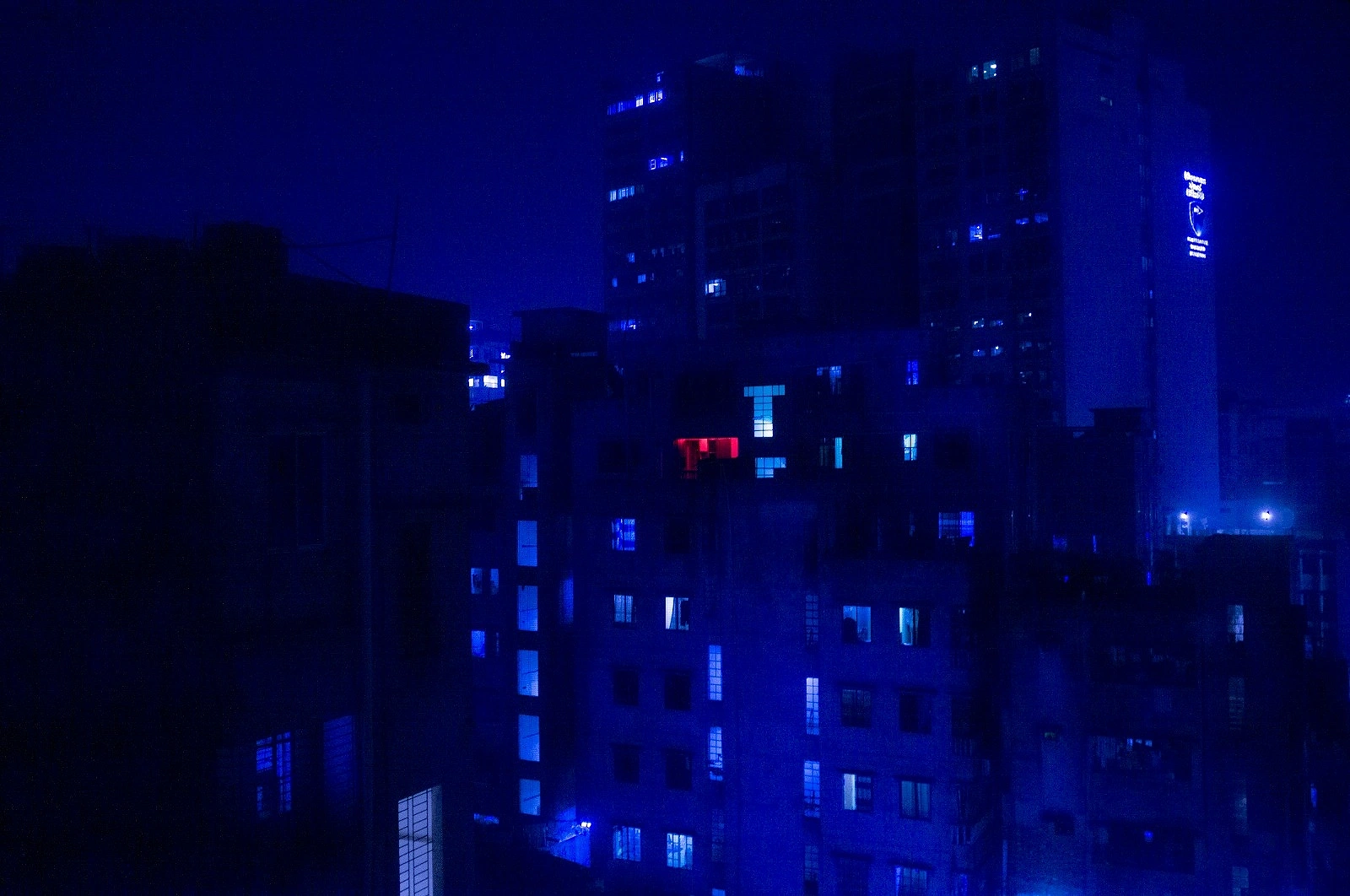
Dhaka at night. Photo: Omar Faruk

Majid eventually commits a crime. It is not natural to feel sympathy for a murderer. Yet Humayun constructs the character in such a way that readers try to understand the human being inside Majid. This is because he represents a section of urban Bangladeshi society that often remains hidden from view. The narrative portrays the lives of wealthy, middle class and poor people. It also depicts domestic workers, spoiled children from affluent families and people from various layers of society.
Humayun generally avoids excessive explanation. However, by the end, this moonlit story is revealed to be more than a narrative about a few people wandering around. It is a story about several lives intersecting over the course of a single night. The city’s moon, rain-soaked streets, a few disillusioned young men and the experiences of a man returning home after many years combine to create a world where something unusual lies waiting within the ordinary.
