
Thirty years on, the dream hero refuses to fade

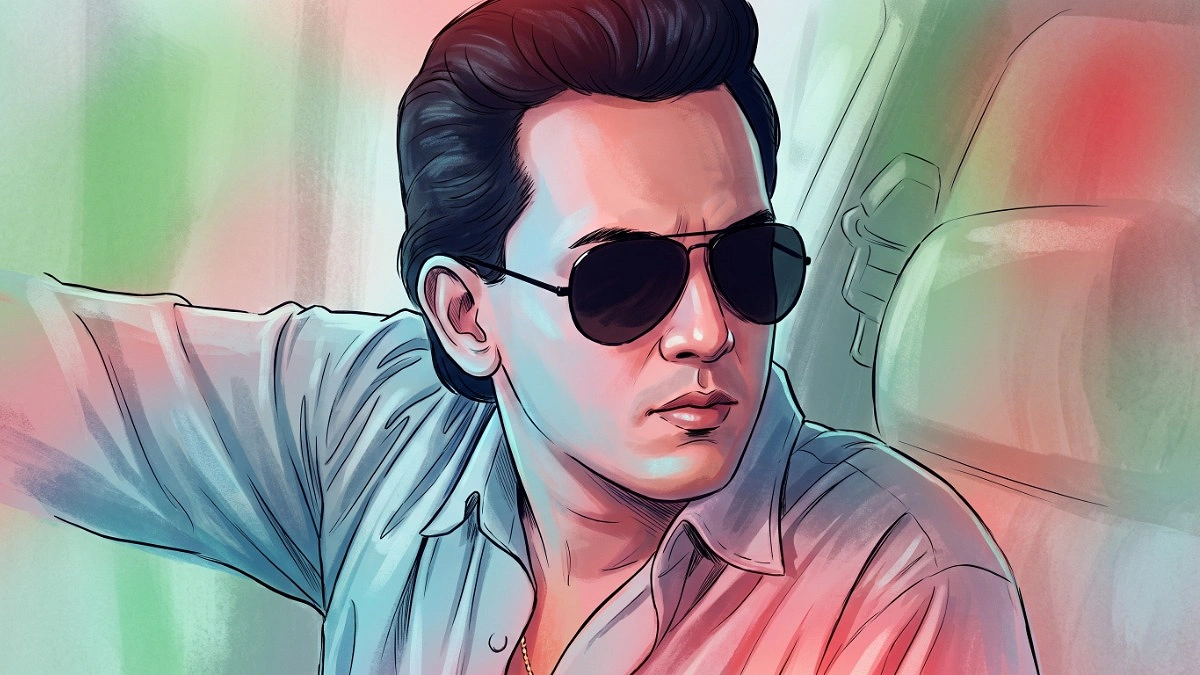
Generated by AI
He made 27 films in three years, changed how a generation of Bangladeshis dressed and spoke, and died at 24. Three decades later, the courts are still arguing about how.
Walk into the Bangladesh Film Development Corporation compound in Tejgaon and there is a statue waiting for you. It is of a young man, permanently young, who last stood on that lot in the late summer of 1996 and never came back.
Yesterday would have been his 55th birthday. Two weeks ago, marked 30 years since his death. In the space between those two dates, every September, the country performs the same ritual it has performed since 1996: it plays his songs, screens his films, argues about how he died, and remembers a career that lasted barely longer than a university degree.
His name at birth was Chowdhury Muhammad Shahriar Emon. The nation knows him as Salman Shah.
A boy from Dariapara
He was born on 19 September 1971, in the middle of the Liberation War, at his maternal grandfather’s home in Dariapara, Sylhet. His mother was Nilufar Zaman, known as Nila Chowdhury, a name that would later become familiar to every court reporter in Dhaka. His father was Qamaruddin Chowdhury, who died in 2002. The family traced its roots to Maizgram village in Barahal, Zakiganj. He had one younger brother, Shahran Evan.
His schooling moved with his family. Boyra Model High School in Khulna. Dhaka Residential Model College. He passed his matriculation in 1987 from the Arab Mission School in Dhanmondi, then went to Adamjee Cantonment College for his intermediate, then on to Maleka Science College, now Dr. Maleka University College, for a Bachelor of Commerce.
The degree was never the point. Everyone in his circle knew him first as a singer, not an actor. In 1986 he completed a course in Palligiti, Bengali folk music, at Chhayanaut. Arts and culture had held him since childhood, and the camera found him early.
In 1985, at 14, he appeared on national television in a music video produced by Hanif Sanket. Commercials followed, then small parts in television plays. As a registered artist of Bangladesh Television, he worked through the late 1980s in dramas including Akash Chowa, Shoikote Sharosh and Pathor Shomoy.
He was, in other words, a familiar face long before he was a star. He was simply the boy in the ads.
How Emon became Salman Shah
The story of his casting is one of those industry anecdotes that sounds invented and is not.
The production house Anand Mela came to director Sohanur Rahman Sohan holding the rights to three Hindi films, Sanam Bewafa, Dil and Qayamat Se Qayamat Tak, and told him to remake one of them in Bengali. Sohan could not find a hero or a heroine he believed in, so he decided to do something risky: cast entirely new faces.
A model named Moushumi was chosen as the heroine. The hero was harder. Then Khoshnoor Alamgir, the former wife of the actor Alamgir, mentioned a boy called Emon. Sohan had seen him in a Fanta advertisement and liked him immediately. He offered him Sanam Bewafa. Emon heard about Qayamat Se Qayamat Tak and insisted on that one instead.
He got his way. He also got a new name.
Keyamat Theke Keyamat opened in 1993 and became an instant hit. It made Salman Shah a romantic lead overnight and made Moushumi a star beside him. The pair were immediately put back together in Ontore Ontore, Den Mohor and Sneho. The film remains among the highest grossing in the history of the Dhallywood box office.
He was 21 years old.
Six films, then nine
What followed was not a career so much as a sprint.
In 1994 he had six releases. Tumi Amar, a romantic drama directed by Zahirul Haque, paired him for the first time with Shabnur, the actress with whom he would become most closely identified. His character was read at the time as a portrait of the ambitious, restless young Bangladeshi of that decade. In Shibli Sadik’s Ontore Ontore he played the heir to a zamindar family. In the remake of Khan Ataur Rahman’s Sujan Sakhi, he took on a village boy, his first rural role, and critics noted how carefully he had built the mannerisms, the body language, the accent.
In Mohammad Hannan’s political drama Bikkhov he played a student leader, and was widely tipped for the National Film Award for Best Actor. He lost to Alamgir. In Sneho he acted opposite veterans: Shabana, Alamgir, Humayun Faridi. In Prem Juddho he played a father for the first time, and sang playback on one of the songs. That one did not work at the box office.
1995 was the commercial peak. Shopner Thikana became the biggest blockbuster of his career and one of the highest grossing Bangladeshi films ever made. Den Mohor was his last film with Moushumi. Moha Milon put him opposite Bobita, playing her son. Asha Bhalobasha, a comedy drama with Shabnaz, worked. Konna Dan and Anjuman did not. On television he played twin brothers, Sultan and Raj, in the acclaimed drama Noyon with Shomi Kaiser.
Then came 1996, and nine films.
Bichar Hobe, in which he played a villager searching the city for his brother. Malek Afsari’s family drama Ei Ghor Ei Songsar, with Bulbul Ahmed, Rosy Afsari and Ali Raj. Priyojon. Motin Rahman’s romantic musical Tomake Chai, where the chemistry with Shabnur drew particular praise. Shopner Prithibi, Badal Khandakar’s social drama in which he played a prince rebelling against a ruler father played by Rajib. The confrontation scenes between father and son were considered the heart of the film.
Shopner Prithibi was the last film released while he was alive.
By then the press had stopped hedging. He was a superstar, the word used plainly. He had started out earning 25,000 taka a film. He was ending as the highest paid actor in the industry.
The sixth of September
On 6 September 1996, Salman Shah was found dead at his apartment in Eskaton, Dhaka. He was 24.
The reaction was immediate and enormous, a national grief with no obvious precedent in the country’s film culture. He was buried at the Shah Jalal Dargah cemetery in Sylhet, in the city where he was born.
Police initially filed the case as a suicide. His family rejected that finding and lodged a murder case. From that disagreement grew three decades of investigation, retraction, rumour and litigation that has never fully settled.
The businessman Aziz Mohammad Bhai was alleged to have been involved. A man named Rezvi Ahmed, arrested from the home of the actor’s mother, reportedly named Bhai and the actor’s wife, Samira Huq, as having ordered a killing. Rezvi later disavowed his confession.
On 24 February 2020, the Police Bureau of Investigation completed its enquiry and reported that Salman Shah had taken his own life, citing a family dispute over his relationship with Shabnur. In October 2021, a court accepted that report.
That was supposed to be the end of it. It was not.
On 20 October 2025, the 6th Additional Metropolitan Sessions Judge, Md. Jannatul Ferdous Ibn Haque, accepted a revision petition filed by Nila Chowdhury, nullified the PBI final report and ordered that the original complaint be registered and investigated as murder. The officer in charge at Ramna Model Police Station was directed accordingly.
Late that same night, the actor’s maternal uncle, Mohammad Alamgir Kumkum, filed the formal case. It names 11 people, among them Samira Huq, Aziz Mohammad Bhai and the actor Ashraful Haque, known as Don. The investigation sits with Ramna police.
Twenty-nine years after the fact, the file is open again.
A career finished by other hands
The films did not stop when he did. That is part of what makes the story so strange to revisit.
Sotter Mrittu Nei, a social drama in which he played a man convicted of murder, opposite Alamgir, Shabana and Shahnaz, was released on 13 September 1996, one week after his death. It was a blockbuster. His performance and the song Chithi Elo Jelkhanate were widely praised.
Five more films followed in 1997, none of them completed by him. Directors improvised. One used a body double. One recast the role with a different actor. One rewrote the story around the gap. Most failed.
The exception was Anondo Osru, his third collaboration with Shibli Sadik, a tragic romance in which he played Dewan Khosru, a musician driven out of his mind by a conspiracy engineered by his uncle, played again by Humayun Faridi. He died before he could dub his own dialogue. The performance is still cited as among the finest in Bangladeshi cinema.
He left several films abandoned midway: Mon Mane Na, Ke Oporadhi, Rinshodh, Tumi Shudhu Tumi and Premer Baazi. All but Premer Baazi were reshot with other actors. Premer Baazi was never completed at all. He had been set to star opposite Popy in Montazur Rahman Akbar’s Coolie; after his death the role went to Omar Sani, and the film became the highest grossing Dhallywood release of 1997.
Twenty-seven films. Three years.
What he actually changed
It is easy to mistake Salman Shah’s standing for pure sentiment, the automatic elevation of anyone who dies young. The record suggests otherwise.
He worked across an unusually wide spread of genres for a commercial lead of that era: family dramas, comedies, social and political dramas, action, rural stories, coming of age films, romance and tragedy. Film analysts credit him with opening a new kind of meaningful mainstream cinema in Bangladesh and with inventing the modern Bangladeshi leading man, a figure defined as much by style and self-presentation as by heroics.
The fashion influence was not a footnote. He was a genuine trendsetter, and what he wore in the mid-1990s was copied across the country. Media outlets came to call him Amar Mahanayak, the immortal hero. Others called him the successor to Razzak, the pioneer of the previous generation.
The list of actors who name him as an inspiration reads like a roll call of the industry since: Shakib Khan, Arifin Shuvoo, Sariful Razz, Siam Ahmed, Nirab Hossain.
Off screen, he was remembered by colleagues for ordinary decency, a friendly and helpful presence on a set. He was a serious enthusiast of music, fashion and cars. He married Samira Huq, daughter of the cricketer Shafiqul Huq Hira and a beauty parlour entrepreneur, on 12 August 1992, before his first film was released. He visited Shah Rukh Khan at his Mumbai home in 1995. He set up the Salman Shah Foundation to fund scholarships for underprivileged students and to support healthcare work.
The remembering is institutional now, not just personal. The FDC has its statue. The Salman Shah Smriti Parishad holds a festival on his birthday every year. The Bangladesh Film Archive periodically screens digitised versions of his films free of charge, driven by demand from an audience that was not born when he made them.
The title of one of his posthumous releases, Shopner Nayok, the Dream Hero, became the name his fans use for him.
Thirty years on, the dream hero remains exactly what he was in September 1996: a career interrupted, a legacy secure, and a question the courts have still not answered.
