
Why Himu remains Humayun Ahmed’s greatest creation


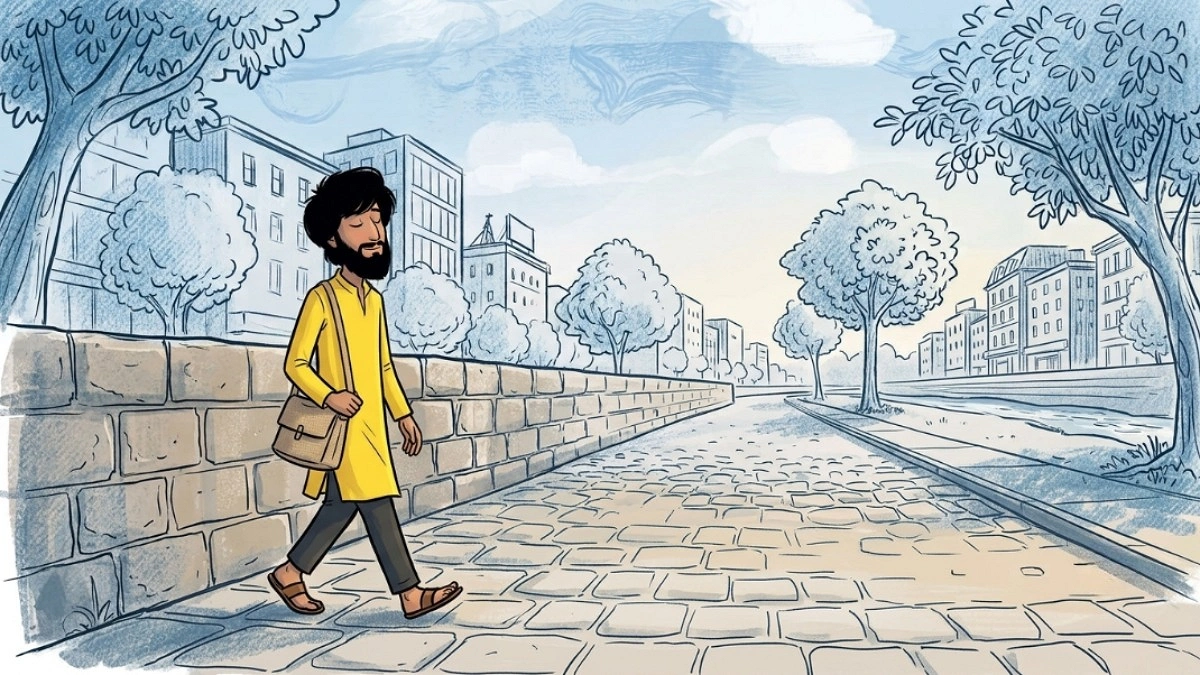
Picture: Generated by AI
More than a decade after his death in 2012, Humayun Ahmed continues to occupy a place in Bangladeshi literature that few writers, living or dead, can claim. He wrote across genres with astonishing speed and range: domestic drama, science fiction, historical fiction, and horror. He created dozens of memorable characters, from the eccentric scientist Misir Ali to the gentle, tragicomic Shuvro. Yet if one were to ask readers across Bangladesh which of his characters has traveled furthest beyond the pages of his novels and into everyday language and imagination, the answer, overwhelmingly, would be Himu.
Himu is not a detective, not a scientist, not a conventional hero of any kind. He is a young man who wanders the streets of Dhaka barefoot, dressed in a yellow panjabi, carrying no money and no fixed plan for the day. He does not seek employment in any ordinary sense. He talks to strangers, tests the patience of his relatives, provokes people into revealing themselves, and occasionally appears to possess a strange, half mystical insight into human affairs. Since his introduction in the novel Moyurakkhi, Himu has appeared in more than twenty novels, and readers still ask for more. To understand why Humayun Ahmed made Himu the centerpiece of his literary identity, and why readers responded so strongly, it helps to look at what Himu represented that his other characters did not.
An Answer to Convention
Bangladeshi middle class life, like middle class life almost everywhere, runs on a script. Get an education, secure a job, marry, raise children, accumulate a modest measure of respectability. Humayun Ahmed wrote about that life often and with affection, but in Himu he built a character who simply refuses the script. Himu has been to university. He is intelligent, arguably more intelligent than most people around him. And yet he chooses to walk away from the entire structure of ambition. He does not chase a career. He does not chase money. He does not even seem to chase romantic fulfillment in any straightforward way, despite his long, unresolved relationship with Rupa.
This refusal is not laziness or failure. Ahmed took care to make clear that Himu could succeed in conventional terms if he wanted to. His choice not to is presented as something closer to a philosophy, even if Himu himself resists calling it that. For readers who felt trapped by the demands of respectable adult life, whether they were students under pressure from family, office workers exhausted by routine, or young people anxious about the future, Himu offered something rare in Bangladeshi fiction: a character who had looked at the entire structure of expectation and simply stepped outside it, without guilt and without a grand manifesto.
The Fakir Reimagined for Modern Dhaka
Ahmed drew consciously on an older tradition when he built Himu, the tradition of the fakir or mystic wanderer found across Bengali folk culture and Sufi influenced village life. The fakir has historically been a figure who lives outside ordinary social obligation, who owns little, and who is treated with a mixture of suspicion, affection, and awe by the community around him. Ahmed took this figure and set him loose not in a village or on a riverbank, but in the traffic and concrete of Dhaka, a rapidly modernizing city where such figures should, by rights, no longer exist.
The friction between Himu’s old world persona and the very contemporary city he inhabits is part of what makes the character so effective. He is anachronistic on purpose. He rides rickshaws, deals with police who find his lack of possessions suspicious, and encounters modern anxieties about money and status at every turn, yet he carries himself with the detachment of a figure from an older, slower Bengal. Ahmed once described wanting Himu to be a kind of mahapurush, or great soul, for the present day, someone whose eccentricity conceals a deeper commentary on how his society actually behaves. That tension between the old wandering mystic and the new anxious city gave the character an unusual staying power, because it let Ahmed comment on urban Bangladeshi life through a lens that felt both fresh and rooted in something familiar.
A Vehicle for Gentle Social Observation
Himu novels are episodic by design. He wanders, he meets people, strange things happen, and by the end there is rarely a tidy resolution. This loose structure gave Ahmed enormous freedom. Through Himu’s aimless walks across Dhaka, Ahmed could drop in observations about family hypocrisy, about the absurdities of bureaucracy, about the loneliness hidden inside crowded households, about how people treat those who do not conform. Because Himu himself claims no fixed moral position, and often seems to be testing people rather than judging them, the social commentary in these books rarely feels heavy handed. Readers absorb it as part of the entertainment rather than as a lecture.
This is a different mode from the one Ahmed used with Misir Ali, his other enormously popular recurring character. Misir Ali is a logician, a man devoted to explaining the seemingly supernatural through reason and psychology. He represents the rational mind confronting mystery and, in most cases, dissolving it. Himu is almost the opposite. He does not explain mysteries so much as create small ones wherever he goes, and he is comfortable letting them remain unexplained. Readers often describe Misir Ali as the character they admire and Himu as the character they wish, at least for a day, they could be. That distinction matters. Admiration is respectful but distant. The desire to become someone, even briefly, is a much stronger form of attachment, and it is this second, stronger reaction that Himu inspired in generation after generation of readers.
The Yellow Panjabi as Cultural Symbol
Few literary costumes have moved so completely off the page and into real life. The plain yellow panjabi that Himu wears in almost every book became, over the years the series ran, an actual item that young men across Bangladesh sought out, wore to gatherings, and associated openly with the character. Public walks and gatherings inspired directly by the character, where participants dressed as Himu, became a recognizable part of Dhaka’s cultural calendar in the years around Ahmed’s greatest popularity. It is difficult to think of many other Bangladeshi literary characters who generated that kind of tangible, wearable devotion. This crossing over from fiction into fashion and public ritual is itself evidence of how deeply the character embedded itself in the culture, well beyond ordinary readership.
Humayun Ahmed’s Own Attachment
Ahmed wrote about many of his characters with visible affection, but his comments over the years about Himu suggest something closer to identification. He described the character as an expression of a side of himself that could never be fully lived out given the responsibilities of an actual writer’s life, a family man’s life, a public figure’s life. Where Ahmed himself had to manage publishers, deadlines, television productions, and public expectation, Himu owed nothing to anyone. Writing Himu may have functioned as a kind of release valve, a way of imagining a self unburdened by all the obligations that came with being Bangladesh’s most famous living author.
This personal investment shows in the writing itself. The Himu novels have a looseness and a playfulness that some of Ahmed’s more plotted work does not share. He seemed to enjoy writing them, and that enjoyment is transmissible. Readers frequently note that a Himu novel can be finished in a single sitting, not because the plot is thin, but because the voice is so engaging that putting the book down feels unnecessary.
Why He Endures
Literary characters last when they capture something that does not go out of date even as the specific society around them changes. Bangladesh today is not the Bangladesh of the 1990s, when Himu first appeared. The city has grown, technology has reshaped daily life, and the anxieties of young people have shifted in their particulars even if not in their essence. Yet Himu still resonates, because the underlying tension he embodies, between the demands of a structured, ambition driven life and the pull toward freedom, wandering, and unstructured meaning, has not disappeared. If anything, in an era of relentless productivity culture and constant connectivity, the appeal of a character who owns nothing, answers to no schedule, and remains curious about the world rather than anxious about his place in it, may be even stronger than it was when Ahmed first put pen to paper.
Humayun Ahmed created many memorable figures across a long and prolific career, and readers will continue to debate which among them deserves the label of his finest achievement. But if the measure is cultural reach, the ability to move from fiction into daily language and public ritual, and the depth of personal identification the author himself expressed, Himu stands apart. He is not simply a well written character. He became, for millions of readers, a standing invitation to imagine a different way of living, and that is a rare thing for any writer to build.
