
The Ferryman of Kaladuba


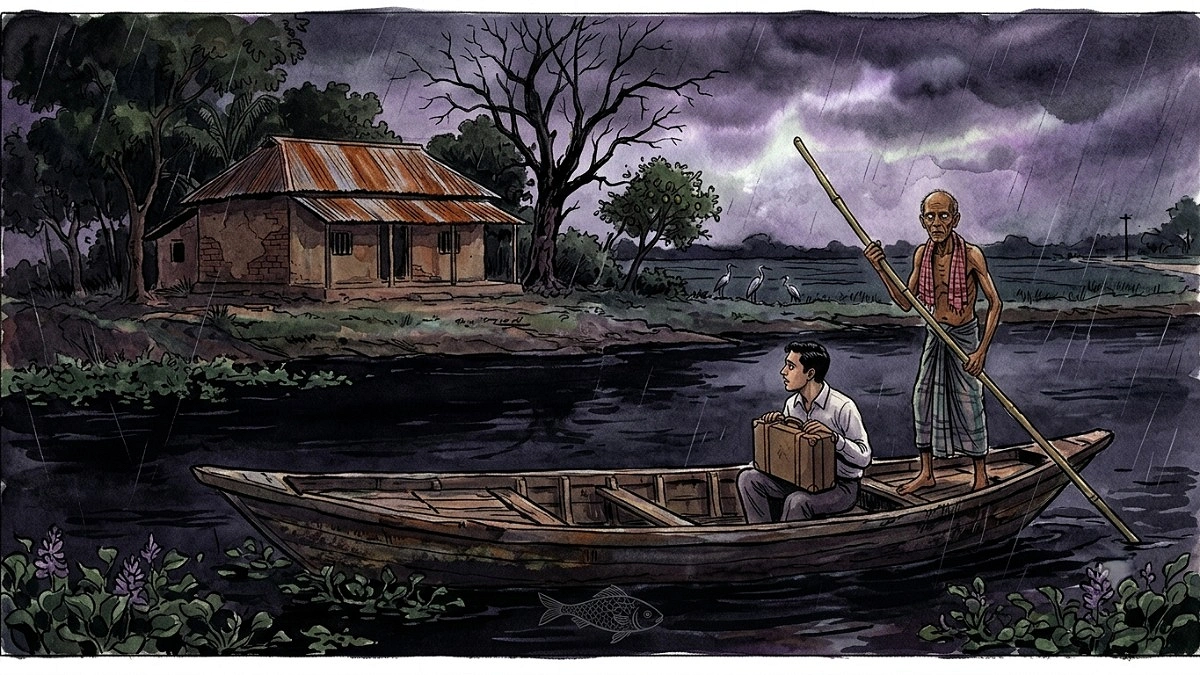
Graphics: Agamir Somoy
I.
The bus from Khulna let Rafiq off at a crossroads that did not deserve the name. There was no signpost, no tea stall, and no huddle of rickshaws waiting for fares. Only a stretch of cracked asphalt swallowed on both sides by paddy fields gone the color of old bruises under a sky thick with the promise of rain. The conductor had shouted “Kaladuba bazaar!” and shoved Rafiq’s bag out before the bus had even fully stopped. Then the bus was gone, its taillights dissolving into the haze, and Rafiq was alone with his suitcase and the smell of wet earth and something else beneath it, something faintly sweet and rotten, like the inside of an old well.
He had not been back to his grandmother’s village in fourteen years. The last time, he had been nine years old, clutching his mother’s sari as they walked the raised footpath between the fields. His grandmother, Dadi, as everyone called her, though she was not really anyone’s grandmother by blood, only by the accumulated affection of a whole village, had been alive then. She was sitting on the veranda of the old house shelling betel nuts with a small brass tool, her spectacles catching the afternoon light.
Now Dadi was dead. She had died six weeks ago, alone in that same house, and no one had found her for three days because the village had grown thin over the years. The young people had gone to Dhaka or to the Gulf, and the old people were dying quietly one by one, until Kaladuba was less a village than the memory of one. Rafiq had come to settle the house. There was some money in it, his uncle had said on the phone, not much, but enough to be worth the trip, and besides, someone had to go through her things.
He found the path his memory insisted was there, and after twenty minutes of walking between fields where herons stood motionless as if painted onto the gray air, he came to the river. The river had no proper name that anyone used. The old people called it Kaladuba khal, meaning the black drowning canal, though it was wider than a canal and deeper than its narrow, sluggish surface suggested. It cut the village in two, and the only way across, in his grandmother’s time and apparently still now, was a ferry. This ferry was a long wooden boat poled by a single boatman. No bridge had ever been built, and no one, Rafiq’s mother had once told him with a strange flatness in her voice, had ever wanted one built.
The boatman was waiting at the ghat, though Rafiq had told no one what time he would arrive. He was an old man, impossibly thin, his skin the color and texture of a dried tobacco leaf. He wore a lungi hitched up around his knees and a gamcha wound loosely around his neck. He did not smile or nod in greeting. He simply held the boat steady against the muddy bank with his long bamboo pole and waited.
“Kaladuba bari?” Rafiq asked, meaning his grandmother’s house. The old man’s eyes, which were pale and almost colorless, as though the pigment had been slowly bled out of them by decades of staring at water, moved to him and then away toward the far bank. He made a small gesture with his chin that might have meant yes, or might have meant get in.
Rafiq got in. The boat sat low in the water. The boatman poled them across in silence, and Rafiq found himself studying the water. It was black. It was not merely dark, but black in a way that seemed to absorb the failing light rather than simply fail to reflect it. Here and there the surface was broken by the pale, waxy blooms of water hyacinth. Once, near the middle of the crossing, Rafiq thought he saw something pale turn over beneath the surface several feet down. It was a long shape rolling slowly like a sleeper turning in bed, and then it was gone and he told himself it had been a fish, or a trick of the current, or nothing at all.
“How long have you been the ferryman here?” Rafiq asked, mostly to fill the silence. The silence had begun to feel less like an absence of sound and more like a presence in itself.
The old man did not answer immediately. When he did, his voice was dry and cracked, like paper being folded. “Since before your grandmother’s time,” he said. “Since before this village had a name.”
“That’s not possible,” Rafiq said, smiling, because the old man could not have been more than seventy.
The boatman looked at him then, fully, for the first time, and something in that look made the smile die on Rafiq’s face. “Many things are not possible here,” the old man said. “And yet.” He said nothing more for the rest of the crossing.
II.
His grandmother’s house stood at the edge of the village proper, a squat structure of mud-plastered brick with a corrugated tin roof gone orange-brown with rust. It was surrounded by a compound of packed earth and a few fruit trees, including a guava, a jackfruit, and an ancient tamarind that Rafiq remembered climbing as a boy. Now the tamarind tree looked diseased, half its branches bare and black even in this season when everything else was green with the coming monsoon.
A neighbor woman, introduced to him only as Rahima’s mother, had been given a key and instructions to look in on the house. She met him at the gate with the wary, assessing look of someone deciding how much to tell a stranger. She was perhaps sixty, broad-faced, with the particular weariness of a woman who has buried more people than she has celebrated.
“You’ll stay here?” she asked, as though the idea troubled her.
“For a few days. Just to sort her things.”
Rahima’s mother glanced back at the house, and Rafiq saw her make a small gesture, with two fingers brushing her forehead and chest, so quick and habitual he almost missed it. “Your grandmother was a good woman,” she said. “Devoted. She kept the house right, kept the...” she stopped herself. “She kept things as they should be kept.”
“Kept what as they should be?”
“Nothing.” Rahima’s mother pressed the key into his palm as though glad to be rid of it. “There’s rice and dal in the kitchen; I put them there this morning. If you need anything, my house is the third one past the mosque.” She was already backing away. “Cross back before dark if you go anywhere. The ferryman doesn’t like to cross after dark. No one does.”
“Why not?”
But she was already walking briskly away down the path and did not look back. Rafiq stood alone at the gate of his dead grandmother’s house as the sky continued its long, gray collapse toward evening.
Inside, the house smelled of dust and turmeric and the particular mustiness of a place that has been shut up with grief. Rafiq wandered through the two small rooms. There was a bedroom with a string cot and a wooden almirah, and a slightly larger room that served as kitchen, sitting room, and everything else. He found, with a tightening in his chest he had not expected, that his grandmother’s life was still arranged here exactly as she had left it. Her spectacles sat folded on a shelf beside the Quran. A half-finished nakshi kantha, its intricate embroidery abandoned partway through a border of stylized lotus flowers, lay across the cot as if she had simply set it down to go and would return any moment to pick it up again.
On the wall above the cot hung a single photograph in a cheap wooden frame. It showed his grandmother as a young woman, unsmiling in the manner of old photographs, standing beside a man Rafiq did not recognize. He was not his grandfather, whom he had seen in other photos, but someone else, a thin young man in a boatman’s dress, his hand resting with strange formality on her shoulder.
Rafiq took the photograph down and turned it over. On the back, in faded ink, in a hand he recognized as his grandmother’s, was written a single line: "Amar bhai, jei nodi niye gelo. Khoma koro amake." My brother, whom the river took. Forgive me. He had never known his grandmother had a brother.
III.
That night, after a dinner of reheated rice eaten alone by the light of a kerosene lamp, since the electricity had flickered and died within an hour of his arrival and did not return, Rafiq lay on his grandmother’s cot and tried to sleep and could not. The sounds of the village at night were unfamiliar to him now, city-softened as he was. There was the endless percussion of insects, the occasional low complaint of a dog, and the wind moving through the diseased tamarind tree outside with a sound like something dragging itself across dry ground.
But beneath these, or perhaps around them, there was another sound, one he could not place. It was a soft, rhythmic sound, distant and yet somehow also close, like the dip and drag of a bamboo pole through water. He told himself it was the river. He told himself the ghat was not so far from the house, and sound carried strangely at night in the flat delta country. He reasoned there was nothing at all sinister in the sound of a boat being poled across a river in the darkness, even though Rahima’s mother had told him plainly that the ferryman did not cross after dark.
He got up eventually, unable to sleep, and went to the door and looked out across the compound toward the path that led down to the water. The night was moonless but not entirely dark. The sky held a strange, diffuse luminescence, as though the clouds themselves were faintly phosphorescent. By this queer half-light, Rafiq could see quite clearly the shape of the ferry boat out on the black water, and the thin, upright figure of the boatman standing in it, poling steadily toward the far bank. Seated in the boat before him was another figure, small and still, wrapped in what might have been a white sari, or might have been nothing at all, only mist given the suggestion of a shape.
Rafiq’s mouth went dry. He told himself, even as he watched, that it was Rahima’s mother’s superstition working on him. He felt that fear was a kind of contagion and he had simply caught it from her warning, that there was nothing at all strange about a boatman ferrying a late passenger across a river at night, regardless of what village custom said about it. He watched until the boat reached the far bank and the two figures disembarked and were swallowed by the darkness of the far shore. There had certainly been two figures. He went back inside and lay down and did not sleep again until the muezzin’s call for fajr prayer came seeping gray and thin through the walls, and even then his sleep was shallow and full of water.
IV.
In the morning, everything was ordinary again, and Rafiq was almost embarrassed by his fright of the night before. He spent the day sorting through his grandmother’s belongings. There were clothes to be given away, a small tin box of jewelry and documents to be taken to his uncle in Dhaka, and letters in Bengali script too faded and too formal in their old-fashioned phrasing for him to read easily. He found, folded at the bottom of the almirah beneath a stack of saris, a bundle of older photographs, and among them three or four more of the same young man from the framed photograph. He was in the boatman’s dress, with the same thin, unsmiling face, though in these he looked younger still, almost a boy.
He took the photographs to Rahima’s mother’s house in the afternoon, thinking she might know something, and found her sitting on her veranda husking coconuts with practiced, violent strokes of a long knife. She looked at the photographs for a long moment before she spoke.
“That is Amirul,” she said finally. “Your grandmother’s younger brother.”
“I didn’t know she had a brother.”
“No one speaks of him.” Rahima’s mother set down her knife. “It is not a story for outsiders.”
“I’m not really an outsider. She was my grandmother.”
The old woman studied him with an expression that seemed to be weighing something. She might have been weighing his claim to the story, or simply whether he could bear to hear it. At last she sighed, the particular sigh of someone about to do something they consider unwise.
“This was before my time, understand. I have it from my own mother, who had it from hers. Amirul was the ferryman here, in his young days, as his father had been before him and his grandfather before that. The crossing has always belonged to that family, has always needed someone of that blood to work it, though no one now remembers exactly why. It was said even then that the river was not an ordinary river. Something lived in it, or under it, or was bound to it. The old people called her Shakchunni, though whether that is truly what she was, I cannot say. It is the spirit of a woman who died a bad death by water, and who resents the living for the lives she does not have.”
Rafiq felt the skin at the back of his neck tighten, though he kept his face carefully neutral, maintaining the polite skepticism of an educated city man listening to village superstition.
“Amirul fell in love,” Rahima’s mother continued, “with a girl from beyond the river, from a village three crossings distant. She was a girl he had no business knowing at all, let alone loving, because her family and his were not equals. Hers were landed people and his were only ferrymen. They met in secret, across the water, for nearly a year. Then one night, this was in the month of Bhadra, when the river runs full and fast with the last of the monsoon, he took the boat out after dark to meet her. It is not wise, and was never wise, to cross after dark, because that is when she who lives in the water is most awake, most hungry for what she was denied in life, which was love, and a wedding, and children, and all the ordinary things the living take for granted.”
“What happened to him?”
“The boat was found in the morning, drifting empty near the far bank. Amirul was never found, not his body, nor so much as a sandal. Some said he had simply run away with the girl, and perhaps that is what the family told themselves, to have something bearable to believe. But your grandmother never believed it. She used to say, my mother told me this, that the river had wanted a bridegroom, and that Amirul had gone to it as one goes to a wedding, dressed and eager and unknowing. She said that she, your grandmother, had failed to warn him in time, though she had felt something was wrong that whole evening, a coldness in the air, a smell like standing water where there had been no water before.”
“And the ferry?”
“The ferry needed a ferryman. It has always needed one of that family’s blood, or so it is believed, though whether that is truth or simply the shape grief took in an old woman’s mind, I could not tell you.” Rahima’s mother picked her knife back up, seeming eager now to end the conversation, to return to the ordinary business of husking coconuts in the ordinary afternoon light. “Karim, who ferries now, he is not of that blood, as it happens, which is why some of us are uneasy about him, though he has done the work for longer than anyone can properly account for. Go home before dark, Rafiq bhai. That is all the advice I have for you, and it costs you nothing to take it.”
V.
Rafiq did not, in the end, take her advice, though not from bravery so much as from the ordinary carelessness of a man absorbed in a task. He spent the following two days deep in his grandmother’s affairs. He visited the small local land office in the neighboring bazaar to sort out questions of the deed, and he arranged for a local mason to assess the crumbling boundary wall for his uncle. He drank tea with elderly relatives who remembered him as a boy and wept a little over Dadi and pressed him to eat more than he wanted. The story Rahima’s mother had told him settled into the back of his mind the way such stories do, filed alongside village ghost tales generally, being vivid and unsettling in the telling, but easily set aside in the flat light of day.
But he could not entirely set aside the boat he had seen, nor the second, smaller figure in it, nor could he entirely set aside a small, nagging detail from the photographs. He noticed that in every one of them, however faded, Amirul’s eyes held the same pale, colorless quality he had noticed in the eyes of Karim, the current ferryman, on the first crossing.
On the third evening, returning later than he intended from the bazaar, having lost track of time over a dispute with the land office clerk regarding an outstanding tax record, Rafiq found himself hurrying down the darkening path toward the ghat. The sun was already gone and only a bruised violet afterglow remained in the west. The insects had begun their evening chorus. The air had thickened with the particular mineral smell of a monsoon evening, wet earth and coming rain, and beneath it, as before, was that faint sweetish rot he had smelled on his very first arrival.
Karim the boatman was at the ghat. He did not seem surprised to see Rafiq, though the light was nearly gone entirely now. There was only that same strange, diffuse phosphorescence in the clouds that Rafiq had noticed on his first sleepless night.
“You should not be crossing now,” Karim said, without preamble, his cracked-paper voice flatter than usual.
“I have to get back.”
“There will be another crossing in the morning.”
“I don’t have anywhere else to sleep tonight.” This was not, strictly speaking, true, as Rahima’s mother would certainly have taken him in. But Rafiq, tired and irritable from his afternoon’s frustration with the land clerk, was in no mood to be told what to do by a boatman, however strange his eyes. “Just take me across, please.”
Karim studied him for a long moment in the failing light. Then, without further argument, he steadied the boat and gestured for Rafiq to board.
They were perhaps a third of the way across when Rafiq noticed the change in the water. It was subtle at first. A stillness had appeared that had not been there a moment before, as though the entire surface of the river had, all at once, ceased its ordinary small movements, its ripples and eddies, and become instead something closer to glass, black glass, holding the last violet light of the sky without disturbance. The insects, too, had gone silent. Karim had stopped poling, though the boat continued to drift forward as though pulled by some current Rafiq could not feel.
“What’s wrong?” Rafiq asked, and his voice sounded strange to him in the new stillness. It was too loud, an intrusion.
Karim did not answer. His pale eyes were fixed on the water ahead of the boat, and his knuckles, Rafiq saw, had gone white around the bamboo pole, though he held it now not to push but simply to grip, as a man grips something in fear. Then the water directly ahead of the boat began, very slowly, to rise. It did not splash or churn as water disturbed by a swimmer would. It rose smoothly, in a long, vertical column no wider than a human body. The black water somehow held its shape against every principle Rafiq’s frightened mind could summon to insist that this was impossible. As it rose, it began gradually and terribly to take on a form. It took the form of the narrow shoulders and long hanging hair of a woman. Her back was to the boat, and her hair reached down into the water even as the rest of her rose clear of it. It was streaming and endless, as though the river itself were simply an extension of that hair and had no true bottom at all.
Rafiq could not move. He would remember later that his body had simply refused every instruction his mind attempted to give it. He had sat frozen in the belly of the boat while the thing in the water continued its slow, impossible rising. It was close enough now that he could see the water sheeting off her shoulders did not fall back into the river below but simply vanished, evaporating a foot above the surface, as though the whole scene existed slightly outside the ordinary rules that governed such things as gravity and water.
“Amirul,” the thing said, without turning. Its voice was not loud but carried across the stillness with terrible clarity. It was a woman’s voice roughened by something that might once have been weeping and had long since hardened into something else. “You have kept me waiting.”
Karim, or whoever Karim truly was, made a sound low in his throat, not quite a word. Rafiq saw, in the last failing light, that the old boatman’s face had changed. It had gone somehow younger and more terrified all at once. The face of the thin, unsmiling young man from the photographs was superimposed, for just a moment, over the face of the old ferryman Rafiq had crossed with three times now without truly seeing him.
“I am not him,” Karim said, and his cracked voice, too, seemed to hold two voices within it. It was an old man’s and a young man’s, layered and struggling. “I have never been him. You know this. I have only ever done the crossing, as my father did, and his father, because the river requires it, because if no one does it...”
“You wear his blood,” the thing in the water said, and now at last it began to turn. Rafiq did not see its face fully. Some mercy of the darkness, or of his own mind’s refusal, spared him that, but he saw enough. He saw a face that was, in its structure, unmistakably a young woman’s, and had perhaps once been beautiful, but which now seemed to be composed not of flesh but of something like wet river clay. It was sliding and shifting even as he looked at it, the features never quite settling into a single configuration, as though the face beneath the water had forgotten, across a hundred years of drowning, exactly what a human face was meant to look like and could only approximate it from increasingly imperfect memory. Where her eyes should have been there was only the same black stillness as the river itself, depthless, holding no reflection of the sky at all.
“Every year the river takes what it is owed,” she said, and her clay-face turned, slowly and terribly, to regard Rafiq directly for the first time. “And I have waited a long time, ferryman, for the river to bring me someone new. Someone of proper blood, to make a proper bridegroom, so that I need not settle, again, for the pale imitations you and your fathers have given me for a hundred years.”
“He’s not...” Karim’s voice cracked entirely now, the old man’s fear breaking through whatever composure decades of this terrible duty had taught him. “He’s only a visitor. He has no part in this. Let him go.”
“He is your blood’s blood,” the thing said. Rafiq, frozen still, felt some cold understanding move through him. His grandmother was Amirul’s sister, and he himself was her grandson, carrying whatever thin thread of that ferryman’s lineage might yet run in his veins. It was dilute across two generations but perhaps, to a thing that had waited a hundred years in the dark, not dilute enough to be safe. “He carries what I have been owed since the last true bridegroom was stolen from me by a coward’s fleeing.” Her black eyes, if eyes they were, did not blink or move. They held Rafiq with the terrible patience of something that had already waited longer than a human life and would wait, if it must, a hundred years more. “Come then,” she said, and her clay hand rose from the water. The fingers unfolded with a wet, sucking sound like mud releasing a footstep, reaching toward the boat, toward Rafiq. “And let us finish, at last, what your family began.”
VI.
What happened next, Rafiq would never afterward be able to describe with full confidence, because his memory of it came to him always afterward in fragments. These fragments were disordered and slick with the particular unreliability of true terror, but he would remember Karim moving suddenly and with a speed that seemed impossible in so old and thin a body, placing himself between Rafiq and the reaching hand. He would remember the old boatman’s cracked voice rising into something between a shout and a wail, speaking words in an older dialect of Bengali than Rafiq could fully follow, though he caught fragments such as "take me instead, as you have always taken me," "I am the one who owes you," and "I am the one bound to this water, not him, never him." And he would remember, with a clarity that never left him, the sight of the pale clay hand closing not around his own wrist but around Karim’s thin arm. He saw the old boatman’s face, in that final instant, lose all of its terror and settle, astonishingly, into something like peace, as though a debt carried a very long time had finally come due and there was, in that, a kind of relief.
The boat rocked violently. Rafiq was thrown against its wooden side, and water, real water, cold and utterly ordinary, came sheeting over the gunwale. In the chaos and the dark, he lost sight of everything except the black surface of the river closing, without splash or sound, over the place where Karim had been standing a moment before. It closed as smoothly and completely as a curtain drawn across a stage, and then the stillness broke all at once. The insects resumed their chorus, the water resumed its ordinary small ripples, and the boat, rocking gently now with only the wind’s disturbance, drifted the remaining distance to the far bank entirely on its own, as though nothing at all had happened, as though it had simply been an ordinary evening crossing on an ordinary river.
Rafiq did not remember climbing out of the boat. He did not remember the walk back to his grandmother’s house. He came to something like full awareness sitting on the floor of the bedroom, his back against the string cot. The kerosene lamp was unlit beside him, and his hands were shaking too badly to strike a match. He stayed that way in the dark until the muezzin’s call for fajr came again, gray and thin and blessedly, completely ordinary.
VII.
He left Kaladuba two days later, having told no one, not Rahima’s mother, not his uncle, not anyone, what he had seen on the water. He reasoned in the flat gray light of the following mornings that there was no one who would believe him, and no good that believing him would do. Karim was simply gone, and the village, with the particular fatalism of a place that had lived beside its river’s hunger for longer than living memory could properly account for, absorbed the disappearance without excessive surprise. A new ferryman was found within the week. He was a distant cousin of Karim’s, Rafiq learned before he left, a young man named Anisur with the same thin build and, though Rafiq did not mention this to anyone, the same pale, water-colored eyes.
He did not cross the river again himself. He arranged, at some inconvenience and no small expense, for a boat from a village further downstream to collect him directly from a different point along the bank. This arrangement required no crossing of the black water at all, and if the boatman who ferried him thought this arrangement strange, he did not say so.
Before he left, Rafiq returned the photograph of Amirul to its frame above his grandmother’s cot, and beside it he placed a second photograph. It was one he had taken himself, of Karim, on that first afternoon at the ghat, though he could not afterward remember having taken it. He could not remember the camera in his hand or the moment of the shutter’s click, only that it existed now, developed and printed among his things. The old ferryman’s pale eyes looked out of the frame with an expression that might, in a certain light, have been read as gratitude.
He locked the house, gave the key to Rahima’s mother, and did not look back at the tamarind tree. He was almost certain, though he did not stop to confirm it, that its black, diseased branches had put out, in the days since his arrival, a small and unseasonable scattering of new green leaves.
The bus back to Khulna passed the crossroads at Kaladuba bazaar in the early afternoon. Rafiq was looking out the window as the fields gave way slowly to the ordinary business of the wider world, including trucks and tea stalls and the confident, indifferent noise of the living. He found that he could not entirely shake the sense that stayed with him for years afterward, at odd unguarded moments, in the particular stillness of standing water, or in the sound of a pole dragged through a canal. He felt that somewhere behind him, patient and unhurried, something in the black water was still waiting, and would go on waiting, for as long as there was a family whose blood remembered the debt, and a river that had never once, in all its long dark history, forgotten to collect what it believed it was owed.
