
The Weeping House


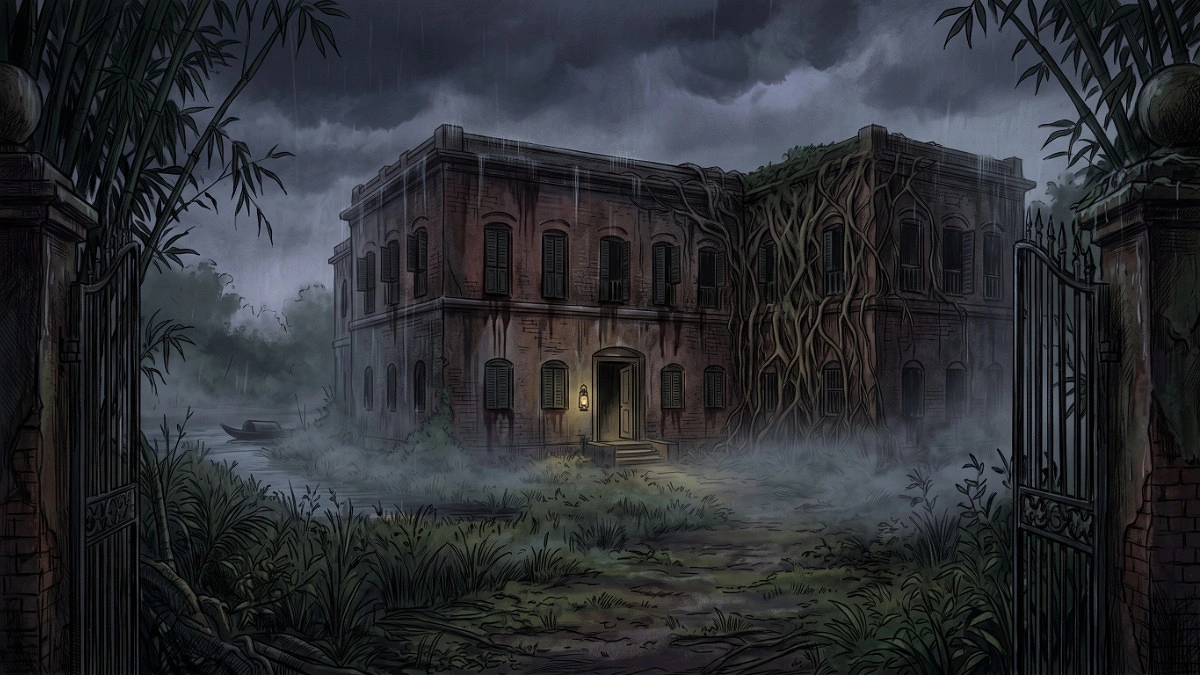
Generated By AI
The letter arrived on
a Tuesday, though Ridwan Chowdhury would later insist it had been a Wednesday,
for Tuesdays in his memory had always been ordinary, and nothing about that
letter, or the house it summoned him to, was ordinary in the slightest.
It came sealed in wax the colour of dried blood, bearing a crest he did not
recognise: a heron standing over a drowned man. Inside, in handwriting so
cramped it seemed to be hiding from itself, an advocate named Halder informed
him that his great aunt Monimala Chowdhury had died in her sleep at Kandanpur
Kuthibari, and that as her only living relation, the house and its grounds now
belonged to him.
Ridwan had never heard of Monimala Chowdhury. He had never heard of Kandanpur.
His mother, before her own death some years prior, had spoken only rarely of
her family, and always with a haste that suggested she was eager to leave the
subject behind, the way one hurries past a graveyard at dusk. He remembered her
saying once, when he was small and pressing her for stories of grandparents and
cousins, that some families were better left unexamined, like old wounds that
healed wrong and would only bleed again if picked at.
He should have listened to her. He understood that much later, when it was too
late to matter.
The house sat at the end of a lane so overgrown that the boatman who had
ferried him up the narrow khal refused to moor any closer, muttering something
about the trees not liking strangers and touching his chest twice before
turning his boat back downstream. Ridwan walked the rest of the way alone, past
paddy gone to marsh and bamboo groves gone black with damp, his sandals sinking
into a soil that seemed unnaturally soft, as though the earth itself were
exhaling.
Kandanpur Kuthibari rose out of the mist like a rotted tooth. It was an old
zamindar house, built of brick gone dark with a century of monsoons, its many
windows narrow and shuttered, its roofline a jagged silhouette of turrets and
chimneys left behind by some long dead planter, all leaning toward one another
as if in conspiracy. Banyan roots had swallowed one entire wing, and where they
had not yet reached, the brick wept with moisture that left long dark stains
beneath every window, as though the house itself had been crying for a very long
time and had simply given up trying to stop.
A woman answered the door before he had even raised his hand to knock. She was
perhaps sixty, dressed in unrelieved white, with eyes the pale grey of a winter
sky.
“Ridwan Bhai,” she said. It was not a question. “I am Bimala. I kept house for
your aunt these thirty years. We have been expecting you.”
“You knew I was coming?”
“The house knew,” she said, and turned inside without further explanation,
leaving him to follow or remain in the cold.
The interior smelled of mustard oil and old wood smoke and something underneath
it, something sweetish and faintly rotten, like flowers left too long in
stagnant water. Portraits lined the entrance hall, their painted eyes following
him with the particular malevolence that only old oil paintings seem to
possess. He paused before one: a woman in a red bordered shari, her face so
like his own mother’s that his breath caught.
“Your great grandmother,” Bimala said, appearing at his shoulder without a
sound. “Indubala Chowdhury. She built the east wing. Before the trouble.”
“What trouble?”
Bimala did not answer. She never did, he would come to learn, not directly, not
the first time he asked. Answers at Kandanpur Kuthibari arrived slowly, like
water finding its way through brick, and by the time they arrived they had
usually cost something.
That first night he slept in a room that had, Bimala informed him, belonged to
his aunt, though the woman had died in a different chamber entirely, one Bimala
would not name and would not show him. He lay beneath a mosquito net gone grey
with dust and listened to the house settle around him, its beams groaning like
something in pain, and told himself it was only the wind finding gaps in old
walls.
He woke near three in the morning to the sound of weeping.
It came from everywhere and nowhere, a low and terrible sobbing that seemed to
rise from the very brick, and when he pressed his palm flat against the wall
beside his bed, he felt it vibrate faintly, as a throat vibrates when it cries.
He lit a lamp and searched the corridor and found nothing, only the portraits
watching him with their painted patience, and Bimala’s door closed fast at the
hall’s far end, no light beneath it.
In the morning, he asked her plainly what he had heard.
“The house weeps,” Bimala said, setting down his cha without meeting his eyes. “It
has wept since your great grandmother’s time. Some nights worse than others.
You will grow used to it.”
“People do not grow used to weeping walls, Bimala.”
“They do here,” she said, “or they leave.”
He resolved, in the bright and reasonable light of morning, to leave within the
week. There was nothing for him at Kandanpur but debts and damp and a
housekeeper who spoke in riddles, and Halder the advocate had assured him the
land would fetch a fair price even in its neglected state. He spent that day
walking the grounds, cataloguing what might be salvaged and what should simply
be burned, and it was in the old family mandir, half collapsed at the edge of
the bamboo grove, that he found the diary.
It had been hidden beneath a loose stone before the small altar, wrapped in
oilcloth that had mostly failed against the damp, and the handwriting inside,
once he had coaxed the pages apart, matched the cramped script of Halder’s
letter closely enough that he wondered if the advocate’s family had served this
one for generations, passing down not only the name but the very slant of the
pen.
The diary belonged to Indubala Chowdhury.
She had built the east wing, the entries explained, as a nursery for a child
she desperately wanted and could not seem to carry to term, four times losing
what she carried before its first breath, until in her grief and her fury she
had gone to a woman in the char villages who dealt in older remedies than any
physician offered. The woman had given her a binding meant to anchor a soul to
this world past the moment its body failed it, and Indubala, mad with wanting,
had performed it upon herself in her fifth pregnancy, not understanding, or
perhaps not caring, what such a binding would cost.
The child had lived. Indubala had not, not truly, not afterward. The entries
grew wilder in their final pages, describing a presence in the walls that spoke
to her in her own voice, that wept when she wept and raged when she raged,
until the two of them, woman and house, could no longer be told apart. The last
entry, dated some eighty years past, read simply: *It will not let me go, and
now I do not wish it to. We are the same grief now, the house and I, and grief
does not die. It only waits for new blood to pour itself into.
Ridwan closed the diary with hands that had gone cold despite the mild
afternoon, and told himself, quite firmly, that his great grandmother had been
a woman undone by tragedy and superstition, and that the story explained
nothing except the depth of her sorrow.
That night the weeping came again, closer this time, seeming to originate from
the wall directly behind his bed, and beneath it, so faint he might have
imagined it, a voice speaking his name.
He did not sleep again in that room. He moved his few belongings to a chamber
at the front of the house, further from whatever lay behind the east wing’s
sealed doors, and told Bimala in the morning that he intended to have that wing
bricked up entirely before he sold the property.
Bimala went very still. “You cannot seal what is already sealed, Ridwan Bhai.
The wing has been shut since your great grandmother’s death. It is not the wing
that weeps. It is what the wing was built to hold.”
“And what was that?”
“Her sorrow,” Bimala said. “Given a shape and a hunger and a very long memory.”
He might have dismissed this as the fancy of an old servant grown strange from
decades of isolation, had he not, that very afternoon, discovered the second
diary, this one belonging to his aunt Monimala, and dated far more recently,
its final entries written in a hand grown shaky within the last year, as though
something had been draining the strength from her even as she wrote.
Monimala had inherited the house, and the burden, from her own mother, and she
had known from childhood what slept, or did not sleep, in the east wing. She
wrote of feeding it, not with food but with attention, with visits, with the
simple act of sitting near the sealed door and speaking to it as one might
speak to a lonely child, for that, she had come to believe, was what it wanted
more than anything: to not be alone in its grief. She wrote of the years this
had cost her, of feeling herself thin and hollow as the thing behind the wall
grew stronger on whatever she gave it, and of her final, desperate hope,
expressed in the very last entry: that when she died, it would finally have
enough, would finally be sated, and would let the next Chowdhury, whoever they
might be, live a life untouched by it.
She had been wrong. Ridwan understood this now with a certainty that settled
into his bones like the damp of the house itself. The thing had not been sated
by her death. It had simply been waiting, the way it had always waited, for new
blood to pour itself into.
He confronted Bimala that evening in the kitchen, the diary open between them
on the scarred wooden table.
“Why did you not tell me this the moment I arrived?”
“Would you have believed me?” Bimala asked, and he had no answer, because she
was right, he would not have. “I have served this house through two mistresses,
Ridwan Bhai. I have watched what it does to those who try to fight it and what
it does to those who try to feed it. Both paths end the same. It only ever
grows hungrier.”
“Then what is left? What am I meant to do?”
For the first time since his arrival, something like pity crossed Bimala’s grey
eyes. “Leave tonight,” she said. “Do not pack. Do not look back at the house as
you go, for it is said to remember faces that look back, and it will call to
them across whatever distance they run. Sell the land from a lawyer’s office in
Dhaka, if you must sell it at all, and never set foot on this soil again.”
It was, he would later think, perfectly sound advice, and he intended to follow
it. But grief, he was learning, had a way of making fools of the sensible, and
as he climbed the stairs to gather at least the diaries, at least the proof
that he had not imagined any of it, he found himself walking not toward the
front chamber where his bag lay packed, but toward the sealed door of the east
wing, drawn by something he could not name and did not, in that moment, wish to
resist.
The door was not locked. It had never needed to be. Something that wanted so
badly to be spoken to would hardly bar the one person capable of speaking to
it.
Beyond it lay a nursery frozen in the fashions of a century past, its cradle
still standing though its linens had rotted to lace, its walls painted in a
pattern of herons that seemed, in the lamplight, to shift their long necks when
he was not looking directly at them. And in the centre of the room, where the
weeping was loudest, he found not a monster, not the shade of Indubala Chowdhury,
but simply a darkness that pooled and gathered like spilled ink, taking, as he
watched, the vague and trembling shape of a woman holding something small
against her chest.
“You are the new one,” the darkness said, in a voice that was his mother’s
voice, and his aunt’s, and some third voice beneath both that might have been
Indubala’s own. “You came back.”
“I did not come back,” Ridwan said, his own voice steadier than he felt. “I
came because I did not know any of you existed until a letter found me.”
“It always finds you,” the darkness said, and there was something so unbearably
sad in it that he felt his anger, which had been rising, drain away despite
himself. “It found your mother too, once. She was the one who ran and did not
look back. I called and called and she did not answer, and so I waited, because
I am very good at waiting, and now you are here instead.”
“What do you want?”
“Only to not be alone with it,” the darkness said, and drew nearer, and he
understood in that moment, with the sudden clarity of a nightmare recognising
itself, that this was precisely how it had claimed Indubala, and her daughter,
and her daughter’s daughter after her: not through violence, not through
terror, but through the simple, patient, unbearable weight of grief asking to
be shared, over and over, for as long as it took.
He thought of his mother, who had run from this house and never once spoken its
name aloud, who had built a whole ordinary life on the far side of that silence
and guarded it fiercely to her last breath. He understood now what she had been
protecting him from, and what it had cost her to protect it, and standing there
in that weeping room he felt something in himself harden into a decision.
“I am sorry for your grief,” he said, and meant it, for whatever else it was,
it had once been a woman who wanted only a living child, and had paid an
unthinkable price for wanting it. “But I will not stay to keep it fed, and I
will not let it take the rest of my life the way it took theirs.”
The darkness surged toward him then, and the weeping rose into something closer
to a scream, and Ridwan did not run so much as simply turn and walk, forcing
each step to be steadier than the last, out through the nursery door and down
the long corridor of watching portraits, past Bimala standing white faced at
the foot of the stairs, out through the front door and into the mist and the
overgrown lane beyond.
He did not look back. Whatever it cost him, whatever it called after him in his
mother’s borrowed voice, he kept his eyes fixed on the dark shapes of the
bamboo ahead and did not once turn his head, and by the time the first grey
light of dawn found him stumbling into the nearest bazar, the sound of weeping
had faded, at last, into nothing more than the ordinary wind.
He sold Kandanpur Kuthibari within the month, through an advocate’s office in
Dhaka just as Bimala had advised, to a buyer he never met and whose name he
made a point of never learning. He built, in time, an ordinary life, much as
his mother had, and guarded its silence just as fiercely.
But sometimes, on nights when the wind found the old joints of his own house
and made them groan, he would lie awake and think he heard, very faintly,
beneath the sound of the storm, something that might have been weeping, patient
and endless, somewhere far away and waiting, as it always waited, for new blood
to pour itself into.
