
Freedom on paper, not in practice


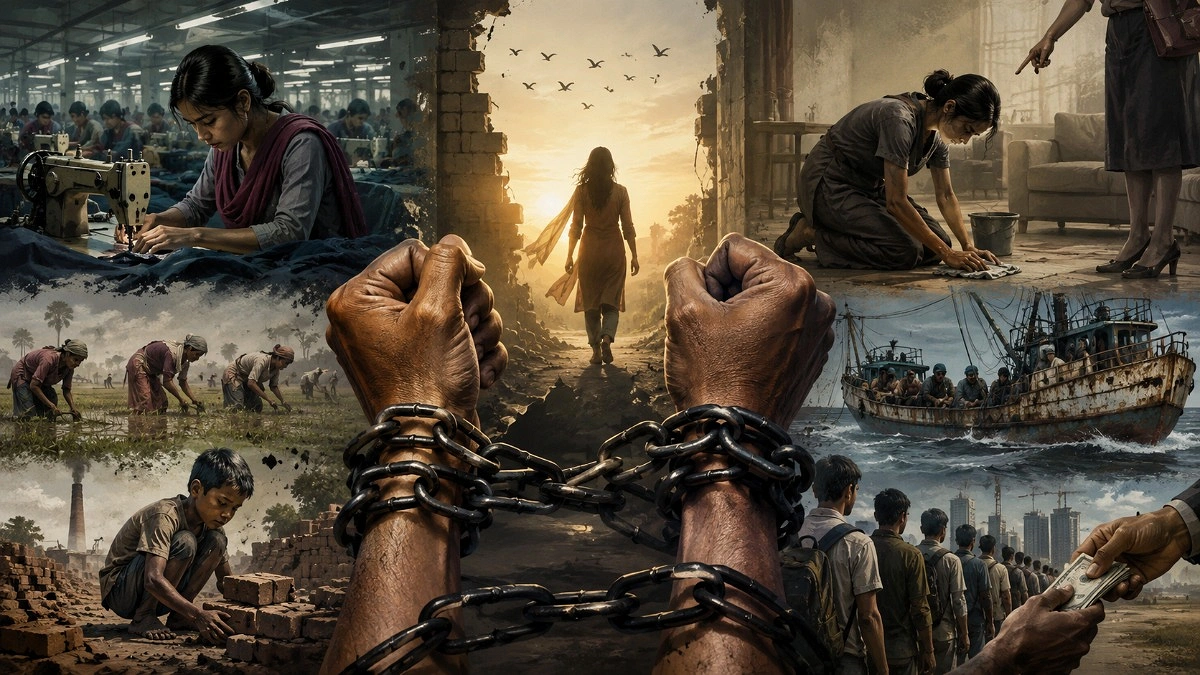
Graphics: Generated by AI
Every year on December 2, the United Nations observes the International Day for the Abolition of Slavery, a date that asks the world to look squarely at something many people would rather believe belongs entirely to the past. The image most of us carry when we hear the word slavery is a historical one: ships crossing oceans, chains on wrists, plantations and auction blocks. That history is real and it still shapes the world today. But the day itself was created for a different, more uncomfortable purpose. It exists to remind governments, businesses and ordinary citizens that slavery did not end when it was outlawed. It changed shape.
A Date Rooted in a Forgotten Treaty
The choice of December 2 goes back to 1949, when the United Nations General Assembly adopted the Convention for the Suppression of the Traffic in Persons and of the Exploitation of the Prostitution of Others. It was one of the earliest attempts by the international community to build a legal framework against human trafficking and exploitation, at a time when the world was still absorbing the aftermath of a war that had exposed just how easily human beings could be reduced to forced labor and worse. Nearly four decades later, in 1986, the General Assembly formally designated December 2 as an annual day of observance built around that treaty’s anniversary.
The day’s focus has always been broader than its founding document suggests. According to the United Nations, the observance is meant to draw attention to contemporary forms of slavery: trafficking in persons, sexual exploitation, the worst forms of child labor, forced marriage and the forced recruitment of children into armed conflict. In other words, the United Nations chose this date not simply to commemorate a piece of paper from 1949, but to use its anniversary as a yearly checkpoint, a moment to ask whether the world has actually moved any closer to the goal that treaty first set out.
Slavery That Wears Different Clothes
The uncomfortable truth is that it largely has not, at least not as quickly as anyone would like. Walk Free’s Global Slavery Index, produced from household surveys across dozens of countries, estimated that around 50 million people were living in conditions of modern slavery on any given day in 2021, split roughly between forced labor and forced marriage. That figure had grown by about 10 million in just five years. Migrant workers, the index found, were three times more likely than others to be trapped in forced labor. More than 12 million of those affected were children.
Modern slavery rarely announces itself with chains. It looks like a garment worker who cannot leave a factory because her passport has been confiscated. It looks like a domestic worker locked inside someone else’s home, unpaid for months, told that leaving means losing everything she has already sent back to her family. It looks like a fisherman held at sea for years because he owes a debt he can never actually repay. It looks like a child pulled out of school and pushed into a workshop or a brick kiln because a household needs the income now, not later. These situations rarely make headlines the way a shipwreck or a rescue raid does, which is precisely why a day devoted to naming them still matters.
Closer to Home
For Bangladesh, this is not a distant or abstract conversation. The country has repeatedly appeared among the ten nations with the highest absolute numbers of people in modern slavery in successive editions of the Global Slavery Index, a ranking driven less by any unique cruelty than by sheer population size combined with genuine structural vulnerabilities. Researchers have documented forced labor concentrated in manual labor, construction, farming and, troublingly, in parts of the readymade garment sector that supplies clothing to shelves around the world.
The country’s migration economy adds another layer to the picture. Millions of Bangladeshis travel abroad each year, many to the Gulf, in search of wages that simply are not available at home. For a significant number of them, that journey has ended not in opportunity but in exploitation: recruitment debts that trap workers before they even board a plane, employers who withhold wages or passports, and labor conditions that meet international definitions of forced labor. Studies following returning migrant workers have found alarmingly high rates of exposure to at least one recognized indicator of forced labor, from restricted movement to unpaid wages. None of this erases the genuine progress Bangladesh has made, including ratifying international protocols on forced labor and strengthening its legal responses in recent years. But progress on paper and safety on the ground are not always the same thing, and that gap is exactly what days like this one are meant to press against.
Why a Symbolic Day Still Does Real Work
It would be fair to ask what a single day of observance can actually change. Slavery, after all, persists because it is profitable, because supply chains are long and hard to inspect, and because the people most affected by it are usually the ones with the least power to demand better. A UN statement is not going to free anyone by itself.
But symbolic dates have a function beyond symbolism. They give journalists a reason to revisit a story that otherwise slips out of the news cycle. They give civil society groups a moment to publish new research and push it in front of policymakers. They give companies a nudge, sometimes an uncomfortable one, to examine their own supply chains before someone else does it for them. And they give ordinary people a small but real prompt to ask where the things they buy actually come from, and under what conditions they were made. None of that solves the problem on its own, but all of it keeps the pressure from disappearing entirely.
What the Day Asks of Us
The International Day for the Abolition of Slavery is, in the end, an argument against comfortable assumptions. It asks people not to assume that because slavery was made illegal, it stopped happening. It asks governments not to assume that ratifying a convention is the same as enforcing it. It asks consumers not to assume that a low-price tag has no hidden cost to someone else’s freedom.
For a country like Bangladesh, where the story of slavery is not confined to a history textbook but continues in garment factories, brick kilns, fishing boats and the recruitment offices that promise migrant workers a better life abroad, the day carries a particular weight. It is a reminder that abolition was never a single event that could be finished and filed away. It is an ongoing obligation, renewed every year on the same date, for as long as it takes for the promise made in 1949 to actually become true.
