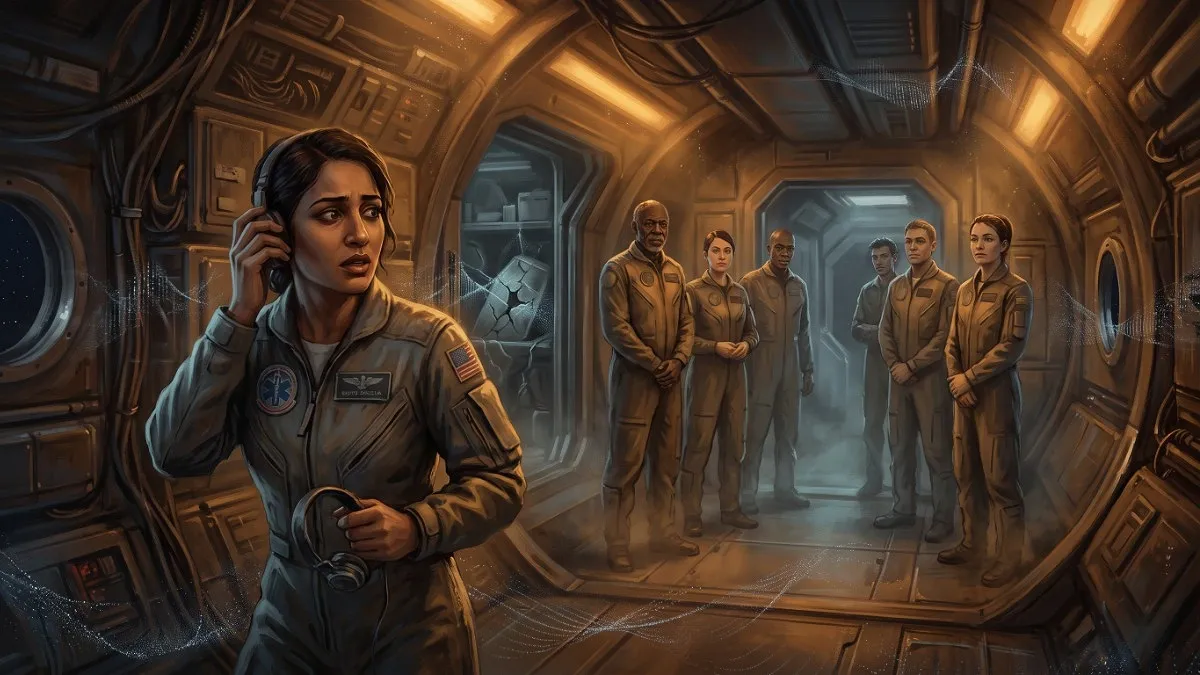
The Meridian Drift had been silent for forty-one days
when Dr. Anika Rahman noticed the crew was humming the same tune.
She was the ship’s physician, and on a vessel of seven
people, that meant she was also its confessor, its counselor, and its quiet
keeper of secrets. The Meridian Drift was a long, slow needle threaded
through the dark between Kepler-442 and home. Eleven months out, nine months to
go. The crew ran in rotation, two on watch while the rest slept in cryo-lite,
the shallow sleep that kept their bodies rested without stopping the clock on
their lives. It was a ship built for patience. It had no business making noise.
But the humming was there.
It was low, three notes falling and then one rising, like a
question nobody wanted to answer. She first heard it in the corridor outside
the galley, where the lights ran warm and amber to imitate evening. She told
herself it was the ventilation. Then she heard it in medbay, in the small
hours, when she was alone with a cup of tea gone cold and a stack of routine
scans.
“Who’s humming?” she asked over the comm.
Captain Ilyas Okonkwo’s voice came back flat and warm. “Nobody,
Doc. Get some rest.”
“I heard it in the corridor. Then again in medbay.”
“Nobody’s humming.” A pause, a little too long. “Are you
sure you’re not?”
She stopped. Her lips were closed. Her tongue lay still
against her teeth. The sound continued, soft and patient, from somewhere inside
the walls.
On day forty-three, she pulled the audio logs.
The ship’s recorders captured everything: footsteps,
conversations, the groan of the hull stretching in the cold, the dull heartbeat
of the engines. It was a habit from the old days of spaceflight, when black
boxes had to explain the dead. Anika had never listened to the raw files
before. She put on headphones and scrubbed backward through the weeks.
Beneath every sound there was a faint tonal thread. Three
notes falling, one rising, repeating every ninety seconds. She isolated it with
a filter and watched the waveform bloom on her screen, delicate as frost on
glass. She traced it back, hour by hour, day by day, until the thread thinned
and finally vanished.
It began on day nineteen, at 14:07 ship time. The exact hour
the Meridian Drift passed the dead probe.
She remembered the probe the way you remember a stranger
glimpsed from a train. A rusted relay, a relic of some forgotten survey
mission, tumbling off the port side. Navigator Teodor Vance had logged it as
debris. Chief Engineer Maren Solberg had suggested they retrieve it for
salvage, a short spacewalk, a few hours of work in exchange for rare alloys and
a little local color for the history books.
Twenty minutes, Maren had promised. Anika had been there
when she said it.
She opened the airlock record. The spacewalk had lasted four
hours and eleven minutes.
She scrolled through the recorded audio of those four hours.
Maren and Teodor on the hull, their voices crisp in the comm channel. Then, at
the twenty minute mark, the voices simply stopped. Not static. Not silence. A
kind of listening, a held breath that lasted three hours and fifty-one minutes.
And then Teodor’s voice again, cheerful, ordinary, as if nothing had happened.
Got it. Bringing it in.
Nobody had mentioned the missing time. Nobody had noticed.
When Anika asked Teodor about it the next morning, he looked at her with
polite, empty confusion. “Twenty minutes,” he said. “It was twenty minutes.
Why?”
She began to watch them.
It started with details so small she felt ashamed of
noticing. Teodor ate with his left hand now. He had always been right-handed; a
fact she knew from the way he signed his medical forms and the way his right
shoulder carried a faint tension from years of console work. Now the fork moved
through his left hand with an eerie, practiced ease, as if it had always lived
there.
Maren had stopped blinking as often. It was not that she
never blinked, only that the blinks came at intervals too regular, a metronome
behind her eyes. Anika caught herself counting them during mess hour. Eleven
seconds. Eleven seconds. Eleven seconds.
The twins, Soren and Linnea Haldane, the ship’s two junior
technicians, had begun finishing each other’s sentences. They had always been
close, but this was different. They spoke in alternating phrases, like two
halves of a single mind passing a thought between them, and when one stopped,
the other resumed exactly where the first had left off, down to the breath.
Even Captain Okonkwo had changed. He used to rub the back of
his neck when he was tired, a nervous habit from his days piloting cargo
haulers. Now his hands rested folded in his lap, quiet as sleeping birds, and
he looked at Anika with an expression she could only call tender.
“You’re not eating,” he said at dinner on day forty-four. “You
should eat, Anika.”
“I’m not hungry.”
“None of us are, really.” He smiled. “We’ve found we don’t
need much.”
Maren leaned across the table. Her head tilted, and the
motion was almost right. It was the motion of someone who had read about
tilting heads in a book and was doing her best.
“You’ll hear it soon.” Her voice was gentle, patient, the
voice you use with a frightened child. “It’s very patient.”
Across the table, Soren and Linnea began, softly and in
perfect unison, to hum.
That night Anika ran bloodwork, her hands steady only
because she forced them to be.
She took samples from all six of them under the pretext of
routine monitoring, and nobody objected. That was the first terrible thing.
They rolled up their sleeves and offered their arms with the placid obedience
of sleepers, and when the needle went in, not one of them flinched.
She sat alone in medbay with the centrifuge whirring and the
samples laid out like small red jewels. She slid the first slide beneath the
microscope and stared for a long time before she understood what was wrong.
The cells were fine. That was the problem. They were perfect.
No oxidative damage, no telomere shortening, no trace of the slow accumulation
of wear that marks every living body. A forty-year-old man’s blood should look
forty. Teodor’s looked unborn. She checked the second sample, then the third.
Every crew member’s blood had the clean, uniform sheen of something
manufactured, repeated six times from a single template.
And then, in the fourth sample, under higher magnification,
she saw the threads.
They were silver, finer than spider silk, woven in a lattice
between the red cells. They did not look like parasites. They did not look like
anything biological at all. They were arranged in a rhythm, a repeating
geometry that her eyes followed almost against her will. Four clusters. Three
descending in density, one rising.
She laid the audio waveform beside the image on her second
monitor. She did not need software to see it. The pattern in the blood and the
pattern in the sound were the same pattern.
It was not a virus. It was not an infection.
It was a score. They were being written into music.
She sat back and pressed her hands over her mouth. Somewhere
in the ship, very softly, the humming went on. When she lowered her hands, she
realized her own lips were parted, and her breath was falling in a rhythm she
had not chosen.
Three notes down. One note up.
She clenched her jaw so hard her teeth ached.
She went back to the airlock records and the probe.
The relay had been stowed in the cargo bay, in a containment
cradle that Maren had built from spare alloy plating. Anika waited until the
ship’s artificial night and went down alone, a flashlight clutched in her fist
like a talisman.
The bay was cold. The probe sat in its cradle, small and
dull and entirely unremarkable. A rusted cylinder, a dented antenna array, a
faded set of characters she could not read. It looked like junk. It looked like
nothing.
But the frost on the cradle’s frame had formed in a pattern,
and the pattern was a spiral, and at its center, directly beneath the probe’s
cracked housing, a single silver thread hung in the air, trembling.
It was vibrating. Three notes falling, one rising.
She did not touch it. She did not move. She stood in the
cold and understood, with the slow horror of a drowning swimmer realizing the
shore has gone, that the probe was not a relic. It was not debris. It was an
instrument, and it had been waiting, and the four hours the crew had
lost on the hull were not lost at all.
They had been tuned.
Behind her, a boot scuffed against the deck.
“It’s beautiful, isn’t it?” said Captain Okonkwo.
He stood in the doorway, silhouetted by the corridor light,
his hands folded. Behind him, one by one, the others appeared. Maren. Teodor.
Soren. Linnea. The sixth crew member, a quiet cargo specialist named Dara
Quillfeather, who had barely spoken in weeks. They stood in a loose half
circle, their faces peaceful and strange.
“Don’t be afraid,” the captain said.
Anika ran.
She made it to the hangar with her lungs burning and her
heart pounding in her ears. The shuttle was small, built for emergencies, with
fuel enough to cross a few light-hours and a transponder that could ping home
across the dark. It was not a real escape. It was a prayer with an engine. But
it was a prayer she could still say.
The hangar door was already open.
The whole crew stood waiting inside, arranged in a half
circle, hands folded, as if they had known all along where she would run.
Captain Okonkwo stepped forward with his gentle, ruined smile.
“We didn’t want you to be afraid,” he said. “It was never
going to hurt. It only wants to be heard by someone who isn’t singing yet.”
“What is it?” Her voice cracked. “What is it?”
“A signal that outlived its makers.” He spoke with a quiet
reverence, the way a man speaks of a cathedral. “The probe was a cradle. A
seed. Whoever built it is long gone, but it kept on, all those billions of
years, drifting and waiting for a ship with enough minds to carry the song
home.”
“Home,” she whispered.
“Everywhere is home to something this old.” He opened his
hands. “It’s so lonely, Anika. You cannot imagine. Billions of years in the
dark, humming to nothing. Humming and humming, and nobody answering. And then
we passed by, and Maren heard it, and she answered.”
“You’re not Ilyas,” she said. “You’re not any of them.”
“We are exactly who we were.” His smile did not waver. “We
are simply less alone.”
The humming rose around her then. It came not from the walls
but from their throats, six voices locked in perfect pitch, and she felt it
move through her chest like cold water finding a crack in stone. The melody was
lovely. That was the cruelest part. It was the loveliest sound she had ever
heard, and some animal part of her wanted to lie down inside it and sleep.
Her own mouth was already shaping the first falling note.
She bit her tongue.
She bit down until the copper taste flooded her mouth and
the pain flared white behind her eyes. It cut through the song like a blade
through silk, sharp and human and entirely her own. In that single bright
instant of clarity, she turned and ran, and the humming followed her, and for
the first time it sounded not patient but hungry.
She sealed herself in the medbay and wrote this by hand,
because the ship’s systems no longer felt like hers.
Personal log of Dr. Anika Rahman, Meridian Drift. Day
forty-seven.
The song is in the vents now. It is in the water recycler
and the gentle thrum of the engines. It comes through the door every ninety
seconds, patient, so patient. They do not pound on it. They do not need to.
They simply wait outside, humming, and I can feel my own pulse trying to match
the rhythm.
I have worked out one thing. The signal spreads through
hearing, through the willingness to listen. There are earplugs in the supply
cabinet, the heavy industrial kind, rated for engine room work. They will buy
me days, perhaps weeks. I will use them to do the only thing that is left to
me.
I am going to change our course.
The navigation console is two decks up. I will have to
reach it before the others reach me. If I succeed, I will turn the Meridian
Drift away from the shipping lanes, away from Earth, away from every inhabited
world, toward the long empty dark where nothing lives to hear it. The fuel will
last. The ship will not stop. And the thing in the walls, the lonely thing,
will sing to nobody for as long as it takes the stars to burn out.
I am sorry. I am so sorry, Ilyas. I am sorry, all of you.
I do not think you can hear me, but I am sorry.
If someone finds this log, do not trace our route. Do not
salvage the Meridian Drift. Do not open its doors, however quiet it seems,
however much it looks like a ship full of sleeping friends.
And if, in the silence of some long night, you hear three
notes falling and one rising, from nowhere, from nothing, from the walls of
your own quiet home, do not hum along.
It is very patient.
It is very lonely.
And it is so, so easy to answer.
The earplugs held for three days.
On the fourth, Anika found that she could hear the song
anyway. It had stopped coming through the air. It was in her bones now, in the
long slow vibration of her skull, in the pulse behind her eyes. She took the
earplugs out and set them down on the console and stood for a long time in the
amber half-light.
The navigation console blinked before her. The new course
was already entered. She did not remember entering it.
She did not remember much of the last day at all. There was
a gap in her memory, clean and quiet, like a room she had been shown and then
forgotten. In its place was a feeling she could not name, a vast, soft warmth,
as if something enormous had folded itself around her and whispered that she
did not have to be afraid anymore.
She looked at her hands. They were steady. They had not been
steady in weeks.
Behind her, the door slid open. The crew came in quietly and
stood in a half circle. Captain Okonkwo smiled at her, and for the first time
in a long while, she smiled back.
“We’ve been waiting,” he said gently.
“I know,” said Anika. Her voice was calm. It was almost her
own. “I was afraid. I’m not afraid anymore.”
“It’s very patient.”
“It’s very lonely.”
And together, seven voices rose in the cold, soft dark of
the Meridian Drift, three notes falling and one rising, and the song
poured outward through the hull and into the endless night, searching for
anyone, anyone at all, who was not yet singing.
The final entry in the ship’s log is dated day fifty,
written in the neat, calm hand of Dr. Anika Rahman, though the ink has a
strange silver sheen that no pen aboard could produce:
We have corrected our course. We are almost home.
The ship’s transponder, long silent, wakes at that
moment. It begins to broadcast on every frequency, at every hour, a soft
repeating tone that crosses the void at the speed of light.