
Bhangon

Generated by AI
The launch left Sadarghat an hour after the evening azan, and by the time it crossed into the wider water I had stopped pretending to read. There is an hour on the rivers of this country when the light gives up all at once, the way a sick man gives up, and the far bank turns from green to grey to a long black seam. The wind off the water in Bhadra carries a chill that has nothing to do with the temperature.
I was travelling to photograph a house before the river ate it.
That was the commission. A heritage trust in Dhaka, with a list of two hundred and forty zamindar houses across the delta and money enough to document nine. Nurjahan Manzil at Rupdaha was ninth because it was last in time. My job was to come back with a folder that would sit in a cabinet after the house itself was silt.
My mother did not like the assignment. When I told her the name of the village, she went quiet for a length of time that did not fit the conversation, and then said, in the flat voice she used for ending things, that I should carry a mosquito net. I remember it now with the clarity of a photograph. At the time it was nothing.
We reached Bhandaria ghat near midnight. From there a van, a bus at dawn, then eleven kilometres on the back of a motorcycle taxi. When I said the name of the house the boy did not turn the bike around. He sat with the engine running and looked past me down the track.
“Nobody stays there,” he said.
“There is a caretaker.”
“Abed chacha stays in the outbuilding. That is not the house.” He put the bike in gear. “Bhai, do your work and come back before evening. The road floods.”
The road did not flood. I learned later that this is what people here say when they do not want to say the other thing.
I walked the last stretch with my tripod bag cutting into my shoulder. The smell was of mud and cattle and rotting water hyacinth, a smell I associate to this day with the beginning of fear. Then the track rose slightly, which in this country means something is buried under it, and through a screen of betel nut palms I saw Nurjahan Manzil for the first time.
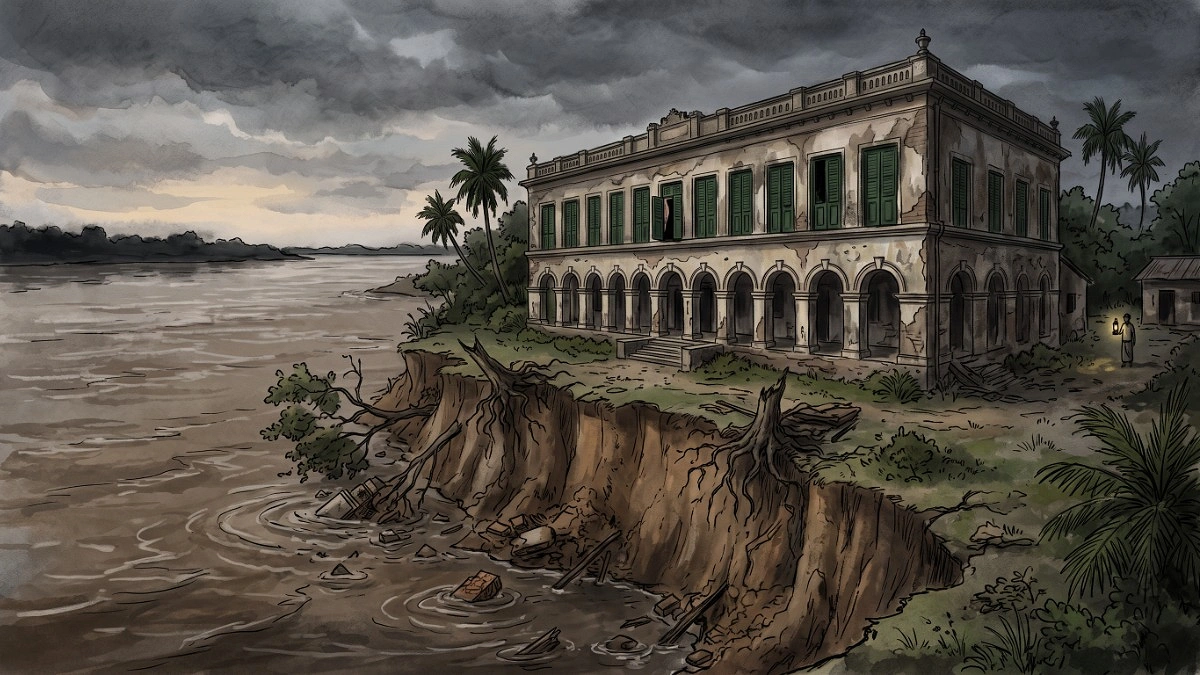
It stood three storeys, long rather than tall, its face to the river and its back to the village, which I noticed at once because every other house I had seen faced the road. The plaster had gone the colour of old bone. Along the front ran a verandah of arches, thirty-two of them, and above, a row of green shutters, all closed, not one broken. Over the entrance, in raised Bengali letters, the name and a date: 1894.
And behind it, close, far too close, a brown shine of moving water.
The Shonai had come within forty feet of the rear steps. It had taken the garden wall, the cookhouse, half of what the 1962 survey called the inner courtyard. Where the lawn had been there was a raw vertical cut of earth with roots hanging out of it like severed wiring, and every so often a lump of the bank detached and dropped in with a sound like a door closing in another room. That is bhangon. Erosion is the English word and it is a poor one. It suggests patience.
“You are the photographer.”
He had come up behind me without any noise at all, and I would like to record that I did not flinch, but I did, and he saw it, and something moved across his face that was not quite a smile.
Abed Ali was past seventy, small and very upright, in a white panjabi gone yellow at the collar, a gamchha over one shoulder, his beard hennaed to a dull orange. He had the eyes of a man who sleeps four hours and has done so for fifty years.
“Ishraq,” I said. “From the trust. They sent word.”
“They sent word.” He looked at the bag on my shoulder, the tripod, the aluminium case. “You will stay how long?”
“Four days. Five if the light is bad.”
He turned and started toward the outbuilding, and over his shoulder, as though it were a detail about the plumbing, he said, “You will sleep in my room. Not in the house.”
His room was a brick shed with a tin roof, built against the old stable, and he had lived in it since 1979. A rope cot, a second cot he produced for me, a tin trunk, a framed verse in Arabic, a calendar four years out of date. That evening he made rice and a thin curry of small fish, and we ate it on the step while the light went, and he asked me nothing about myself, which I found restful and later found terrifying.
I asked him about the house instead.
The family were Chowdhurys. The founder, Ashraf Ali Chowdhury, had not been a zamindar at all in the beginning but a dewan for an English concern. He built the house in 1894 with money nobody could account for, and by the time he died in 1931 the fiction was complete and everyone called him Chowdhury Sahib without irony. His grandsons lost the land in 1947 and again in 1971, and the last of the line, a widow called Nurjahan Begum, died in 1978 in a Dhanmondi flat with a nurse and no visitors. Abed Ali had been appointed by a lawyer whose firm no longer existed. The salary stopped in 1993.
“And nobody in the family comes?”
“Some came. Early.” He was cleaning his teeth with a neem twig, unhurried. “In eighty-six two grandsons came with a surveyor to sell. They stayed one night in the house.”
“And?”
“They did not sell.”
I waited, and he did not continue, and I understood that this was a complete answer and I was expected to take it.
Then he gave me the rules.
He did not call them rules. He listed them the way a man lists the defects of a borrowed bicycle. I could work from after sunrise to before sunset. The east wing was locked and he did not have the key. I should not draw water from the old well, even to wash my hands, because the well was fouled. And if I heard anyone moving on the upper floor, I should not answer, I should not go up, and I should come out to him.
“Who would be moving on the upper floor?”
“Monkeys,” said Abed Ali, looking at the river. “There are many monkeys.”
There were no monkeys. In five days at Rupdaha I did not see one monkey.
I began at seven, the good hour for an east facing facade, and for three hours the work absorbed me so completely that I forgot to be uneasy. This is the mercy of technique. You set the tripod, you check the level, you wait for the cloud to move off the cornice. The plaster mouldings were lotus and acanthus together, Bengal and Europe agreeing to disagree.
Inside, the house was dry. That was the first thing that did not fit. Every abandoned house in the delta is wet. The monsoon comes through the roof, the walls sweat, the air tastes of mushroom. Nurjahan Manzil was dry as paper, smelling of camphor and something under the camphor, sweetish, the way a fruit smells two days before it turns.
At eleven I found the courtyard well.
It sat in the middle of the inner court, a circular curb of brick and lime, four feet high, with an iron lid bolted down over it. Not a wooden cover. A plate of iron rusted orange, fixed with four bolts set into the brickwork with lead. Somebody had gone to real expense to close this well. Setting up the fourth shot, I put my palm flat on the iron and pulled it back at once.
The lid was cold. Not the ordinary cool of metal in shade. It was cold the way the inside of a refrigerator is cold, on a September morning in Faridpur, in ninety percent humidity, with the sun standing directly over the courtyard.
I told myself a story about groundwater and thermal mass. The story was thin and I knew it was thin. I photographed the well and went to the east wing door instead.
It was at the end of the northern corridor: a double door of teak, black with age, with a brass plate screwed down across both leaves so that it could not be opened without destroying the plate. The screws were mild steel, driven in perhaps thirty years ago. Someone had sealed this door long after the family left.
I wrote east wing inaccessible, secondary sealing evident in my notebook, and as I was folding the tripod I heard, from directly above me, the small unmistakable sound of a woman’s anklet.
Two steps. A pause. Two steps.
Every hair on my arms came up. I stood still with the tripod half folded and my heart going like a bird in a box, and there was nothing more. Somewhere a crow was complaining and the river was making its endless flat noise, and in the corridor, there was only camphor and that sweetish thing beneath it.
I did not answer. I did not go up. I walked out through the durbar hall at a pace that I would describe as brisk, and I found Abed Ali splitting kindling behind the stable, and when he looked at my face, he put down the dao and said, “Sit. Drink water.”
“There is someone upstairs.”
“Yes,” he said.
Not no. Not monkeys. Yes.
He poured me water from the clay pitcher, which came from the tube well by the road and not from the fouled place, and he sat on his heels beside me in the way of village men, and he said the thing that I have turned over in my mind every night since.
“She does not come down. In forty-seven years, she has never come down. You are safe on the ground floor unless you call her.”
“How would I call her?”
Abed Ali picked up the dao again and set a piece of wood on the block.
“By knowing her name,” he said.
I should have left. I have gone over the decision many times and cannot make it look like anything other than what it was: I was twenty-nine years old, and I did not believe him, and at the same time I did, and the two beliefs together made a fever I mistook for professional curiosity.
The trust had given me a second task, minor, almost an afterthought: if there were papers, photograph the papers. On the second afternoon I found them.
The room was at the northwest corner, behind a door I had taken for a cupboard. Shelves to the ceiling, and on them, wrapped in oilcloth, ninety years of estate ledgers. Rent rolls, seed loans, the cost of ice brought upriver in sawdust for a wedding in 1907. The ink was iron gall and had outlasted everything. I set up two lamps and shot page after page, and for six hours I was as happy as I have ever been at work.
Then I came to the indigo books.
Ashraf Ali Chowdhury had made his money as dewan to the Rupdaha neelkuthi, the indigo concern of a Scot who appears in the ledgers as Sahib and in one loose letter as that dog. Indigo in this country is not a colour. It is a wound. The planters advanced money to farmers who could not refuse it, bound them to a crop that poisoned the soil and could not be eaten, and kept men with sticks for those who resisted. All of that is in the history books. What is not in the books is the handwriting of the man who did the arithmetic. It was very neat, and it included a column for what he called persuasion.
In the book for 1889 to 1893 the entries change character. Rupdaha had begun to refuse. There are payments to the police thana, payments for the repair of a burnt godown, a list of fourteen names under the heading absconded, and beside four of them the notation settled, which I did not at first understand and then understood entirely.
And on the last page of that volume, out of order, in a different and much worse hand, as though written quickly and late at night, there was this:
17 Ashwin. The Bagdi girl was brought up from the kuthi. Sahib went home to Scotland on the eleventh. She has no people now; the brother having absconded and the mother dead of cholera in Chaitra. She says she will go to the magistrate at Faridpur. I have explained that there is no magistrate for such as her. She says she will go anyway. She is not afraid, which is the difficulty. Tomorrow the well is to be finished.
The well was finished, according to the accounts in the next volume, on 19 Ashwin 1300 of the Bengali era, at a cost of one hundred and forty rupees, with eleven rupees more for ironwork, lid, urgent.
A well needs a wooden cover to keep out leaves, a rope and a pulley. No mason in Bengal has ever bolted iron over a well with lead set screws in the week it was dug.
I sat on the floor with the lamp buzzing and the book open on my knees and felt the house settle around me, the way a house does when the day heat leaves the bricks, all the beams giving their small reports one after another, and I thought quite clearly: she is above me now, and she is listening, and I am reading her name.
Because it was there. Six lines further down, in the wage column, the last payment ever made to her, three annas for a month of carrying water, and the name written out in full.
I did not say it aloud. I want that on the record too. I did not say it aloud.
But I read it, and my mouth moved, because everyone’s mouth moves.
The next morning, I walked into the village, telling myself it was for batteries and biscuits. I bought those at the one shop, from a man who put them on the counter and then stood back from me as though I had come out of a hospital.
The primary school was two rooms and a mango tree, and the teacher, Rehana, was a woman of about forty with the unbothered authority of a person who has been shouting down eight-year-olds for two decades. She was the only person in Rupdaha who looked at me with curiosity rather than pity.
She gave me tea. I asked about the house. She laughed and said everyone asks about the house, and then she stopped laughing.
The story as the village tells it, she said, has three parts, and the parts do not agree, which is how you know it is old.
The first part is that there is a woman in Nurjahan Manzil who was put into the well while she was alive. Some say a servant. In the oldest version she is not a woman at all but the spirit of the indigo itself, blue and patient, which is the kind of thing that happens to a story after a hundred years.
The second part is that she is not in the well now. Something went wrong with the grave, the lid or the lead or the prayers, and she came out of it and went up, and has been in the upper storey since. This is why the shutters are closed. Abed Ali closes them, and they do not stay closed by themselves.
The third part is the one that made me put my cup down.
“She does not trouble outsiders,” Rehana said. “She has no interest in you. She is waiting for the family.”
“The Chowdhurys are finished. The last one died in Dhaka in seventy-eight.”
“The last one with the name,” she said. “Names are not blood. Chowdhury Sahib had four sons and a great many daughters, and the daughters married, and by now half the district could be his blood and not know it. That is what my grandmother said. She said the house is patient because it knows arithmetic. It only has to be right once.”
I laughed. It came out badly.
“You are from Dhaka?” she asked.
“Yes.”
“Your people are from Dhaka?”
And I opened my mouth to say yes, and found that I did not know. My father’s family were from Comilla and I could recite them back four generations. My mother never spoke of hers. There was one photograph, a studio portrait of a young woman sitting very straight with her hands in her lap, and on the back in faded ink a place name I had looked at a hundred times as a child without ever asking what it meant.
The place name on the back of that photograph was Bhandaria.
I walked back along the paddy bunds in the white afternoon heat with my heart going wrong in my chest. Two sections of the track had slumped since morning. At the turn by the palms I stopped and looked up at Nurjahan Manzil, at the long face and the thirty two arches and the row of green shutters.
On the upper floor, third from the left, one shutter stood open.
I told Abed Ali about the shutter. He looked for a long moment, then went inside with a lamp, alone, and came out forty minutes later. The shutter was closed. He would not tell me what he had done, and he did not eat that evening.
“Tomorrow, you finish,” he said. “Tomorrow evening you go.”
“I have the east wing still.”
“The east wing is not on your list.”
“It is the whole east elevation. If I do not document it, the trust sends someone else after the rains, and by then there will be nothing to document.” I heard myself being reasonable. There is nothing more dangerous than a young man being reasonable. “Chacha, the river takes the east wing first. Whatever is in there goes into the water either way.”
His fingers stopped on the beads.
“Yes,” he said quietly. “That is what I have been thinking also. For two years.” In the lamplight he looked a hundred years old. “When the water reaches the wall, the water opens the wall. And then it is nobody’s business what happens after. I have been sitting here waiting to find out whether a house can be drowned.”
We did not speak again that night. But in the morning, without a word, he brought me a crowbar.
The brass plate came off in eleven minutes. The screws were rotten in their holes and the wood had gone soft behind the plate, and the doors opened inward with a long complaining note, and the air that came out of the east wing was the first wet air I had smelled in that house.
Wet and cold and blue.
I do not know a better way to say it. There is a smell to indigo vats, a flat mineral sourness with ammonia in it, the smell of something being forced to give up its colour. The east wing smelled of that, faintly, a hundred and thirty years after the last vat at Rupdaha was broken up.
The corridor ran twenty feet and opened into a single large room, and the large room had no floor.
That is what my eyes reported for two seconds. Then they corrected: the floor was there, under four inches of standing water, perfectly still, reflecting the ceiling so exactly that the room seemed open to a second room below. The water had come up through the foundations, because the river was nine feet away and the wall was standing in it.
And on every wall of that room, from the waterline to the height of a man’s shoulder, there were handprints.
Thousands of them. Small. Overlapping. Pressed flat against the lime plaster and then dragged, so that each one ended in four smeared lines going downward, and they went around the entire room without a break, and they were blue.
I photographed it. Eleven frames. My hands were not steady, and in four of them you can see my own reflection in the water, a man crouching in a doorway with a camera where his face should be.
In the eleventh frame there is a second reflection. It is standing behind me. I have shown that photograph to two people and then I stopped showing it to people.
I backed out of the east wing. I did not turn around. The water did not move at all, not even where my weight on the floor should have sent a ripple across it, and that unmoving surface is the thing I still see when I close my eyes too slowly.
When I got to the corridor, I found that I was saying her name.
Not loudly. Under the breath, the way you carry a word you have been trying not to carry, the way a tune gets into you. I had been saying it, I think, since the ledger room. I had been saying it for a day and a half.
Above me, the whole length of the upper floor, something began to walk.
The rain came at four in the afternoon and did not stop.
It arrived as a grey wall that swallowed the far shore, then as a sound on the tin roof so total that Abed Ali and I could not hear one another at three feet.
The track flooded. The boy on the motorcycle had been right, and I had been given fair warning by a stranger and paid no attention, which is the shape of my whole life if I am honest. There was no leaving. There was the shed, the rain, and the river rising, which by seven had become a low roar with deep concussions in it as the bank went in, fifty tons at a time.
Abed Ali prayed the Isha and then he sat with his back to the wall facing the door, and he said, over the noise, “Tonight it reaches the east wall.”
“How do you know?”
“Because I have been measuring it every day for two years with a stick.” He almost smiled. “You have your instruments. I have a stick.”
Then he said, “Whose blood, are you?”
I did not answer him. He nodded as though I had.
Here is what happened next, and I will set it down as plainly as I can, because ornament is a way of hiding and I am tired of hiding.
Sometime after midnight the sound changed. The river noise took on a grinding, and under the grinding a series of impacts that came up through the ground into the cot frame and into my back. Abed Ali was already at the door with the hurricane lamp. I went out after him into water over my ankles and warm as blood, and he held the lamp up, and we saw the house.
The eastern quarter of Nurjahan Manzil was standing in the river.
The bank beneath it had gone. The whole corner had dropped four feet and canted toward the water, and the wall had split from the roofline down in a crack you could have put your arm into, and while we watched, the top of that wall let go and fell outward into the Shonai and vanished with hardly any sound, because the river was making all the sound there was.
The east wing was open to the sky and the water was in it and the water was going out of it, and with the water, out of the broken wall, in the light of one hurricane lamp at sixty feet in heavy rain, something came.
I will not describe it. I have tried, in the years since, on paper, at three in the morning, with a doctor, with a man in Comilla who took four thousand taka and told me to keep a Quran under the pillow, which I do. Every description makes it a thing among other things, and it was not. I will say three true statements and stop.
It came out low, through the water, and it did not swim.
It was wearing what she had been wearing, and the cloth had not rotted, because nothing in that house had rotted, because rot requires time and time had been refused entry.
And it did not go into the river, which was thirty feet in one direction. It came up the bank, into the wind, toward the lamp.
Abed Ali put the lamp down on the step, carefully, the way you put down something breakable, and stepped in front of me. This small old man who had been paid nothing since 1993 put himself between me and it and began to recite, and what he recited was no prayer I know but a long string of village words, half Arabic and half Bengali and half something with no language in it at all, and the lamp guttered and went out.
In the dark he said, “Run to the road. Do not look. Do not say the name.”
And I ran.
That is the part I have not been able to put anywhere. I ran. I went through the water and through the paddy and I fell twice and got up and ran, and behind me I heard him still reciting, and then I heard him stop, and then for a while I heard something else, and then only the rain.
They found me at first light on the Bhandaria road, sitting in twenty inches of water with my arms around a milepost.
Abed Ali was not found on the first day or the second. On the fourth a fishing party pulled him out of the Shonai eleven kilometres downstream. The police report gives drowning, which is certainly true. I was not permitted to see him, and I have been grateful for that, and ashamed of the gratitude, every day since.
Of Nurjahan Manzil there remained, by the end of that week, the western third: eleven arches of the thirty-two. The rest was in the river. The trust has my photographs, the only complete record of the house that exists. I have never submitted the eleventh frame from the east wing.
The well went in on the second night. I went back in November and stood at the edge of the new bank where the inner courtyard had been. There was nothing. Not a curb, not a brick, not a rag of iron. The Shonai had carried the whole of it away and put it down somewhere in the two hundred kilometres between Rupdaha and the sea, and I waited to feel something like relief.
What I felt instead was the sensation of being counted.
In December I asked my mother, finally, about her mother.
She was making tea and did not turn around. Her mother’s people had been from a village near Bhandaria. Her mother had married at sixteen and never gone back, not once, not for a death. Her mother had been the granddaughter of a Chowdhury of some sort; there had been land once. And when her mother was dying, in a room in Azimpur in 1981, she had spoken for two days to somebody who was not in the room, and called that person by a name, and asked her, over and over, to please wait.
“What name?” I spoke.
My mother put the lid on the pot.
“You will not hear it from me,” she said.
I have not heard it from her. But I read it once, in a ledger, by lamplight, and said it under my breath for a day and a half without knowing what I was doing, and there is no unsaying such a thing. Names are not blood, Rehana Miss told me. She had it backwards. Blood is a name. It is the one name a person carries that they never chose and cannot put down.
I live now on the ninth floor of a building in Mirpur, which I chose for the height, and I do not keep water standing anywhere in the flat, not a vase, not a bucket, not a saucer under a plant. My wife thinks it is a quirk from the fieldwork years. She is patient with it.
But the delta is one body. Every canal runs to a river and every river to the Meghna, and in Shraban the drains back up and the whole city sits in the water like a plate in a sink. Whatever the Shonai took at Rupdaha, it did not destroy. Rivers do not destroy. They move things, patiently, from a place where they were buried to a place where they are not.
The house only ever had to be right once.
Last Shraban the water came up Shewrapara and stood four days in the lane, and on the third night, in the lift lobby of the ninth floor, which is dry, which is ninety feet above the street, I found a wet mark on the tiles. Small. A handprint, pressed flat and dragged downward in four lines.
Not blue. It has been a long time. The colour had gone out of it.
But it had come up.
