
The Mahanayak: How Uttam Kumar Became the Face of Bengali Cinema


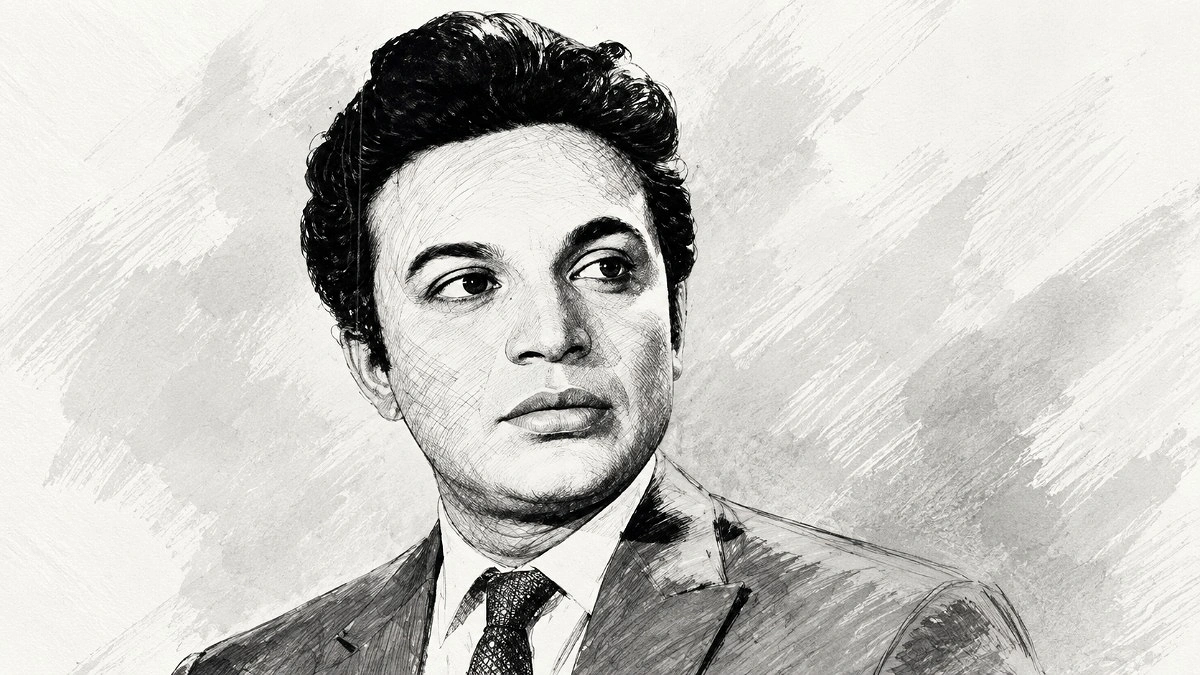
Uttam Kumar
There are actors, and then there are institutions. In the history of Bengali cinema, Uttam Kumar belongs firmly to the second category.
For nearly three decades, from the early 1950s until his sudden death in 1980, he did not simply appear in Bengali films. He defined what a Bengali film was supposed to feel like. To an entire generation of viewers in Calcutta and across Bengal, the word "hero" and the name "Uttam" became almost interchangeable. Even today, more than four decades after his passing, he is remembered by the title his admirers gave him: Mahanayak, the great hero, a name so completely his that it needs no further explanation in Bengali households.
A Clerk Who Became a Legend
Uttam Kumar was born Arun Kumar Chattopadhyay on 3 September 1926 in Ahiritola, a neighbourhood in northern Calcutta. His father, Satkari Chattopadhyay, worked as a projectionist at Metro Cinema, which meant that the future superstar grew up literally in the shadow of the silver screen, watching light flicker into stories from behind the glass of a projection booth. His mother, Chapala Devi, ran the household. The family was not wealthy, and young Arun’s early years carried none of the glamour that would later surround him.
He studied at South Suburban School before enrolling at Goenka College of Commerce and Business Administration, though he never completed his formal education. Instead, financial necessity pushed him toward employment, and he took up a clerical job at the Calcutta Port Trust. It is a detail that modern audiences often find hard to reconcile with the man who would go on to embody romantic elegance on screen for thirty years. Before he was a matinee idol, he was pushing paper across a government desk, dreaming of something larger.
That dream had deep roots. Kumar’s family ran an amateur theatre group called Suhrid Samaj, and he also founded his own troupe in his youth known as the Lunar Club. He took music lessons from Nidanbandhu Banerjee and performed in local stage productions long before any camera pointed his way. He was also, interestingly, a serious athlete in his youth. He played football, volleyball and cricket, trained in the martial art of lathi khela, wrestled, and won the Bhawanipur Swimming Association championship three years running. This physical grace, this ease in his own body, would later become one of the defining features of his screen presence, a naturalness that set him apart from the more theatrical acting styles common in Indian cinema of that period.
The Long, Difficult Climb
Contrary to the myth that surrounds most legends, Uttam Kumar’s rise was neither swift nor smooth. He entered the film industry in the mid-1940s and, according to accounts of his early career, worked as an extra in an unreleased Hindi film called Maya Dore, earning a modest fee for five days of work. His actual screen debut came with Drishtidan, directed by Nitin Bose, but the film failed to make any real impression. For several years afterward, Kumar struggled through a string of commercial disappointments so consistent that he earned an unkind nickname within the industry, one that suggested his films were doomed at the box office regardless of effort.
It was the 1953 film Basu Paribar that first drew serious attention to him, but the real turning point came a year later with Agni Pariksha in 1954. That film paired him for the first time in a major hit with Suchitra Sen, and the chemistry between the two actors turned out to be one of the most consequential pairings in the history of Indian regional cinema. Over the following years, Uttam Kumar and Suchitra Sen appeared together in roughly thirty films, and there on-screen romance became a cultural phenomenon in its own right. Audiences did not merely watch their films, they anticipated them, memorised their songs, and treated the pair almost as a real life couple whose fortunes they were emotionally invested in.
Through the mid to late 1950s, Kumar built on this momentum with a series of films that are still considered classics of Bengali cinema: Sabar Uparey, Harano Sur, Shapmochan, Sagarika, Indrani. Each film cemented his image as the romantic lead of Bengali cinema, a performer whose subtle expressions and understated delivery contrasted sharply with the more exaggerated acting conventions of the time. Critics and ordinary viewers alike responded to something genuinely different in his craft. He did not perform emotion so much as inhabit it.
Beyond the Romantic Hero
What separates Uttam Kumar from many stars who achieve early fame on the strength of romantic charisma is that he refused to remain confined to that single register. As his career matured through the 1960s and 1970s, he sought out roles that tested his range and pushed him toward more complex, morally ambiguous, or psychologically demanding characters. Films like Nayak, directed by the celebrated auteur Satyajit Ray, gave him the opportunity to play a version of himself: a matinee idol wrestling privately with doubt, loneliness and the emptiness of fame. It remains one of the most self-aware and quietly devastating performances of his career, and it demonstrated that Kumar understood exactly what stardom cost a person even as he continued to enjoy its rewards.
He also worked extensively with other major directors of Bengali art and commercial cinema, appearing in films such as Chiriyakhana, Jatugriha, Bicharak, Khokababur Protyabarton, Chowrongiee, Ekhane Pinjar and Thana Theke Aschi. Across more than 250 films over the course of his career, he took on roles as detectives, tormented husbands, ordinary working men, and tragic figures, refusing to let his early image as a heartthrob limit the kind of stories he could tell. In 1967, when the Indian government instituted the National Film Award for Best Actor, Uttam Kumar became its very first recipient, honoured jointly for his performances in Antony Firingee and Chiriyakhana. Over his lifetime he would collect five National Awards and four Filmfare Awards, along with eight Bengal Film Journalists’ Association awards, a staggering tally for any performer, let alone one working primarily in a regional language industry.
More Than an Actor
Uttam Kumar’s ambitions extended well beyond acting. He worked as a producer, director, screenwriter, composer and playback singer, involving himself in nearly every stage of filmmaking. As a producer, he backed Saptapadi, the 1961 film that many consider the definitive Uttam Kumar and Suchitra Sen collaboration. The film was both a commercial triumph and a critical success, earning a Certificate of Merit as the second best feature film in Bengali at the National Film Awards that year. Its soundtrack and its central romance remain deeply embedded in Bengali popular memory even today.
He also ventured into Hindi cinema, appearing in films such as Kitaab, Dooriyan, Plot No. 5, Amanush and Anand Ashram, though it was always Bengali cinema that remained his true home and the arena in which his legend was built. In recognition of his contribution to Indian cinema, he received the Padma Shri, one of the country’s highest civilian honours, and in 1975 the Government of India presented him with an award recognising him as the greatest actor of his generation, accompanied by a substantial cash prize.
A Life Cut Short
Behind the public image of effortless charm, Uttam Kumar’s personal life carried its own complexities. He married Gauri Chatterjee in 1948, and the couple had a son, Gautam. In 1963, Kumar left his family home and began living with actress Supriya Devi, his frequent costar, with whom he remained until the end of his life. Their relationship was widely known and much discussed in Bengali society, a rare instance of a public figure’s private choices becoming almost as talked about as his films.
Kumar was, by every account, a relentless worker, often accepting far more projects than a person in ordinary health might reasonably sustain. This work ethic ultimately contributed to his downfall. While filming the comedy Ogo Bodhu Sundari in July 1980, he suffered a sudden health crisis and was rushed to Belle Vue Clinic in Calcutta, where he died on 24 July 1980 at the age of just fifty-three. His death sent shockwaves through Bengal. Satyajit Ray, who had directed him in Nayak and Chiriyakhana, publicly mourned him, remarking that Bengali cinema had lost a leading light whose absence could never truly be filled. Ogo Bodhu Sundari, ironically one of the most beloved comedies in Bengali film history, was released only after his death, turning what should have been a joyous cinematic experience into something tinged permanently with grief.
The Legend That Outlived the Man
Kolkata’s tribute to Uttam Kumar did not end with his funeral. The Tollygunge metro station, situated in the heart of the city’s own film industry hub, was later renamed Mahanayak Uttam Kumar Metro Station, a permanent civic acknowledgment of what he meant to the city and its culture. His films continue to be broadcast on Bengali television with a regularity that suggests they have never really left the popular imagination. New generations of viewers, many born decades after his death, still discover him through Saptapadi, Nayak or Harano Sur, and find themselves drawn into the same quiet magnetism that captivated audiences in the 1950s.
What made Uttam Kumar extraordinary was not simply his talent, though that was considerable, nor his productivity, though 250 films across roughly three decades is an almost unimaginable output. It was the way he made naturalism itself into a kind of stardom. At a time when Indian film acting often leaned toward the theatrical and the declamatory, Kumar chose restraint. He let silence and small gesture carry weight. Bengali cinema, both the commercial romances that made him famous and the more introspective, art inflected films that proved his range, found in him a performer capable of holding both worlds together.
More than forty years after his death, the title Mahanayak has never passed to anyone else. No actor since has been granted that name with the same unquestioned authority. In an industry that has produced many gifted performers, Uttam Kumar remains singular, not merely the greatest hero Bengali cinema ever produced, but the actor against whom every subsequent Bengali hero continues, whether they intend it or not, to be measured.
