
The awakened char


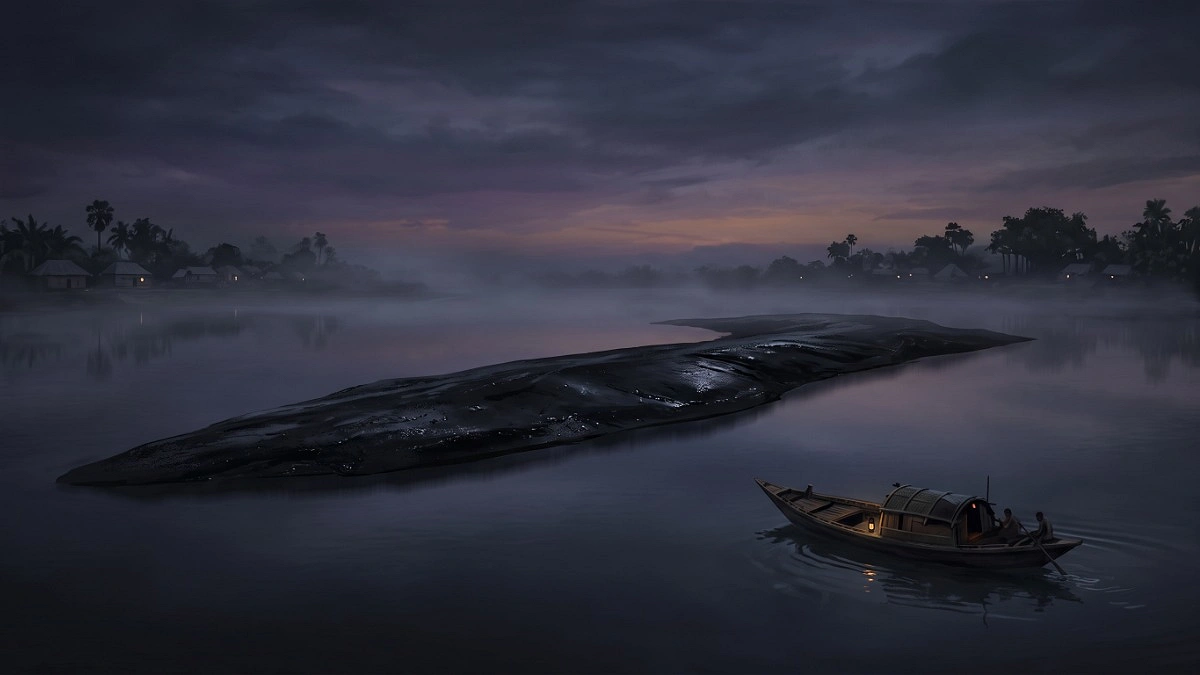
Generated by AI
At the mouth of the Meghna, where river and sea stand facing each other with clasped hands, the land is never permanent. It is a beggar’s bowl, filled today and broken tomorrow. The river snatches from one bank and returns the gift on another, and in the middle people drive the posts of their houses into a promise nobody can guarantee.
Dr. Tahmina Rahman had been keeping the accounts of that promise for twenty-two years. At the Water Resources Research Centre in Dhaka, her desk held a heap of satellite images, and each image was like a sigh of the river. Where the banks were collapsing, where a char was rising, where a new life might take root in the sand, she could read all of it, the way a fortune teller reads the lines of a palm.
One morning in the month of Ashwin, one of those images stopped her.
South of Bhola, pressed against the flank of Char Hasan, a black island had risen over the past three weeks. A rising char was nothing new. But the speed of this island was unnatural. Every night it grew by forty metres, and it grew only at night. In daylight the line of its shore did not move at all. Silt does not obey rules like that. Silt settles by the signals of the seasons, by the arithmetic of the tides, never by the loyalty of a clock hand.
Her assistant Rashed, a sharp young man of twenty-seven, looked at the image and whistled. “Madam, the colour is wrong. Silt is grey. This is black. Like coal tar.”
“And there is not a blade of grass on it,” Tahmina said. “On a new char the seeds of kash grass and casuarina arrive in the first week. Birds come. Nothing has come here. It is as if the soil is not inviting anyone.”
Tahmina had a habit that her colleagues smiled about behind her back. Because her eyes tired easily, she never wrote in a notebook. Every night she recorded the day’s observations in her own voice on her phone, then sent the file to the office inbox. Writing can lie, she believed, because writing can be arranged, but the tremor in a voice cannot be arranged. She would pay the price of that belief one day, though she did not yet know it.
The next evening, they boarded a launch at Sadarghat. All night the launch tore through the chest of the river, and outside the window the dark water slid by like black silk. At dawn they stepped off at the Bhola ghat and hired a trawler. The boatman’s name was Abdul Gani, a man near sixty, with the map of the river drawn in the creases of his face. One look at his eyes and you knew he had seen many things sink, and that the weight of seeing had made his gaze go still.
When the trawler entered the wide water of the estuary, the river moved slowly under the pull of the ebb. A black line appeared on the far horizon, as though someone had drawn a stroke with coal beneath the sky. As they came closer the line thickened and took shape. It looked like the back of an enormous sleeping buffalo, slick, wet and silent.
Rashed raised his camera. “Madam, look. The wind is blowing all around us, but there is not a single ripple near the char. The water there has turned into a mirror.”
Tahmina looked. It was true. The wind tugged at their hair, the estuary slapped and splashed against the hull of the trawler, but at the shore of the black char the movement had stopped, as though the river had caught its own breath and held it.
Gani Majhi suddenly swung the tiller. “I will go no further, Apa. This part of the river breathes.”
“Breathes? What do you mean, Majhi Bhai?”
“I have been on this river fifty years. Chars rise, chars sink, I have watched. But this land is not rising, Apa. It is sitting up. There is a gap between rising and sitting up.”
Tahmina did not smile. She was a scientist, but twenty-two years of river life had taught her never to dismiss a boatman’s words. She only said, “Take us to Char Hasan. We will watch from there.”
Char Hasan is the name of a weary village. In the last fifteen years it has moved its houses seven times. Each time the river took a courtyard, people unscrewed their tin roofs, carried them on their shoulders a little farther west, drove new posts into new land, and said, God gives what He gives. To the people of this village the river is a living deity, and also an enemy. Love and fear eat from the same plate here.
Habib Master, the teacher of the village primary school, gave them a room in the school building. In the afternoon he sat on the veranda with tea, and with him came an old woman in a white sari, eyes clouded, an old brass bowl in her hand. Her name was Rahima Buri. Her age was seventy, or perhaps eighty, she did not know herself.
“Have you come to see that black char?” the old woman asked. There was no tremor in her voice, as though she were only asking the price of something in the market.
“Yes, Dadi. Have you seen anything there?”
The old woman stayed silent a long while. Outside the sun was setting, and the red light was spreading in ribbons across the water of the Meghna. Then she said, “My son Kalam went into the river last Bhadra. The bank collapsed at midnight, and he was taking down the tin roof. I heard the sound. Then I heard nothing more.”
Tahmina said nothing. Before grief, science has no language.
“From the day that char rose,” the old woman said again, “I hear a call at night. Kalam’s voice. He says, Ma, keep rice for me. I am hungry. Lately I am hungrier than before, Ma.”
Tahmina looked toward Habib Master. The teacher did not lower his eyes. “Madam, I am an educated man. I do not believe in ghosts. But there are seven families in this village who lost people to the river in the last two years. All seven families are saying the same thing. Everyone hears the voice of their own. And everyone hears the same words.”
In Tahmina’s mind a line of scientific explanations stood up. Collective grief, insomnia, the sound of wind on water, the ear hearing what it wants to hear. Every explanation was logical, every explanation was tidy, and every explanation felt a little cold, like a wet cloth wrapped around the body on a winter night.
Rashed called from inside the room, “Madam, please come. Look at the geophone reading.”
She stood up. The small seismometer they had set up that morning on the western edge of the village, on the soil nearest the black char, showed a slow, regular wave on its screen. Once every three and a half seconds, a deep, heavy pulse.
“This is not an earthquake,” Rashed whispered. “Earthquakes do not follow rules like this. Madam, this is like a heartbeat. The heartbeat of some enormous sleeping animal.”
Tahmina kept looking at the screen. Outside, the brass bowl in the old woman’s hand was knocking softly against the veranda post, perhaps without her knowing, perhaps in time with the pulse. And that sound, astonishingly, did not match the rhythm of the screen. Rather, the pulse of the black char seemed to be sliding into the gaps of the old woman’s words, as if someone were putting an ear to them.
That night the old woman spoke again, in a soft voice, as if reciting a spell. “Tonight, you will see, Ma. Tonight, he will come.”
That night there was no moon. The dark fortnight of Ashwin had spread a black sheet over the river, and on Habib Master’s veranda a single hurricane lamp trembled, as if the darkness had not yet dared to swallow it. Tahmina and Rashed sat on a bamboo platform. In their hands were an infrared camera and an open laptop. In the corner of the courtyard Gani Majhi sat on his haunches, humming a bhatiali tune in a low voice, only the melody, no words, the kind of melody in which the sorrow of the river sleeps.
When the night had grown deep, the crickets suddenly fell silent.
Nature has a language of its own, and the most terrible word in that language is silence. Tahmina felt the hairs on her neck rising one by one.
“Madam,” Rashed whispered, “look at the screen.”
In the greenish grey light, the shore of the black char had come into view. And from that shore, out of the water, human beings were rising one by one.
First the head, then the shoulders, then the whole body. Some wore lungis, some had the end of a sari tucked at the waist, one carried a small child in her arms. There were nearly thirty of them. All were wet, water streaming down their bodies, and yet there was no sound of water. No splash, no drip. They crossed the knee-deep channel between the char and the village, and not a single ripple rose on the water, as though they were walking not on water but on the memory of water.
After climbing the bank, they left footprints in the wet mud. Tahmina could not look away. After each footprint was made, black silt pushed up from within and filled it, slowly, tenderly, as though someone were erasing a line at the very moment it was written.
“Where are they going?” Rashed’s voice was cracked.
It was Gani Majhi who answered. He had stopped his song, his head was bowed, his lips moving in a silent prayer. “To their own houses, Apa. Each to his own house.”
They spread out along the village paths. One came straight toward Habib Master’s courtyard, but he passed the teacher’s house and went toward the crumbling hut of Rahima Buri. Tahmina and Rashed followed him without a sound.
On the man’s shoulder was a sheet of tin roofing. Yes, a tin roof, the very thing he had been taking down when he fell into the river’s jaws last Bhadra. His body was smeared with mud and water, his eyes were open, but no light fell on those eyes, there was no reflection in them. He stood at the old woman’s door and called, “Ma. O Ma. Open the door.”
The door opened. Rahima Buri had lit a lamp inside and was already sitting ready. There was no fear on her face. There was a strange, broken, terrible calm.
“Come, my boy. I have kept rice.”
“Ma, give me rice. I am very hungry today.”
Kalam sat down on the floor. The old woman served rice and lentils on a bell metal plate. Kalam stretched out his hand, lifted rice to his mouth, chewed, swallowed. But Tahmina noticed that the rice on the plate was not decreasing at all. Water dripped from his wet hair, ran down his forehead, and yet not one drop fell on the floor. It was as if the water were part of the picture of his body, not a real liquid.
“Ma, give me rice. I am very hungry today,” Kalam said again. The same tune, the same voice, the same pause.
The old woman gave him another ladle of rice. “Eat, my son. Eat.”
Tahmina gathered her courage and stepped into the room. Her scientific mind was screaming, step back, and another mind, the oldest part of being human, was saying, reach out. She touched Kalam’s hand.
Cold. But not the cold of the dead. The cold of wet clay, inside which threads as fine as silk moved like living veins. And that throbbing, once every three and a half seconds, was exactly the slow, heavy rhythm she had seen on the geophone screen.
She drew her hand away. Kalam did not look at her. He only said again, “Ma, give me rice.”
Outside, Tahmina stood for a long time holding onto a wall. Rahima Buri came to the door.
“You saw, Ma?” Her voice did not shake. “I know he is not my Kalam. Somewhere there is a mistake in him. But Ma, I am close to eighty. If the river gives my son back, even his mistakes are my own.”
Tears came to Tahmina’s eyes. She knew that against these words science had no argument.
Just before dawn, when a pale light caught the corner of the sky, Kalam stood up. No farewell, no glance behind. Silently he took the path toward the water, the sheet of tin on his shoulder. And exactly as he had come, he descended into the water, without raising a single ripple.
The next morning Gani Majhi flatly refused to take the boat near the char. After much pleading he said at last, “I will go as far as the bank, Apa. No further. Do what you must.”
Tahmina and Rashed set foot on the black char.
The ground was soft, but not soft enough to swallow a foot. When you stepped, it sank a little and then rose back, as though they were walking on the chest of a sleeping creature. Rashed stopped as he read the thermometer. “Madam, thirty eight degrees. The air outside is thirty. This soil is warm. Warm like a human body.”
Black, glossy, odourless. There was not an insect anywhere, not a snail shell, not a splinter of mussel. A river char cannot be so barren, because the river never throws anything away, it mixes the seeds of life into every gift. Yet this char seemed made not to oppose life but to digest it.
They carried samples back to Habib Master’s school building, where an old microscope and Rashed’s portable lab were set up. Tahmina put her eye to the lens, and the whole world changed in a single moment.
Every grain of the soil was not a grain at all. They were threads as fine as glass, a net of translucent filaments branching like the roots of a tree, and at the tip of every branch a knot of tiny crystal. Together they formed the plan of an immense nervous system, a plan which a human brain would have recognised as a relative.
“Madam,” Rashed said, attaching the wires of the oscilloscope, “these filaments are carrying current. Very weak signals, but regular. Shall I connect a speaker?”
Tahmina nodded.
From the speaker came at first only a hiss, like rain. Then, slowly, out of that sound, human voices began to surface.
Not one voice. Hundreds, thousands. One on top of another, layer upon layer, as if every voice drowned at the bottom of the river were whispering at once. “Ma, give me rice.” “Turn the boat, a storm is coming.” “Khoka, hold my hand.” “Allah, Allah.” “The hilsa has come up, O Rahim, pull the net.” The dialect of Bhola, the lilt of Noakhali, the tune of Barisal, all mixed together. The sentences were raw, broken, half finished, but each carried such a human warmth that, heard through a cold speaker, it turned the chest to ice.
Rashed switched the speaker off. His hands were shaking.
“It is learning,” he said, letting the breath out of his lungs. “Madam, this is not a haunting. It is a process. Something is collecting the final electrical imprints of the brains of the drowned. Memory, voice, gesture, everything. Then it builds people again from those imprints.”
“But why?”
“To learn a language,” Rashed said, frightened by his own words. “Something unknown has come to this world and is trying to understand what a human being is. And the easiest way to understand a human being is to copy one.”
Just then Habib Master came into the room with an old diary in his hand. He turned the pages and showed them. “On the last night of Bhadra a star fell from the sky, Madam. So large and so bright that the whole village came out of their houses. It dropped straight into the mouth of the Meghna. The fishermen called it a fallen star. I wrote it down. Exactly one week later the char began to rise.”
Tahmina sat silent for some time. Outside, a gust of wind was passing over the paddy fields, and far away, over the black char, that slow, heavy heartbeat went on.
A seed had fallen from the sky into the mud of the Meghna. It had sunk its roots. And its food, its fruit, its language, all of it was the drowned children of this river.
That night Tahmina switched on the recorder on her phone and said slowly, in a clear voice, “Dhaka Centre, this is the observation of Dr. Tahmina Rahman for the third day. Our assessment is that the char is a living organism. It takes the nervous imprints of the drowned and produces copies of them. The copies return to the village at night. They speak, they eat, but I still cannot understand what exactly they are getting wrong.”
She paused. The words sounded strange even in her own ears. Wrong. What wrong? The old woman had used the very same word.
Outside the room Rashed was putting on his jacket. “Madam, I am going down to the ghat for a while. I will talk to Kalam tonight. An experiment has come into my head.”
“Do not go alone, Rashed.”
But the boy had already melted into the dark.
As the dawn light first tapped the tin roof of the school building, Rashed came back.
Tahmina had sat awake all night. She ran to the door. Rashed stood on the threshold, clothes soaked, hair dripping, on his lips that familiar, slightly crooked smile. Under his feet not a drop of water gathered on the floor.
“Madam, good news,” he said. The voice was entirely Rashed’s, that eager, youthful voice. “I questioned Kalam. I asked him, what will you do tomorrow. He could not answer. I understood then that they know only what has already happened.”
A piece of ice slid down into Tahmina’s stomach.
“Rashed,” she said, very slowly, “did you go into the river?”
“I went to the ghat. Then I went into the water. I liked it, Madam. There was no pain. You should come one day.” He stopped. The smile on his lips stayed exactly the same. “I mean, you ought to have come.”
Tahmina stepped back. “Rashed, tell me, what will we do tomorrow?”
Rashed frowned, as if the question had been asked in a foreign language. His lips moved. “Tomorrow we… tomorrow we took samples.” He said it again, more earnestly, with more belief, “Tomorrow we took samples, Madam.”
From behind came the voice of Gani Majhi. Broken, but steady. “That is not Rashed, Apa.”
“Gani Chacha, I am Rashed,” the boy said softly. There was hurt in his voice, and that hurt was the most terrible thing of all. Because he truly believed it.
Tahmina sank down on the floor. She felt she had just received news of the death of a beloved person, and that person was standing in front of her, consoling her.
That morning, she gathered the whole village together. A broken microphone, a shaking voice, but with all the firmness of science she said that this char was dangerous, that the village must be abandoned at once. Everyone listened in silence. Then Rahima Buri stood up.
“You go, Ma. You have your work, you understand things. We will stay.”
“Dadi, they are not your own people.”
“No, Ma. They are not.” The old woman raised her wrinkled face. “But they come wearing the faces of my own. And for two years now nobody has called me Ma. What will you give me that is more than that char gives?”
Tahmina had no answer. Science knows what is happening, but the answer to why it is happening always hides inside tears.
Seven families stayed in the village. The others did not speak of leaving either.
That night Tahmina could not sleep. Sitting in a corner of the school room she began to listen to the recording files on her phone, one by one. An ordinary task. Arranging her words before sending the report to Dhaka. But as she listened to the third file, her finger stopped.
Her own voice was saying, calm and tired, “Observation of the second day. The old woman says her son comes at night. I have taken her words as an expression of grief.”
She played the next file. Then the one after. The first night’s file, the second night’s, today’s. Every sentence had verbs, and yet every verb was past or present. I analysed. I took it as. I can see. I cannot understand.
She went back to the very first file. Recorded on the evening before leaving Dhaka, sitting at Sadarghat. There her voice said clearly, “Tomorrow morning we will reach Bhola. The day after, we will go to the char.”
Will reach. Will go. After that evening, after that launch, she had never once spoken a verb of the future.
Cold sweat ran down her forehead. She whispered, “I will return to Dhaka tomorrow.” Before the sentence could leave her mouth, her tongue snagged on something. The last syllable would not form. She tried again. “I will return to Dh…” Again, something stood in front of her like a wall. Her mouth could say, I returned, I am returning, I return. It could not say, I will return. That word had been quietly cut out of her language, the way a surgeon removes an organ, leaving no pain behind.
She laid the fingers of her left hand on the wrist of her right. Her pulse.
Once. Then waiting. One second, two, three. Once again.
Once in every three and a half seconds.
The memories came back then, one by one, like bodies surfacing from the river. After the trawler entered the wide water of the estuary, she could remember nothing. Gani Majhi’s words, I will go no further, Apa. Then a jolt. Not the sound of water, the silence of water. The darkness around her turning black, something soft and warm winding around her, entering her nose, her mouth, her ears. Then a torn page. Then Habib Master’s veranda.
Gani Majhi. Gani Majhi had not met her eyes. Not once in these three days. He had brought tea, but he had set the cup on the ground, not placed it in her hand, as though afraid to touch her. As though he had seen two people sink into the water in that night’s jolt, then watched both walk up out of the dark onto the bank, and knew that some truths in this world cannot be spoken, because hearing them breaks a person.
And Rahima Buri, who on the first day had said, tonight you will see. She had known. Old women always know. They only do not say.
Tahmina leaned her head against the tin wall of the school room. She wanted to cry. Her eyes burned, but no water came. The eyes that hold the memory of a river cannot find the water of tears.
After a long while she sat upright. She was dead, that was true. But the Tahmina who was thinking this was not only a copy. Inside her was that twenty-two-year weariness, that patience of learning to read rivers, that silent love for her mother which she had left behind in a flat in Dhaka. Except for the mistakes, all of it was her own. The old woman had been right.
And she understood what the char wanted.
It was not attacking. It was returning. It was sending every drowned child of the river home, because it had learned that the greatest language of human beings is going home. And every copy, returning to its own house, hears the words of the house, eats the rice of the house, carries the memory of the house, and dives again into the roots of the char. That was how it grew. That was how it learned. The more homes, the more languages. The more languages, the more roads.
And Tahmina’s home was in Dhaka.
With the phone in her hand, before dawn, in a trembling but clear voice, she recorded her last report.
“Dhaka Centre, this is the final observation of Dr. Tahmina Rahman. You do not need to believe me after hearing this file. Only do one thing. Listen to my voice, and notice that I am using no verb of the future. If in any file, in the mouth of any person, you see this sign, do not open the door to them. They enter through sleep. They call out Ma. They ask for rice. Please, please, let nobody who lives near a river open a door on any night.”
She sent the file. Then she slowly stood up and looked out through a gap in the window. In the morning mist the black char had come closer still. Its edge now touched the first paddy field of the village.
She looked once toward the ghat. The Dhaka bound launch left at noon. She remembered clearly where her mother lived. All her life her mother had left the door open for her at night.
I am going to Dhaka, she said inside herself.
Am going. The present continuous. The only door that was still open.
She knew that she did not want to say these words to her mother. And yet her feet had already begun walking toward the ghat on their own, slow and inevitable as the pull of the ebb tide.
At nine in the morning at the Water Resources Research Centre in Dhaka, Nahid switched on his computer. Four new voice files in the inbox, sender Dr. Tahmina Rahman. He put on headphones and played the first, then the rest. Forty minutes later he took the headphones off, but his hands stayed motionless over the keyboard.
Madam Tahmina’s voice. There was no doubt. Yet in none of the files was there a single sentence in which the word tomorrow appeared.
Nahid slowly opened the page of satellite images. The black mark at the mouth of the Meghna in Bhola was no longer an island. It had become a line, thin, patient, creeping up the chest of the Meghna toward the north, toward Dhaka.
Outside the office window, the water of the Buriganga lay unnaturally still that morning. Not one ripple rose.
And somewhere far away, beneath the water, a heavy, slow pulse was counting time, once in every three and a half seconds, as though it were learning to keep step with the sleeping chest of the city.
