
Young Nazrul in Trishal: A journey through stories and memories

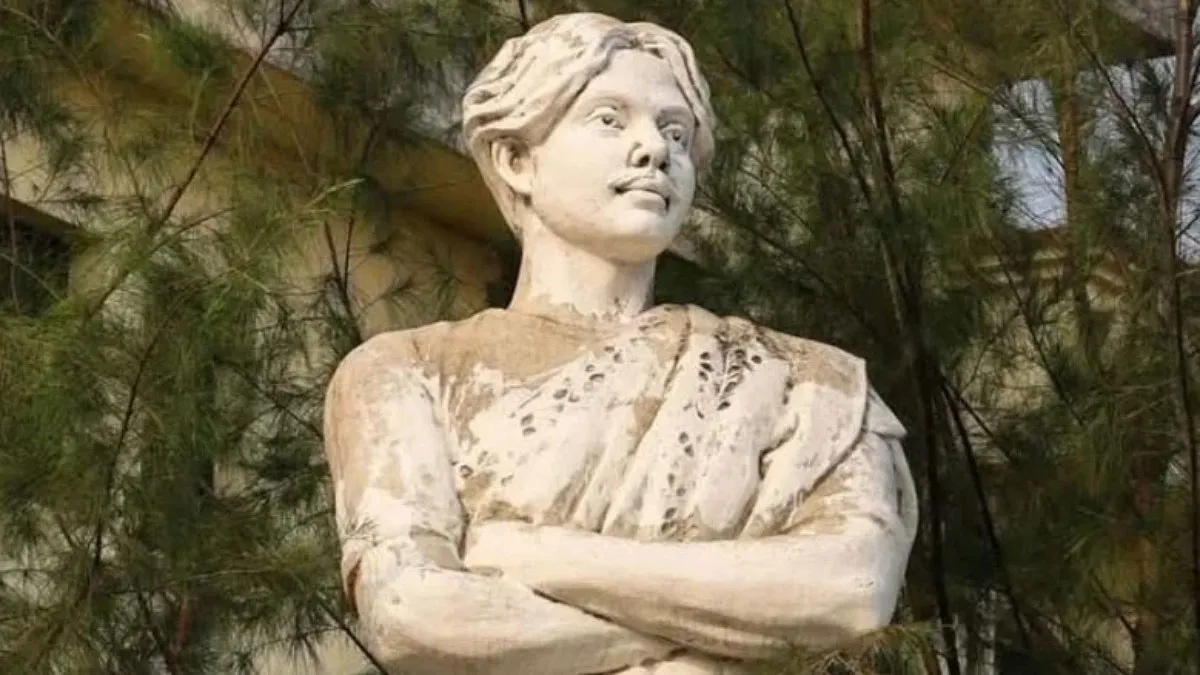
Sculpture of National Poet Kazi Nazrul Islam. BSS Image.
To understand a person, is it enough to trace the geographical boundaries of their life? Perhaps not. Yet some places become so deeply woven into a person's experiences that understanding them requires a return to the land that shaped them-to its soil and dust, its rivers and breeze, its people and everyday lives, and the memories that time threatens to erase.
For National Poet Kazi Nazrul Islam, Trishal in Mymensingh was one such place. The poet who would later burst onto the literary firmament of Bengal like a comet, giving voice to humanity's yearning for freedom and bringing love and rebellion together in verse, first came to Trishal not as a poet but as a simple adolescent, standing at the threshold of an uncertain future.
Who could have imagined that the boy who arrived there in search of an education would one day become one of the most fearless voices in the Bengali language?
More than a century later, retracing Nazrul's footsteps in Trishal means looking beyond the memorials and landmarks that bear his name. It means seeking the experiences that shaped the young boy, the people and landscapes that entered his consciousness, and the ways in which this corner of Mymensingh continues to preserve a vivid yet complex chapter of his life.
To revisit Nazrul, after all, is not merely to remember a poet. It is also to rediscover the world in which he grew up.
Nazrul himself returned to memories of Trishal at different stages of his life. One literary window into that past is his short story Agnigiri (The Volcano or The Mount of Fire). Through its characters, relationships and setting, the story invites readers to explore the possible connections between the writer's imagination and the experiences of his adolescence.
Where literature meets the landscape
Trishal forms the backdrop to Agnigiri, which refers to recognisable places and local features, including the madrasa in Trishal, an elephant belonging to the zamindar of Gafargaon and the hospital in Mymensingh. The village of Birrampur depicted in the story is understood to correspond to Darirampur, a place closely associated with Nazrul's life.
The geographical details offer further clues to the connection between fiction and lived experience. During the later part of his stay in Trishal, Nazrul lived as a tutor and boarder at the Bichutia Byapari house in Namapara. The neighbouring village was Salimpur. Residents travelling from Salimpur to Darirampur market would pass the Bichutia Byapari house and a banyan tree along the way.
Such details bring the landscape of the story into sharper focus. They also offer a way of imagining the world the young Nazrul inhabited: village paths, familiar landmarks, households that offered temporary shelter and the everyday rhythms of rural life.
The parallels, however, invite interpretation rather than certainty. The characters Sabur, Nurjahan and Rustam prompt questions about whether people Nazrul encountered in his youth, or experiences he witnessed during his stay in Trishal, found their way into his fiction. The available connections make such questions compelling, though they do not establish that any character was a direct portrait of a real person.
An adolescent in search of a place to belong
Nazrul came to Trishal in June 1914 with police officer Rafizullah. Around 14 or 15 years old, he enrolled at Darirampur English High School, now known as Nazrul Academy. It was a formative age, when a young person begins to develop an individual view of the world and a desire to live on their own terms. But for Nazrul, life offered little certainty or stability.
His first accommodation was in Kazi Shimla village, about five kilometres from the school. He walked the distance each day. Rafizullah later arranged for him to stay at the home of Kazi Hamidullah in Namapara, but that arrangement did not last long. He eventually found shelter in a small room beside a pond at the Bichutia Byapari house.
Moving from one household to another may appear, at first glance, to be a minor detail in a biography. Yet for an adolescent living away from home, each move meant adapting to unfamiliar surroundings, negotiating the rules of other people's households and learning to find a place in the world without the security of a settled home.
These experiences provide a meaningful point of comparison with Sabur's life in Agnigiri, where a similar pattern of upheaval unfolds. Such parallels do not prove that Sabur represents Nazrul himself. They do, however, invite readers to consider how the uncertainties of the young writer's life might have informed his literary imagination.
Trishal thus emerges as more than a geographical setting in Nazrul's biography. It becomes a place where the circumstances of his adolescence and the possibilities of his fiction can be explored side by side. Agnigiri opens a window onto that world.
The bitter-sweet lessons of Trishal
Nazrul's years in Trishal were not shaped by hardship alone. The lush landscape of Mymensingh and the hospitality he encountered were also part of his experience. But alongside these warmer memories came loneliness and occasional bitterness.
His manner of speaking, which marked him as an outsider, sometimes exposed him to teasing by local boys. His talents also set him apart. He sang, played the flute and excelled in examinations, at times coming first in his class. Such achievements could attract admiration, but they also provoked jealousy among some classmates.
These experiences formed part of the bittersweet inheritance of his adolescence. Nazrul did not forget the people or the land that had shaped those formative years. In a letter sent to the Gafargaon Praja Sammilani in 1926, he expressed gratitude for his immense debt to the soil and people of Mymensingh and recalled the vivid memories of his early life there.
Through Agnigiri, he also preserved something of that vanished world in literature: familiar places, remembered people and experiences that had become part of his personal history.
Maola Prince, a writer and professor at Jatiya Kabi Kazi Nazrul Islam University, believes the Trishal chapter is indispensable to understanding the poet.
"It is impossible to assess Nazrul's life without considering his years in Trishal," he said. "In his own words, he came to Trishal 'to become a human being', and he remained 'indebted beyond measure' to Mymensingh district."
Prince observed that Trishal was Nazrul's first experience of travelling to and observing a place distant from his familiar surroundings, followed later by Karachi. The natural environment and people of both places, he said, found their way into his creative work.
"His short story Agnigiri, his letter to Principal Ibrahim Khan and the address he sent to the All-Bengal Praja Conference in Gafargaon offer insights into his memories and experiences of Trishal, as well as his literary identity," Prince said.
These recollections suggest that Trishal was not simply a temporary stop in the young Nazrul's education. It was a place whose people, landscape and experiences remained meaningful to him long after he had left.
Keeping the memories alive
Today, efforts to preserve Nazrul's legacy in Trishal include two memorial centres: one at the house of police officer Rafizullah in Kazi Shimla and another at the Bichutia Byapari house in Namapara. The centres preserve memorabilia, photographs and books associated with the poet.
Darirampur English High School, where Nazrul studied, is now known as Nazrul Academy. In 2006, Jatiya Kabi Kazi Nazrul Islam University was established in Trishal. That year also saw the launch of a programme called 'Nazrul Tourism' by the Bangladesh Parjatan Corporation and the Nazrul Institute.
Every year, the poet's birth anniversary is marked with discussions, cultural programmes and Nazrul fairs. These events help keep his memory alive, bringing together literature, music and public commemoration.
Yet preserving a literary legacy requires more than annual celebrations and the existence of memorial buildings. The sites need regular maintenance, additional artefacts must be collected, and research into the poet's life and work must continue. Without sustained care, places that hold important historical and cultural memories risk becoming little more than names on a map.
Prince believes the preservation of these sites should be a shared responsibility. He suggested that the National Poet Kazi Nazrul Islam Institute in Dhaka and Jatiya Kabi Kazi Nazrul Islam University in Trishal could jointly oversee the houses and other locations associated with the poet.
"Assigning responsibility alone will not be enough," he said. "It is essential to ensure that those who take charge and manage these places are genuinely devoted to Nazrul, possess the necessary skills and commitment, and receive adequate support from the government."
He also called for a larger budget for the study and promotion of Nazrul's work, alongside proper and effective use of the funds allocated.
"The sites associated with Nazrul's memory must be developed into centres where the public can engage in literary and cultural activities," he said.
A boy, a place and a lasting legacy
The significance of Trishal lies not only in the landmarks that recall Nazrul's presence but also in the human experiences those places represent. The roads he walked, the homes where he sought shelter, the school where he studied and the people he encountered all form part of the story of a young life still taking shape.
The poet who would later give Bengali literature some of its most powerful expressions of rebellion and love was once a teenager negotiating uncertainty, separation from home and the challenges of growing up. In Trishal, the future poet was still becoming himself.
More than a century on, Agnigiri offers a literary passage back to those years. Its possible echoes of the young Nazrul's experiences invite readers to look beyond the established image of the revolutionary poet and glimpse the adolescent behind it.
To preserve Trishal's Nazrul heritage, therefore, is to preserve more than buildings, photographs and memorabilia. It is to protect the places and stories that help explain how a boy's experiences became part of a literary legacy that continues to speak across generations.
