
O Hilsa, Come Back to Bangladesh!

Agamir Somoy photo.
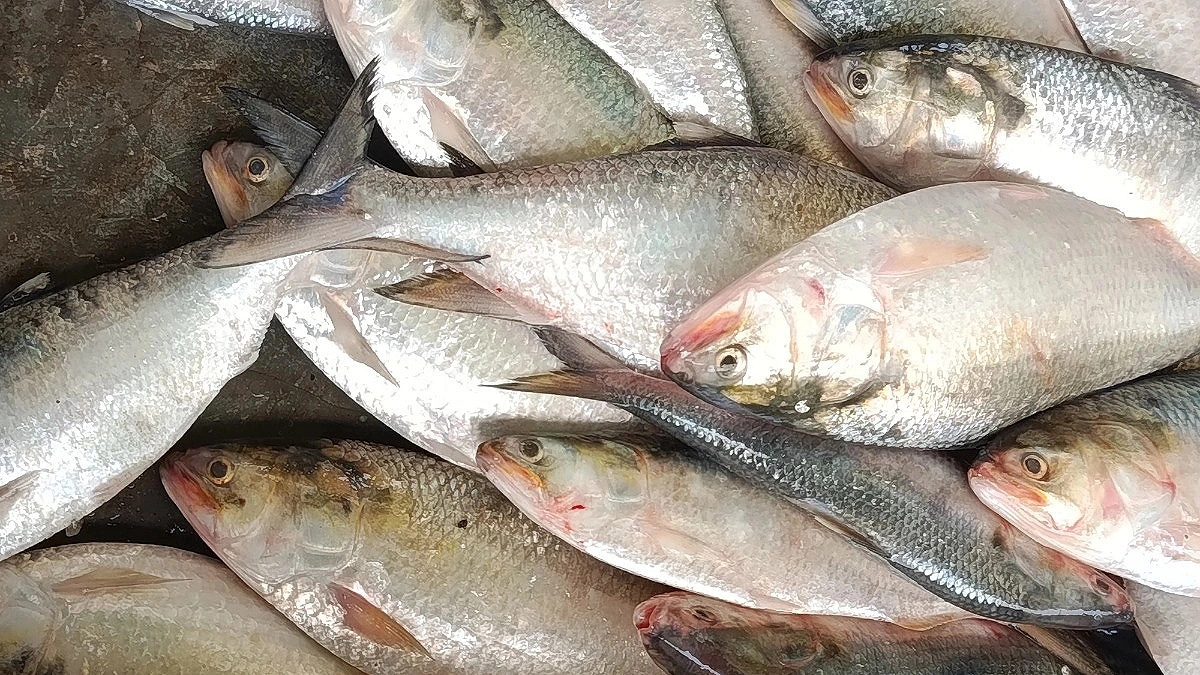
Since Thursday, hilsa has been caught in large quantities in various areas near Char Fasson. In a single net, 2 to 3 maunds of hilsa are being caught. Strangely, throughout the entire monsoon season of 2026, not even a trace of hilsa was seen. People bought small jatka at high prices. Meanwhile, Indian hilsa was imported. It came from Gujarat. The people of Gujarat do not really eat hilsa. So, it seemed as if we had struck gold! Later it was learned that hilsa from Myanmar was also being imported to Bangladesh as Indian hilsa. Then it was learned that the import of Indian fish had stopped. Immediately after that came the news that a large quantity of hilsa had been caught in Char Fasson.
I was trying to understand: for several years before crisis, we were getting plenty of hilsa in the market. In the meantime, a major student-people uprising took place. Sheikh Hasina fled to India. And then, as if hilsa stopped coming into the rivers! I could not accept it. It felt to me that suddenly something had happened that the king of fish, the hilsa, did not like. For the past few days, I had been thinking about the matter. There have been many reports in the newspapers about it. There, jatka fishing, reduced navigability, and unjust fishing were blamed. I was wondering whether there might be some other reasons beyond these. I started a conversation with DeepSeek and other artificial intelligences. How much can shoals really grow in two or three years? Even if I accepted the jatka issue, in order to understand the matter of large hilsa, I asked: when did earthquakes occur in India, Bangladesh, Nepal, and Myanmar in the last two years? What were their magnitudes? I saw that from March through September, there were quite a few earthquakes in this region. There were fewer in India. It seemed to me that hilsa can sense earthquakes. On asking, I learned that hilsa cannot sense earthquakes. Fish such as ayr and pangas (cat fish) can sense earthquakes. And in the estuaries of Bangladesh, yellow-tailed pangas are found in large numbers. Willie Online Library published a full research paper on this on October 12, 2024. Anyway... I was thinking about hilsa. Later I saw that before a tsunami in Japan in 2011, a large number of ryugu sukai, or oarfish in English, come to the shore from the deep sea or begin to be caught in fishermen's nets. The tsunami 15 years ago struck the Tohoku region in northeastern Japan most severely and most fatally. As a result, researchers' attention turned toward the oarfish, not the hilsa. Japanese folklore speaks of this ability of the oarfish. However, we can look at the earthquake records of India, Bangladesh, Nepal, and Myanmar. Let me quote directly from DeepSeek:
Myanmar
March 28, 2025: A major earthquake of magnitude 7.5, centered near Mandalay (Sagaing Fault). It was followed by a 7.0 magnitude aftershock.
February 3, 2026: A magnitude 6.0 earthquake in the Magway region (near Yenangyaung), along with a 5.3 magnitude aftershock.
May 18, 2026: A magnitude 5.2 earthquake near Yangon.
April 5, 2024: A magnitude 5.8 earthquake in Kachin State.
June 2, 2024: A magnitude 5.0 earthquake, tremors also felt in Bangladesh.
May 29, 2024: A magnitude 5.4 earthquake.
November 26, 2024: A magnitude 4.4 earthquake.
April 2025: Multiple earthquakes—magnitude 5.3 (April 13) and many incidents of magnitude 4.1–4.9 throughout the month.
Now Bangladesh:
November 21, 2025: A magnitude 5.4 earthquake in central Bangladesh (near Tongi, close to Dhaka).
June 2, 2024: A magnitude 5.0 earthquake, felt in Dhaka and various parts of the country (epicenter in Myanmar).
May 29, 2024: A magnitude 5.4 tremor (epicenter in Myanmar).
April 2026: A magnitude 5.0 tremor in Dhaka (epicenter near the Manipur border, in India).
June 2026: A magnitude 4.5 earthquake (epicenter near Silchar in Assam).
Now let us look toward Nepal.
February 28, 2025: A magnitude 5.5 earthquake in Chautara, Sindhupalchok District, central Nepal (about 45 km northeast of Kathmandu).
December 21, 2024: A magnitude 5.2 earthquake in Bajura District, western Nepal.
May 22, 2025: A magnitude 4.6 earthquake in the Mahakali region.
August 22, 2025: A magnitude 4.4 earthquake in the Sankhuwasabha area.
In 2024: A total of 27 earthquakes (between magnitudes 4.0 and 5.0), including one of magnitude 5.0.
Finally, we can turn our attention to India.
September 14, 2025: A magnitude 5.8 earthquake in Udalguri District, Assam (near the Kopili Fault).
August 20, 2024: Two earthquakes of magnitude 4.9 and 4.8 in Baramulla District, Jammu and Kashmir (about 7 minutes apart).
May 28, 2025: A magnitude 5.2 earthquake in Manipur (near the Churachandpur-Mao Fault).
October 13, 2024: A magnitude 4.2 earthquake in Udalguri, Assam.
April 11, 2025: A magnitude 4.1 earthquake near Ranir Bazar in India.
The biggest tremor in Myanmar was the magnitude 7.5 in 2025, and although Bangladesh experienced comparatively fewer tremors, the magnitude 5.4 earthquake in 2025 was notable. Moderate earthquakes (magnitudes 4–5.8) continue to occur in Nepal and India's northeastern region.
We see that during the period when the monsoon influence was present, and shortly before it, there were quite a number of earthquakes in this region. Even though some tremors occurred in other countries, Bangladesh felt their effects, too. But research claims that hilsa cannot sense earthquakes. I became frustrated and tried to understand: could it be that rainfall was low? I saw that there had also been plenty of rain. Data from the Bangladesh Meteorological Department (BMD) says that in 2024–2025 the country experienced excessive rainfall and severe flood situations followed.
Weather records show that at the very time when hilsa was migrating toward Gujarat, Bangladesh was facing heavy downpours and floods.
July 2025: Record rainfall: According to data from the Bangladesh Meteorological Department (BMD), in July 2025 the whole country received 23.5% more rainfall than normal.
Massive increase in coastal areas: In several divisions, rainfall rates increased severely, two of the most important coastal regions being: Khulna Division, where rainfall was +82.9% above normal, and Barishal Division, where rainfall was +64.2% above normal.
The severe monsoon season of 2024
Repeated floods: Between May and July 2024, extreme flood conditions occurred at least three times, severely devastating the country. Even in June 2024 alone, a single precipitation session recorded up to 242 millimeters of rainfall in Sylhet and Sunamganj districts, which exceeded even their entire monthly average rainfall.
And, record-breaking rain occurred in May 2025. At that time, Dhaka received 196 millimeters of rainfall in a single day, the highest in the last 54 years. And, in Sylhet, the season's highest 24-hour rainfall was recorded at 404.8 millimeters. As a result, severe flooding began in the pre-monsoon season in mid-May, affecting thousands of people.
So, it appears that there was no shortage of rainwater. Why, then, did the hilsa not come into the rivers? This time I asked DeepSeek about the use of insecticides, pesticides, and similar substances. DeepSeek informed me that these can harm the movement of hilsa. However, DeepSeek kept trying to say that even during low tide, there must be a water depth of 20 to 22 feet for hilsa to move upward, but in Bangladesh this depth has decreased to 8 to 9 feet. As a result, hilsa cannot come upstream into Bangladesh's rivers. But can navigability really decrease by 10 feet in just two years? DeepSeek says that due to Farakka, many shoals have formed, and this has disrupted the movement of fish. Artificial intelligence says that due to excessive rainfall, the fish may also have moved to Gujarat. Because of the rain in Gujarat this time, the salinity of the Narmada River has decreased, which is suitable for hilsa to spawn.
So, we still did not get a complete answer. My personal suspicion is excessive use of insecticides and earthquakes. It appears that in 2025, more than 41,000 metric tons of insecticides were used, whereas in 1990 it was only 3,000 metric tons. In just the last five years, use has increased by more than 81 percent. About half of these insecticides are considered low-quality or adulterated. Artificial intelligence says: river pollution is harming hilsa. These insecticides are washed by rainwater into the rivers, and this has a direct effect on hilsa: hilsa experts say that when river water is polluted, oxygen levels decrease, and then hilsa does not like to wade in river water for breeding purposes. Chemical waste coming from agricultural land (insecticides, fertilizers) is damaging river water quality, which directly affects the life cycle of hilsa. Pollution from the Shitalakshya and Buriganga is already spreading into the Meghna River, which is the main migration route of hilsa.
There is a popular song in the movie Hawa. Basudeb Baul sang, "30 taka a kilo fish, babu will buy and eat, don't add too much water, don't be late, it's 8 o'clock." We have many songs about hilsa. This fish is very savouring to us. So, it is only natural that there would be songs about it. On a Kolkata website, "Bangla Aajtak," there is a folk song like this: "Ilisha uthiya bole khoilsa re bhai / tumi thako khali-bile ami ujan bai, machh ilishare..." meaning: the hilsa is coming towards upstream. And therein lies its danger. It gets caught in the fishermen's nets. Quoting researcher Chandra Mukherjee, it was said: she had heard from Dhauli Barman of Rangpur, "Naya jal khaguri mui felanu sagare porthom kheuyer machh ilisha othe, machh mor ilishare."
When hilsa comes home, it is cut and washed. What do the women think then? They think to themselves that perhaps their fate will not bring them a good share. They know that. In this regard, Debirani Bhowmik of Noakhali told her, "Ilish machhga kute lo bou petir dike chay / ahare ilishar pedi kar pate jay, machh ilishare..."
I do not know whether the saying "Bangalis live on fish and rice" has become so because of hilsa. But, if there are no rivers, if the rivers become poisonous, if many shoals form in the rivers, there is no doubt that our thousand-year-old food habit will be affected.
