
The bell of Harrowmere


Generated by AI
The carriage left me at the iron gates of Harrowmere Hall as the last light bled out of the sky. The driver did not wait. He flung my trunk into the mud, crossed himself twice, and whipped his horses back down the lane as though the very hedgerows were reaching for him.
I stood alone before the house. It rose from the moor like a black tooth, its windows dark, its chimneys leaning against the clouds. Ivy had strangled the eastern wing so completely that the stone seemed to breathe beneath it. Somewhere deep within, a bell was tolling, slow and patient, though I had been told no bell had hung in Harrowmere for forty years.
My name is Edmund Voss, and I had come to catalogue the library of the late Lord Ashcombe, whose solicitor had written to me with an offer too generous to refuse. I was a poor scholar with a failing lodging and a sister to feed. I did not ask why a dead man’s books needed cataloguing so urgently. I should have.
The door opened before I could knock. A woman stood in the threshold, thin as a candle, her face the colour of old wax. She introduced herself as Mrs. Thorne, the housekeeper, and she spoke in a voice so soft I had to lean toward her to hear it.
“You are expected, Mr. Voss. You have been expected for a long while.”
I laughed, thinking it a country figure of speech. She did not laugh with me.
She led me through corridors lined with portraits whose eyes seemed wet in the lamplight. Each painted face belonged to the Ashcombe line, and each wore the same stiff, strained look, as if listening for something. At the end of the longest hall, she stopped before a door of black oak.
“The library. You may work here by day. By night, Mr. Voss, you will keep to your chamber, and you will not answer the bell.”
“The bell?” I said. “I heard it as I arrived.”
“Yes,” said Mrs. Thorne. “It tolls for whoever it wants.”
My chamber was cold and smelled of damp roses. A single window looked out upon a walled garden where nothing grew but pale, sprawling thorns. I lay awake a long time, listening to the house settle and sigh around me. Near midnight the bell began again, nearer now, from somewhere beneath my floor. Each stroke seemed to pass through the mattress and into my bones. I pressed a pillow over my ears and prayed for morning.
Morning came grey and grudging. In the library I found shelves that climbed into darkness, thousands of volumes bound in leather gone soft as flesh. I worked until my eyes ached. Toward evening, behind a row of sermons, I found a slim book without a title. Its pages were written in a woman’s hand, and the ink was brown, the colour of dried blood.
The first entry read: “They tell me the bell is only the wind in the chimney. I know my husband’s hand when I hear it.”
I read on, enthralled and uneasy. The diary belonged to Lady Cordelia Ashcombe, wife of the third lord. She wrote that her husband had grown obsessed with death, that he believed the soul could be held in a house if the house were fed. He had cast a great bell of bronze and bone, and he rang it each night for the dead of Harrowmere, calling them back to the walls. Servants had begun to vanish. Guests who stayed the night were never seen to leave.
The final entry was dated the eve of her disappearance. “He has told me what the bell requires. It requires one who is willing to be counted. One who answers. If I am not found, look beneath the chapel, and do not, God forgive you, ring it.”
I closed the book with trembling hands. The lamp had burned low, and the shadows in the library seemed to lean closer. When I looked up, Mrs. Thorne was standing in the doorway, and I had not heard her come.
“You have found her,” she said. It was not a question.
“Lady Cordelia,” I whispered. “What happened to her?”
Mrs. Thorne smiled for the first time, and I wished she had not. Her lips parted too wide. “She answered the bell, Mr. Voss. They all answer eventually. It is such a lonely sound.”
I did not sleep that night. I sat upright in the chamber with a candle and a poker, and when the bell began at midnight, I counted the strokes. Twelve. Then, impossibly, a thirteenth, and beneath it a voice, a woman’s voice, calling my name from the corridor in tones of aching tenderness.
“Edmund. Edmund, please. I am so cold.”
I knew that voice. It was my sister Margaret’s, who lay sick in London, three hundred miles away. My blood turned to ice. I rose and crossed to the door, and my hand closed upon the handle before I understood what I was doing.
“Edmund, I am in the cellar. They have brought me here. Please come.”
It was a lie. It had to be a lie. Yet the voice wept so naturally, so exactly as Margaret wept, that every reasoning thought in my skull began to crumble. I remembered Mrs. Thorne’s warning and nearly turned away. Then the voice broke into a sob so raw that I flung open the door.
The corridor stretched empty and black. A cold wind poured along it, smelling of earth and old roses. At the far end, a lantern swung in the air without a hand to hold it, and by its light I saw a stair descending into the dark.
I should have run. I know that now. But grief and fear make fools of us, and I followed the lantern down. The stair wound beneath the house, past walls that sweated and wept, past alcoves where something pale and shapeless lay folded in on itself. The bell grew louder with every step until the stones themselves hummed.
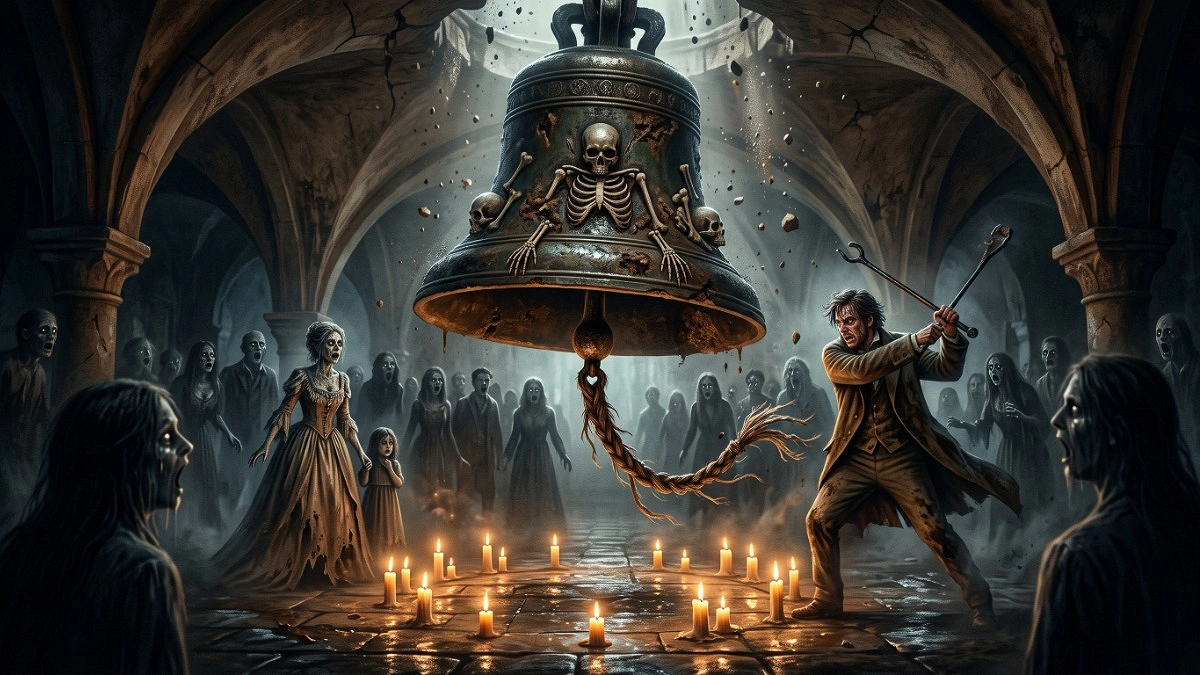
At last, the stair ended in a vaulted chamber, and in its centre hung the bell. It was larger than any bell should be, black bronze veined with something white, and I understood with slow horror that the white was bone. Skulls, ribs, and the long delicate bones of fingers were fused into its metal like fruit in a cake. Beneath it, in a circle of candles, stood a congregation.
They were the servants and the guests, the lost of Harrowmere, a hundred pale figures with their faces turned upward. Among them stood Lady Cordelia in a gown of rotted silk, and at her side, small and trembling and wearing my sister’s face, stood a child of shadow.
“Edmund,” it said, in Margaret’s voice. “You came.”
The figures turned toward me as one. Their eyes were wet and shining, and their mouths opened soundlessly, and I felt the bell reach into my chest and draw out something I could not name. My memories began to loosen. I forgot the road I had travelled. I forgot my lodging, my books, my own mother’s face.
Then I remembered the diary. Do not ring it, Cordelia had written. The bell required one who answers. It fed upon those who came when called.
I had come. I had answered. But the bell had not yet been rung for me, not truly, and I saw that the great clapper hung from a rope of braided hair, and that the rope dangled just within my reach.
The shadow child smiled with Margaret’s mouth. “Ring it, Edmund. Then you may stay with us. Then you will never be cold again.”
Beautiful and terrible, that offer. I think many have accepted it. But I thought of my real sister, sleeping in her narrow bed in London, and I knew that the creature had learned her voice by listening to my longing, as the house listened to everything. I did not ring the bell. I swung the poker with every ounce of my strength against the braided rope.
The hair parted with a shriek like tearing silk. The bell lurched, groaned, and began to fall. The congregation screamed, and the scream was the sound of a hundred years of waiting finally breaking. The candles guttered. The ceiling cracked. I ran, blind and weeping, up the winding stair as Harrowmere shuddered around me, stone grinding on stone, the portraits tumbling from their walls with faces gone slack and peaceful at last.
I do not remember reaching the gates. I remember only the grey dawn, the mud beneath my knees, and behind me a roar of collapsing masonry. When I turned, the Hall lay in ruin, a heap of black stone smothered in ivy, and no bell tolled anywhere upon the moor.
A farmer found me at noon. He said no one had lived at Harrowmere since before his grandfather’s day. I asked after Mrs. Thorne, and he went white and would say nothing.
I returned to London to find Margaret recovering, her fever broken in the night. She told me she had dreamed of me standing in a dark place, calling for her, and that she had woken at the stroke of midnight with my name upon her lips.
I have not slept soundly since. Sometimes, when the night is very still, I hear a distant tolling, soft and patient, like a hand upon a door. I keep my ears covered, and I do not answer.
But I am so very tired, and the sound is so very lonely, and I am no longer certain it is only in my memory.
