
The lantern at Kirtankhola ghat


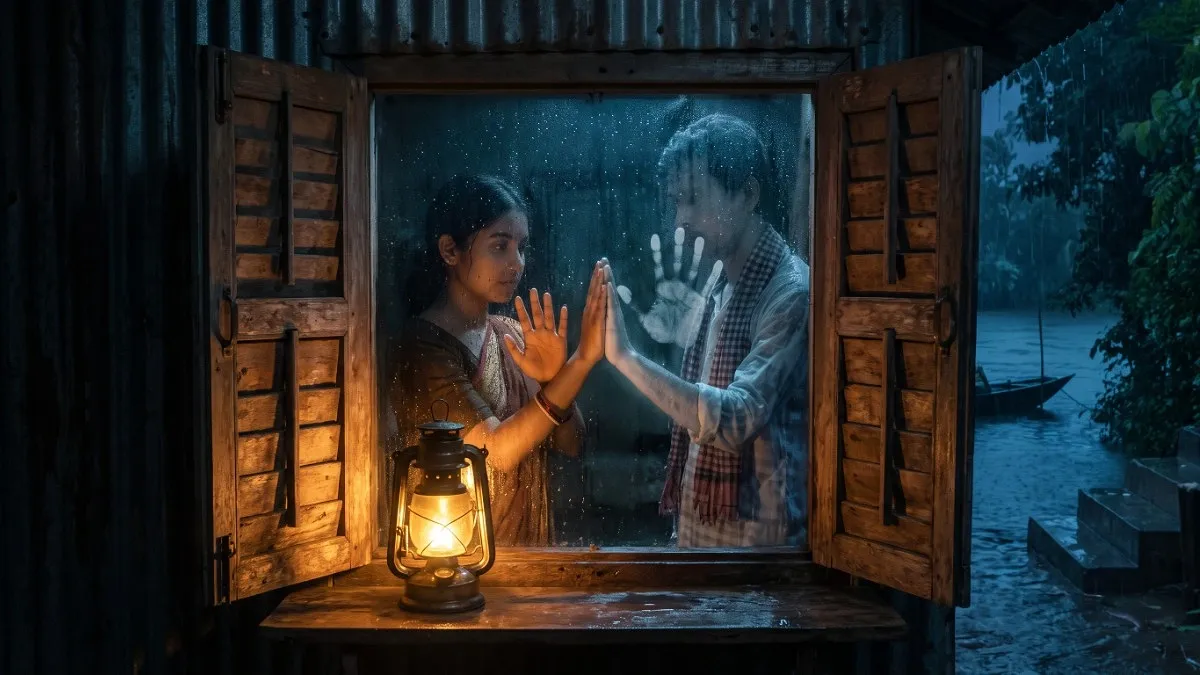
Photo: Generated by AI
Nusrat Jahan reached the old house on the bank of the Kirtankhola just as the evening tide pushed the river over the ghat steps behind her. She had spent a night on the launch from Sadarghat and two more hours on a trawler that smelled of diesel and wet rope. Now she stood before her Dadi’s tin roofed house with one suitcase and a heavy iron key. Dadi Rokeya Begum had died in Choitro, and in all the years Nusrat had known her, Dadi had never once sung a song, never once walked to the river, and never once let a boat be tied at her ghat.
Inside, the rooms smelled of mustard oil and damp wood. Every window faced the water. The power had failed across the village, and on the kitchen, table sat a hurricane lantern beside an envelope with her name on it, written in a shaking hand. She read three lines.
Do not answer when he knocks. Do not open the east window. Do not make him a promise, no matter how sweetly he sings.
Nusrat smiled, because the alternative was fear, and she was a Dhaka girl who did not believe in such things. She slipped the letter into a drawer, lit the lantern, and slept under a nakshi kantha that smelled of jasmine and something colder underneath.
The song woke her first, a boatman’s bhatiyali drifting over the water, slow and aching, the voice of a man calling someone home from a great distance. Then came three soft taps on the east window, patient as a heartbeat.
She crept downstairs. A man stood outside in the dark, soaked to the skin, a checked gamchha knotted at his neck, his eyes dark as monsoon water. He smiled as though he had waited a very long time and did not mind.
“You have her hands,” he said, and his voice passed through the shutter as if it were not there. “Rokeya’s hands. I would know them anywhere.”
Nusrat stumbled back. When she looked again, he was gone, and only a wet handprint remained on the glass, fading in the lantern light.
At dawn she walked to the bazaar, where Kader Chacha was pouring tea beside a smoking clay stove. When she spoke her grandmother’s name, he set down his kettle.
“Anwar Majhi,” he said quietly, as if she had asked. “The best boatman on this river. He loved your Dadi more than anything the water ever gave him. In the storm of 1970, he took his boat out to bring her brother back from the char, and before he left, Rokeya stood on the ghat and promised to keep a lantern burning in her window until he came home. The boat was found. Anwar was not. She kept that lantern lit for six years. Then her family married her to a schoolteacher in town, and she put it out. That very night every boat in the harbour tore loose from its rope, and we heard a voice crying in the wind. It did not sound like anger. It sounded like a broken heart.”
Nusrat walked home along the embankment with her arms wrapped around herself. When evening came, she lit the lantern and set it in the east window, and she could not have said why.
He came at midnight, and this time she opened the shutter.
Anwar stepped over the sill without a sound, leaving river water across the floor. Up close he was beautiful in a way that frightened her, pale as a lotus, his lips faintly blue, his chest unmoving beneath the wet shirt. He kept a careful distance, as if he feared she might break.
“You lit the lamp,” he whispered. “No one has lit it for more than fifty years. Do you know what it is to wait in the dark and see a light on the shore, and then watch it go out?”
Nusrat found that she was crying. She laid her palm against his cheek. It was cold as river clay, yet he leaned into her touch with such hunger that her whole body ached. He told her of the green silence of the deep, and how Rokeya laughed with her head thrown back, exactly as Nusrat did. At dawn he faded like breath on a mirror, and she slept all day with a smile on her face and silt drying in her hair.
So, it went for a week. He taught her to read the tide by the colour of the water. She read him the poems of Jibanananda Das, and he listened with his eyes closed as though every line were rain after a drought.
Then she noticed small things. The jasmine in the kantha was gone, replaced by river mud. Her face grew paler each morning, her lips tinged violet. Her pulse, when she pressed two fingers to her wrist, seemed far away, like footsteps in another room. She was always cold now, and the cold no longer troubled her. That frightened her most of all.
On the eighth day she went to the ghat to catch the morning trawler. The steps were dry. She stepped down, and the water crept silently up to meet her until it lapped her ankles. She turned back, and the steps were dry again. She tried a second time, and a third, and each time the river rose a little higher, patient and gentle and absolutely certain.
That night she was waiting at the east window before he knocked. She held out her grandmother’s letter. “You knew,” she said. “You knew what this does to me.”
Anwar read the three lines, and something broke in his face. “I swear by Allah, I did not mean it,” he said. “The dead do not know how to love lightly. We only know how to hold on. Every night a little more of the river came with me, and I could not stop, because you were the first warm thing I had touched in fifty years.”
“Then let me go,” said Nusrat.
“I want to.” He sank to his knees. “But I am not the one who holds you. The river holds you. It has held every woman of your blood since the night Rokeya broke her promise. I am only the face it wears.”
Then Nusrat understood what her grandmother had truly feared. It was never the man at the window. It was the debt beneath him, a promise made on a monsoon shore and left unpaid for half a century. Dadi had run from it. But the river does not forget. It had only waited for the next pair of hands.
Water was rising in the walls now, a slow murmur beneath the floor, a tide climbing the stairs one patient step at a time. The lantern flickered.
“There is one way,” Anwar said, barely above a breath. “A promise kept ends a promise broken. If someone keeps the vigil to the very end, the river lets go. But I will never ask it of you. I would rather drift in the dark for a hundred more years than watch you drown for me.”
Nusrat looked at the man who had waited through half a century of silence without once cursing the woman who left him. She thought of Dadi, who had spent her whole life listening for the river at her back.
“Do you know what my Dadi’s mistake was?” she asked softly. “She thought a promise was a chain.” She kissed his cold mouth and tasted salt, and rain, and something that felt very much like coming home. “I think it is only a boat. It carries you somewhere, if you are brave enough to climb in.”
The water rose around their waists, gentle as a lullaby. She did not let go of his hands. The cold folded around her like a shawl, and the pain of it faded into something almost like peace.
“Bismillah,” she whispered. “I will keep the lantern lit. I promise.”
The river sighed, long and low, like a creature laying down a burden it had carried too long.
In the morning the tide drew back and the ghat steps lay bare in the sun. Kader Chacha, passing along the embankment, saw the house standing silent, its doors open, its floors still wet. In the east window a lantern burned though it was full daylight, its flame steady and golden and unafraid. On the glass, two handprints were pressed side by side, one small and warm, the other long and pale, their fingers laced together.
And on every night after, when the tide came in and the stars wheeled over the Kirtankhola, the fishermen swore they heard a bhatiyali drifting over the water, a man’s voice and a woman’s braided into one, and saw two shadows swaying on the ghat in the lantern light, while the river itself seemed to hold its breath to let them be.
