
How did the potato get into biryani?


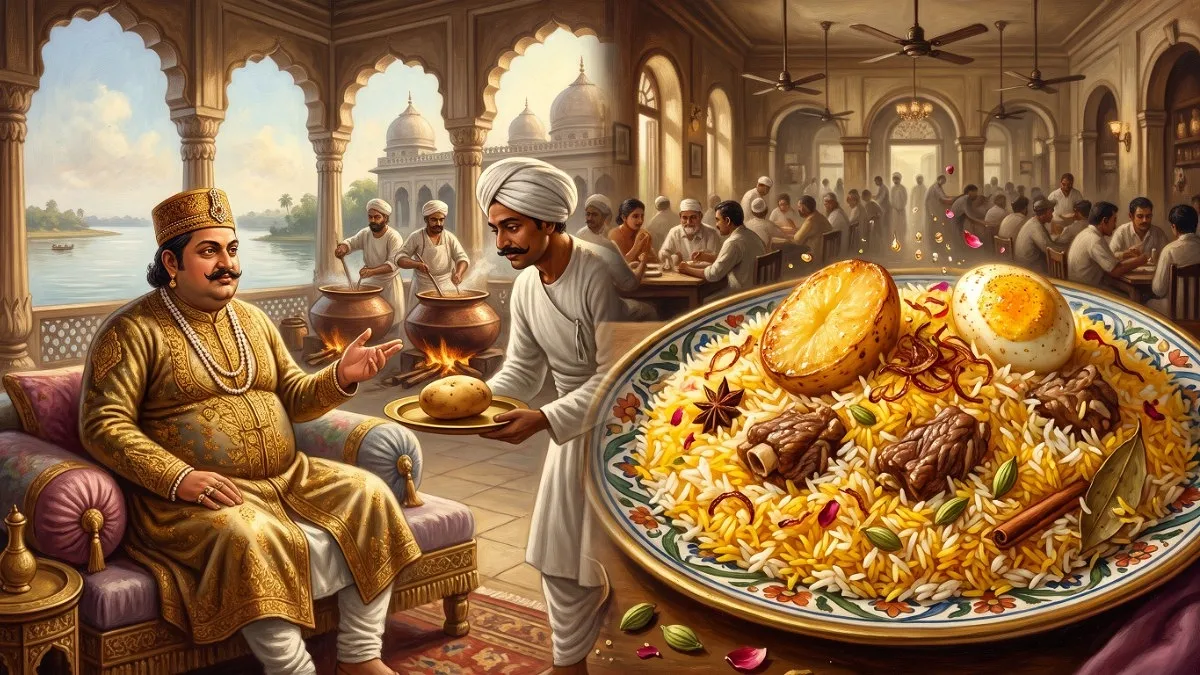
Generated by AI
A plate of Kolkata biryani comes with a boiled potato beside the meat, and often an egg too. To many people elsewhere, especially in Bangladesh, this looks odd. Why would a dish of rice and meat need a potato? There are many popular answers, but the honest one is that no firm proof exists.
An exiled nawab’s kitchen
The story begins in 1856, when the British East India Company deposed Wajid Ali Shah, the last Nawab of Awadh (Oudh). He left Lucknow for Calcutta and settled in Metiabruz, on the city’s western edge, where he built a miniature Lucknow. With him came Awadhi culture, music and culinary traditions.
His name is the one most often attached to the origins of Kolkata biryani. But even the basic claim is hedged in the sources. Several accounts say he is “widely believed” to have brought biryani to Kolkata, and one outlet notes this is not definitively proven.
Theory one: potatoes for a tighter budget
The most popular explanation is financial. In exile, the story goes, the Nawab had a much smaller income but a huge household of begums and retainers to feed. Cooks cut back on meat and added potatoes to make the dish go further. One version adds that the Nawab liked the result so much that he ordered potatoes added whenever biryani was cooked.
An essay by Somrita Urni Ganguly on Sahapedia describes this as one school of thought: that by the time he arrived in Metiabruz, the Nawab was in a financial crisis.
Theory two: an innovation, not an economy measure
The Nawab’s descendants reject this. Begum Manzilat Fatima, his great-granddaughter by some accounts, and Shahenshah Mirza, a great-great-grandson, say the potato was a culinary innovation and had nothing to do with cutting costs.
There is some supporting evidence. According to a Live History India article, Rosie Llewellyn-Jones writes in The Last King in India (2014) that the Nawab was spending around 9,000 rupees a month just on food for his animals. That is hard to square with a ruler too poor to afford meat in his biryani.
One more fact is relevant. The potato is not native to the Indian subcontinent. It reached India from the Americas through Europeans. Some writers therefore describe it as a relatively new vegetable at the time, and see its use in biryani as a possible experiment.
Theory three: the Nawab had nothing to do with it
A third view challenges the whole story. Kolkata food writer Poorna Banerjee says Wajid Ali Shah may have introduced biryani to Kolkata but had nothing to do with adding potato. In her view, potatoes entered biryani only after the 1950s, as biryani spread among ordinary people.
The same Live History India article raises a timing argument. It notes that the Nawab died in 1887, and cites 1879 as the year potatoes arrived in West Bengal, which would leave him only eight years.
Historian Jayanta Sengupta is also skeptical of tidy origin stories. In his view, any popular food acquires an imagined long history. He says he is not sure whether Jahangir or Wajid Ali Shah ever ate biryani. What they certainly ate was pulao, a sophisticated, aristocratic dish, while biryani was food for the masses.
Even the heirs’ kitchens disagree
A Kolkata food blog reports that Gulam Nabi, head chef of the Royal India Hotel, says his recipe was handed down from the Nawab’s rakabdar (cook) family, and that potato is never used there. This is one chef’s own claim, not independently verified. But set beside the descendants’ view that the potato was an innovation of the Nawab’s kitchen, it raises an awkward question. If the potato belongs to the original tradition, why is it missing from kitchens that claim to carry it?
