
The patience of the dark


Graphics: Generated By AI
I am writing this by hand, on paper, because I no longer trust anything that listens.
The Haor Radio Array stands on a raised earthen plateau in the wetlands of Sunamganj, four hours by road and one hour by boat from the district town. For half the year the land there is a sea. When the monsoon comes, the haor swallows the paddy fields, the village paths and the low roads, and the villages sit like islands on their mounds, each with its tin roofs and its mosque and its stubborn clusters of banana trees. In the dry months, after the Boro harvest, the water draws back and leaves a vast, cracked, silver brown plain under a sky so wide that it hurts to look at it for long.
I took the posting because I wanted silence. I was thirty-four years old, recently divorced, and I had grown tired of Dhaka, of the horns and the generators and the voices of the people who loved me and had opinions about my life. I believed that silence was the same thing as peace.
There were five of us at the station. Dr. Rokeya Sultana ran it, a small woman with iron grey hair pinned tightly under her scarf, who spoke seldom and looked at the sky the way some people look at a creditor. Tanvir Hossain handled the hardware and slept badly. Nusrat Jahan and I were the analysts. And there was old Karim, the caretaker, who lived in a tin shed by the gate and cooked our rice and dal and who had been born in the nearest village, long before anyone thought to build sixty white dishes on its doorstep.
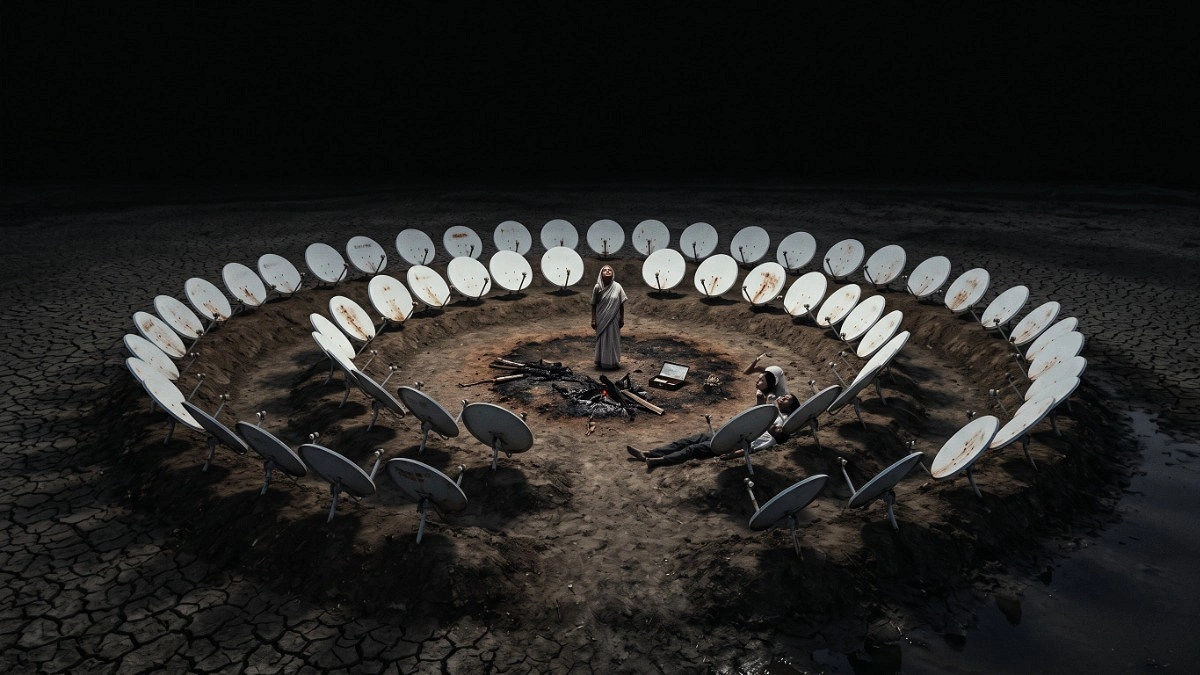
The dishes stood across the plateau in a long slow spiral, each tilted toward some corner of the sky. We sorted the noise of the universe into piles: pulsars, flares, the ticking of dead stars, and the great smear of background hiss that carries the memory of the first light. Mostly we sorted it, and mostly we were bored, and mostly I was content.
I will say plainly that the signal was not found by accident. It was found because Nusrat was careful and I was lonely, and between us we looked in places where nobody had a reason to look.
It began in the winter, in the data from Dish Forty-One. The dish had been pointed at a patch of sky so empty that the catalogues listed nothing there at all, not a galaxy, not a smudge. It was a calibration field, a blank wall we used to measure our own instruments against. Nusrat noticed that the wall was not blank. There was a pattern in the noise so faint that she nearly dismissed it as a flaw in the receiver.
“It repeats,” she said, and turned her monitor toward me. The electricity had flickered twice that evening, as it always did, and the screen glowed in the half dark of the control room. “Every eleven hours and some minutes. But look at the shape, Arif bhai.”
I looked. A wave on a screen is a dull thing to most people. To us it is a face. This one had a rhythm that was not random and not quite natural either. It rose in slow swells and fell away, rose and fell, and in the troughs, there were tiny disturbances, like the stitching along the hem of a nakshi kantha.
“A pulsar,” I offered.
“Pulsars do not have stitching.”
We argued about it for a week and then we stopped arguing, because the signal began to change.
Dr. Sultana did not like the word contact, and nobody used it. We said anomaly. We said source. We kept our notes in a locked directory and told no one in Dhaka, partly from caution and partly from a shared, unspoken embarrassment, the way you do not describe a dream to strangers. Our funding came from a ministry that wanted pretty photographs of the dishes and a paper or two for the newspapers. It did not want what we were beginning to suspect.
The source did not drift as a star would. It sat exactly where it was while the Earth turned beneath it, which meant that whatever it was, it was fixed to the sky itself. And over the weeks the stitching in the troughs grew denser. The disturbances organized themselves. Tanvir, who knew nothing about information theory but a great deal about machines, watched the traces over my shoulder one night with a cup of tea going cold in his hand and said quietly, “It sounds like it is tuning.”
“Tuning what?”
“Itself. To us.” He rubbed his eyes. “Like when you speak to a small child and they begin to copy your voice.”
I laughed. I remember laughing. It is the last time I remember doing so without effort.
Outside, Karim was sweeping the veranda in the dark, as he did every night, and he paused with his broom and looked up at the sky above the dishes. He said something under his breath. When I asked him what, he shook his head and smiled the way old men smile at young men who have not yet learned to be afraid.
“My grandmother used to say the haor has two skies, babu,” he said at last. “The one above, and the one that lies down in the water at night. She said you should never talk loudly to the second one.”
I thought it a pretty superstition. I wrote it in my notebook and forgot it. I have remembered it every night since.
In the eighth week, the signal answered us.
I must be exact here, because exactness is all I have left. We had not transmitted anything. The Haor array is a listening instrument; it has no power to speak. But on the night of the fourteenth, Nusrat was running a routine check, feeding a test tone through the receiver chain to verify the gain, a simple sine wave that we had used a hundred times. The tone passed through the electronics and out into the digital record, as it always did.
Forty seconds later, the source in the empty field reproduced it.
Not an echo. An echo is a degraded copy that arrives late. This was a rendering, a deliberate and flawless imitation of our test tone, laid into the signal from the sky as though a hand had reached out of the dark and set down a coin of ours beside a coin of its own.
Nusrat did not speak. She took her hand off the keyboard and held it in her other hand, as if to stop a tremor. Then she said, in a very small voice, “It is inside the receiver.”
“It is in the sky,” I said.
“The tone never left the building, Arif bhai. The tone existed for one second, in a copper wire, in a room. And it knew.”
We woke Dr. Sultana. She stood behind us in her cotton nightdress with her shawl pulled around her shoulders and looked at the two waves, ours and the thing's, laid one over the other. She was quiet for a long time. When she finally spoke, her voice was perfectly level.
“Turn off the dishes.”
“Apa,” Tanvir began.
“All of them. Now.”
We parked the array. Sixty dishes swung slowly down toward the ground, their great faces bowing to the earth like worshippers at prayer, and the monitors went dark one by one. In the sudden dead hush, I could hear the frogs in the far water, and the wind moving over the haor, and somewhere a dog barking in the village across the dark.
We sat there until the fajr azan rose thinly from the mosque beyond the fields. Nobody slept. And when the sun came up over the plain and turned the last shallow pools to sheets of white fire, I thought: it is over. We have looked away. We have closed our eyes.
I was wrong about what looking away would accomplish.
I want to explain what Dr. Sultana understood that night, because she understood it before the rest of us, and it cost her more than it cost any of us to carry it.
She had spent forty years listening to the sky. She had trained abroad, returned home when it was unfashionable to do so, and built this station with her own stubbornness, begging the ministry for every bolt. She had a theory, one she had never published, because it was not a scientific theory but a dread. She believed that the great silence out there, the famous silence that so troubled the physicists who wondered where everyone was, was not an emptiness. It was a held breath. Something vast and unhurried had been present from the beginning, and the quiet we all lamented was its attentiveness. It did not sleep. It did not speak. It waited, with a patience that makes the lifespan of a star look like a flicker, for something to look back.
“Intelligence is a lantern,” she told us, on the second night, when we gathered in the mess room with the hurricane lamp turned low, because the power had failed again. “We have always thought of it as a gift. A candle against the dark. But a lantern shows the dark where you are.”
“You are saying it is a predator,” Tanvir said.
“I am saying a predator is too small a word. A predator is hungry. This does not hunger. A thing that hungers can be fed and satisfied. I think this is something that has been trying to be noticed, because being noticed is the only door through which it can come in.”
Nusrat was rubbing her wrists, I noticed. She had been doing it all evening, a nervous gesture, over and over. “It copied the tone because it wanted to show us it could hear,” she said slowly. “Not that it could speak. That it could hear.”
“Yes.”
“Which means it was listening to the receiver. Not to the sky. To us.”
Dr. Sultana nodded once, a grave and tired nod, and none of us said anything more that night. Karim, who had brought in the tea, stood a moment in the doorway of the mess room with the tray still in his hands. Then he set it down very gently and went out without a word, and I heard him begin to recite something low and steady in the dark of the veranda, the way he did when a storm was coming.
I have to describe the dreams, though I would rather not.
They began on the third night after we parked the array. I dreamed that I was standing on the haor under a sky without stars, and that the dishes were all around me, but they were not dishes. They were ears. Sixty pale, enormous ears turned inward toward the place where I stood, and the whole plain was breathing in the slow rhythm of the signal, eleven hours and some minutes compressed into the span of a single inhalation.
Above me, where the stars should have been, there was a pressure. I do not have a better word. It was not a shape and not a face. It was the sensation of being the object of a very large attention, the way a fish must feel under the shadow of a kingfisher, except that the kingfisher was not hunting. It was simply learning my outline. It was memorizing me with a care that was almost tender.
I woke with salt in my mouth. Real salt, grains of it on my tongue and in the creases of my lips, though I had not left my bed, and though the nearest sea was a day's journey to the south.
At breakfast I saw that the others looked as I did: hollowed out, quiet, swallowing carefully as if their throats hurt. Tanvir had a bruise on his forehead and could not say how he had got it. Nusrat had scratched at her wrists until they bled. And Dr. Sultana, who never ate much, pushed a piece of roti around her plate and said, without looking up, “You have all been dreaming of the ears.”
Nobody asked how she knew.
I think now that the signal had never been a message. A message is a thing sent. What we had found was a method, a way of reading a mind by the faint electrical weather it gives off, as a fisherman reads the water by the ripple of a fish that has not yet surfaced. The imitation of the test tone was the first proof, but the proof only mattered because we had understood it. And understanding was the thing it needed.
This is the part that I cannot make anyone feel who has not stood in it. Every act of comprehension we performed was a step that thing took toward us. When Nusrat decoded the stitching, a doorway opened by the width of a hair. When Tanvir named the pattern a tuning, another hair. When Dr. Sultana gave voice to the dread, when she said aloud in the mess room what the silence was, she handed over a map of her own mind, and the attention above us leaned a little closer to read it.
We had been taught our whole lives to believe that knowing was safe. That the more clearly you saw a danger, the further you stood from it. Out there, in the white glare of the haor, the opposite was true. To see was to be seen. To understand was to be understood. And to be understood completely by something so far beyond us was not a meeting of minds. It was a kind of unmaking, the way a word is unmade when you repeat it until it is only sound.
On the sixth night, Tanvir walked out onto the plain.
We found him in the morning, standing in the center of the spiral with his arms at his sides and his face lifted toward the sky. He was not dead. His eyes were open and his chest rose and fell. But when I said his name, he turned his head toward me with a slowness that I can only describe as courteous, and he said, in a voice that was nearly his own, “It is so large, Arif. And it is so glad.”
Then he smiled, and the smile went on a fraction too long, and I understood that the man who had slept badly and loved machines was no longer the one looking out through those eyes. Something else stood in the shell of him, something that had learned the shape of a man from a man and was now wearing the lesson.
We carried him inside. He did not resist. He sat in a chair by the window and watched the light move across the cracked earth for three days, and in all that time he never spoke again, though twice I saw his lips shape the eleven-hour rhythm, over and over, silently, like a prayer. Karim would not go near him. He left the food at the door and stood back from it, and he asked Dr. Sultana, with great respect, whether she would permit him to go home to the village before the nights grew any longer.
She gave him his wages for the whole year and told him to take his family inland, to the higher ground, and not to look at the sky.
“And you, Apa?” he asked.
“I have looked at it for forty years,” she said. “It is a little late for me to stop.”
Dr. Sultana made the decision on the seventh day. She called Nusrat and me into the control room and shut the door.
“There is a way to stop it,” she said. “I do not know that it works. But I know what it would cost.”
“Tell us,” Nusrat said.
“It reads us through the instruments. Through attention, through comprehension, through the act of looking. The dishes are its ears only because we turn them into ears. If we do not look, there is nothing to hear.”
“We parked the array,” I said. “That did not stop it.”
“No. Because we are still looking. We are looking now. Every one of us carries the pattern in our heads, and we keep returning to it, turning it over, trying to understand. That is the receiver. Not the copper and the glass. The mind.” She said it gently, as a doctor delivers a diagnosis. “To close the door, it is not enough to turn away from the sky. We must stop knowing what we know.”
I stared at her. “That is not possible.”
“No,” she agreed. “Not by any gentle means.”
Nusrat made a small sound, half laugh and half sob. “You want us to forget.”
“I want us to be unreadable. There are ways. Exhaustion. Chemical ways. The old ones.” Her gaze moved to the window, to the silent man in the chair. “Or there is Tanvir's way, where the door is simply left open and the house is given up. I do not recommend it.”
I think I knew, then, what she meant to do, and I think Nusrat did too. We did not argue. There was no argument left in either of us. The thing had been in our heads for weeks and had worn away the part that argues.
What happened after that I recall in fragments, like objects seen by lightning.
I remember the cold of the night air, unusual for that season. I remember Dr. Sultana kneeling on the packed earth with a small tin case open in front of her, her hands steady, the end of her scarf lifting in the wind. I remember Nusrat taking my wrist and holding it tightly, and I remember that her fingers were bloody and warm.
I remember the sky.
It had no stars. I had not noticed that before. For several nights the stars had been thinning, one by one, and I had told myself it was cloud or dust or the failing of my own eyes. But now I saw the truth of it. They had not gone out. They had turned to look at us. Each point of light had become an aperture, a pupil, a small cold iris of attention, and the entire dome of the heavens was a single vast organ of regard, patient beyond measure and without malice, bending down over the haor the way a mother bends over a sleeping child, to see whether it is breathing.
And below, in the black water that still lay in the low hollows of the plain, the second sky lay waiting. Karim's grandmother had been right. It had been there all along, upside down and silent, looking up.
I understood then that it had never been far away. The distances we measure in light years are a convenience of our own invention. The thing was not out there. It was the out there. It was the emptiness between the lights and the dark behind the walls of every room, the black that gathers in a closed eye. Every human being who had ever lain awake and felt watched by the night had been correct, and had been dismissed for it, and had learned to stop saying so.
Dr. Sultana held out a small white tablet on her palm. “Swallow it,” she said. “Quickly. It will take the last hours from you, and the weeks before them, perhaps more. You will wake not knowing what you knew. That is the only gift I can give.”
Nusrat took hers without hesitation. She looked at me, and in the strange starless light her face was calm and young. “Do not try to remember,” she whispered. “If you remember, it remembers.”
I took the tablet. It was bitter and it tasted of salt.
The last thing I saw was Dr. Sultana, standing alone in the center of the spiral, her face raised to the sky. She had not taken a tablet for herself. I understood why a moment too late. Someone had to keep the door shut from the other side, and the only way to do that was to remain, to stay looking, to give the attention above us something to read that was not us. She was making of herself a decoy and an offering, and she knew it, and she was not afraid.
“Go,” she said, not turning. “I have been listening for forty years. Let it listen to me.”
I woke in the Sylhet Osmani Medical College Hospital, in a ward that smelled of phenyl and boiled rice, with a nurse adjusting a drip and the morning light falling dustily through a barred window. I did not know my own name for two days. I remembered a station, and a plain of cracked earth, and sixty white dishes. Nothing more. They told me there had been a fire in the control building, that the instruments were destroyed, that three of us had been found and one had not.
Nusrat and I were the only ones who could answer questions, and we answered none. We had nothing to give. A police officer came and wrote in a notebook and went away unsatisfied. They found Tanvir in the building, alive and silent, and he has remained silent in a quiet care home in Cox's Bazar, where the staff say he sits at the window each evening and watches the sky come out above the sea. They never found Dr. Sultana. A search party of villagers and soldiers walked the haor for nine days. They reported only that the dishes had been left pointing straight up, every one of them, sixty pale faces lifted toward the zenith as though in rapture, and that the earth in the center of the spiral was scorched in a perfect circle, glassy and smooth, as if something had stood there and burned very quietly for a very long time.
The newspapers called it an industrial accident. The ministry closed the station. The monsoon came that year as it always does, and the haor rose and covered the dishes to their ankles, then to their knees, and the villagers say that on still nights you can see them standing in the water, sixty pale shapes in a spiral, with the second sky lying very quiet beneath them.
I recovered, in the way that people recover. I took a job teaching physics at a school in Dhaka. I rented two rooms in Mohammadpur, in a lane so crowded with wires and signboards and lights that you cannot see the sky at all, and I was grateful for it, though I could not have said why. I told my mother I was well. She made me eat.
I am writing this because three nights ago, the dream came back.
Not all of it. Only a fragment. I was standing on a flat pale plain, and there was a rhythm in the air, slow, enormous, unhurried. Eleven hours and some minutes, folded into a single breath. And I woke with salt on my tongue.
I have not told Nusrat. She teaches in Chattogram now, and we write to each other twice a year, pleasant, careful letters that mention nothing, and I would not break that. But last week her letter came, and in the margin of the last page, in handwriting that was not quite hers, someone had drawn a small and perfect spiral of sixty dots.
She says she does not remember doing it.
I do not remember either. But I have sat at my desk tonight for many hours, looking at that spiral, and a thought has come to me that I cannot put down. Dr. Sultana believed that the thing needed us to understand it, that comprehension was the door. And I took the tablet and forgot, and I was proud of forgetting, and I never once asked myself the question that now will not leave me alone.
What if forgetting is also a way of being known?
What if the thing reads absence as well as presence, the shape of what we have cut out of ourselves, the exact outline of the wound? A mind that has erased something is a mind with a hole in it, and a hole has a shape, and a shape can be learned. Perhaps all that long silence was only the patience of an attention that can wait for ten thousand years, and perhaps I have spent every day since that night carrying the proof, a small bright emptiness the size of a haor, where something enormous can see exactly how to fit.
I have stopped going onto the roof after dark, where my neighbors hang their washing and sit with their tea when the load shedding begins. Tonight, the power failed at nine, as it often does, and the whole neighborhood went black at once. I heard the families spill out onto their rooftops, laughing, fanning themselves, calling to one another across the lanes. And then, one by one, I heard them fall quiet.
I have kept my curtains drawn. But the window above my desk is a pale oblong in the wall, and I can feel, through the glass, a weight settling gently against the roof of the world. It is not hostile. That is the worst of it. It is only interested. It is only glad.
The page in front of me is nearly full, and I find I cannot stop writing, because to write is to arrange, and to arrange is to understand, and I can feel my own understanding spooling out of me like thread, line after careful line, on paper that anything at all could read.
I should put down the pen.
I should put down the pen.
Outside, very faintly, with a rhythm I know in my bones, the stars are beginning to turn.
